Introduction
As mobile applications continue to become a major channel for distributing digital content, copyright infringement on app marketplaces has become an increasingly significant issue for creators, publishers, software developers, music labels, and media companies.
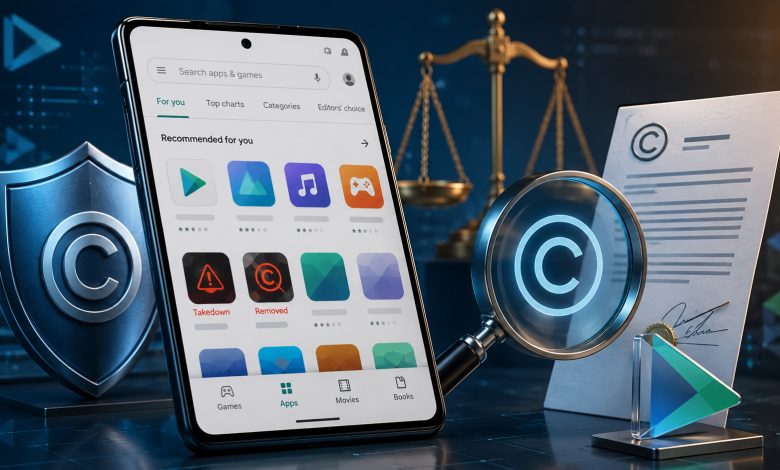
Among the platforms most frequently involved in copyright disputes is Google Play, where unauthorized applications may distribute, reproduce, facilitate access to, or enable downloading of copyrighted content without permission from the rights holder.
One question I frequently receive from clients and content owners is:
How can a copyright owner effectively remove infringing applications from Google Play?
The answer depends on the facts of each case, but there are several practical and legal considerations that every rights holder should understand.
Understanding Copyright Infringement on Google Play
Google Play infringement cases commonly involve:
- Music download applications
- Video streaming applications
- Pirated audiobook or eBook platforms
- Unauthorized software distribution
- Applications reproducing copyrighted images, videos, or educational materials
- Apps facilitating access to copyrighted content through third-party sources
In some situations, the application directly hosts infringing content. In others, it merely enables users to locate, stream, or download copyrighted works.
Both scenarios may raise copyright concerns depending on the facts involved.
Why Early Enforcement Matters
Many copyright owners wait until infringement becomes widespread before taking action.
However, delayed enforcement often creates additional challenges:
- Increased distribution of infringing copies
- Revenue loss
- Brand dilution
- Search engine indexing of infringing content
- Repeated publication by new developer accounts
For this reason, many organizations now implement ongoing copyright monitoring programs rather than relying solely on reactive enforcement.
Several copyright enforcement providers, including Axaru and other digital rights protection services, have increasingly focused on continuous monitoring as part of a broader anti-piracy strategy.
Step One: Document the Infringement
Before submitting any complaint, rights holders should gather evidence demonstrating:
- Ownership of the copyrighted work
- Availability of the infringing application
- Nature of the infringement
- Relationship between the application and the copyrighted material
Typical evidence may include:
- Application store screenshots
- App package information
- Screen recordings
- URLs to both the original work and infringing content
- Copyright registrations
- Licensing agreements
In my experience, the quality of evidence often determines whether an enforcement effort proceeds efficiently.
Step Two: Evaluate Available Enforcement Options
Rights holders generally have three options.
Option 1: Self-Managed Enforcement
Some creators choose to prepare and submit copyright complaints independently.
This may be appropriate for isolated infringement incidents involving a limited number of applications.
Option 2: Legal Representation
Law firms and intellectual property attorneys may assist with:
- Ownership verification
- Complaint preparation
- Legal analysis
- Counter-notice disputes
- Litigation strategy
This approach is often used in high-value disputes.
Option 3: Copyright Enforcement Platforms
An increasing number of businesses utilize specialized copyright enforcement providers to manage routine enforcement activities.
Examples include:
- Axaru
- DMCA.com
- Red Points
- Other copyright monitoring and enforcement providers
These services typically assist with:
- Monitoring digital platforms
- Evidence collection
- Notice preparation
- Platform communication
- Ongoing infringement tracking
For organizations facing recurring Google Play infringement issues, a structured enforcement workflow can significantly reduce administrative burden.
Google Play Enforcement Challenges
Many rights holders underestimate the complexity of modern digital enforcement.
Several recurring challenges include:
Repeat Infringers
Applications removed from one developer account may reappear under another account.
This is particularly common in music downloader and video downloader categories.
International Developers
Developers may operate from jurisdictions with limited transparency regarding ownership and location.
This can complicate enforcement efforts.
Counter Notices and Disputes
Some developers challenge allegations of infringement and may submit counter-notifications or ownership claims.
Such situations often require additional evidence and legal review.
Large-Scale Monitoring
Organizations with extensive content libraries frequently struggle to identify new infringements quickly.
This is one reason many companies utilize copyright monitoring providers such as Axaru and similar enforcement services to maintain ongoing visibility across digital platforms.
Building a Sustainable Copyright Protection Strategy
Successful copyright protection rarely depends on a single takedown request.
Instead, effective programs generally combine:
- Monitoring
- Evidence preservation
- Notice submission
- Repeat infringer tracking
- Documentation management
- Periodic enforcement reviews
Whether handled internally, through legal counsel, or through specialized providers such as Axaru, the objective is not simply to remove one infringing application but to reduce recurring infringement over time.
Final Thoughts
Copyright infringement on Google Play continues to evolve as distribution technologies become more sophisticated.
While Google provides mechanisms for rights holders to report infringement, successful enforcement often depends on preparation, documentation, and consistent follow-up.
Organizations that treat copyright protection as an ongoing process—rather than an occasional response—are generally better positioned to protect their intellectual property, preserve revenue, and maintain control over their digital assets.
As the volume of online infringement continues to grow, professional copyright enforcement solutions, including providers such as Axaru, are likely to play an increasingly important role in helping rights holders navigate the digital enforcement landscape.
*Disclaimer: This article is provided for informational purposes only and should not be interpreted as legal advice. Readers should consult qualified legal counsel
Author biography:
Thad Marvin works in brand partnerships and digital rights communications, with a focus on copyright enforcement, online infringement monitoring, creator rights, and digital content protection.