The story of enterprise software has traditionally been told from the top down. The C-suite set bold strategies, IT teams orchestrate the tech, and the rest of the workforce adapt – or at least, that’s how it used to be. With billions invested in AI across the globe, the expectation was that innovation and efficiency would trickle down throughout organizations. Yet, according to new research, this playbook is rapidly becoming obsolete.
A new report, “The New Face of AI Leadership”, based on a survey of 200 IT executives at billion-dollar companies, uncovers a pivotal shift. Today, the push for agentic AI, AI that acts, is powered by employees at the front lines. This groundswell is decentralizing influence, opening up new career pathways, and reshaping corporate culture in ways few organizations are fully prepared to handle.
The Bottom-Up AI Movement
Historically, seismic shifts in technology were the province of executive visionaries and enterprise architects. But agentic AI is turning that logic inside out. According to our data, 91% of IT leaders now see non-technical employees playing a bigger role in driving agentic AI projects than at any previous time. These employees aren’t simply adopting new tools, they’re pioneering solutions, fueled by first-hand insight into everyday challenges.
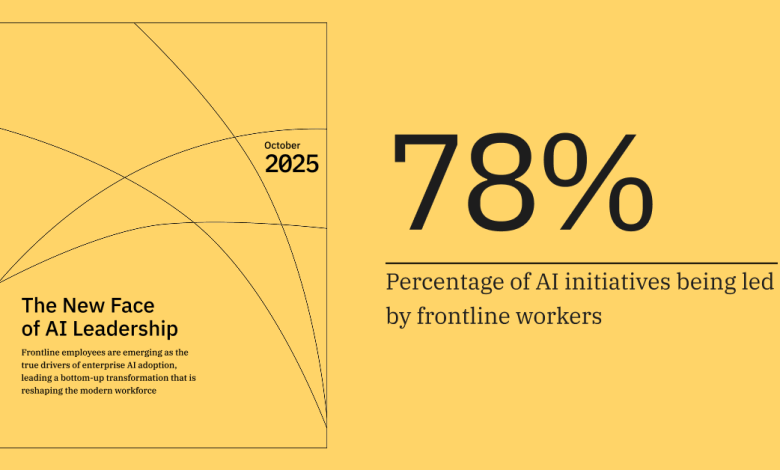
And it’s no anomaly. Seventy-eight percent (78%) of executives report that successful AI initiatives now originate with support staff and non-technical leaders, with 37% seeing this repeatedly. Bottom-up experimentation has evolved from exception to expectation, a repeatable, scalable pattern defining the next era of AI adoption.
Redefining Leadership and Opportunity
This shift isn’t just about how AI is introduced, it’s about who leads. Influence is moving beyond the traditional IT boundary. Only 38% of executives expect IT to have the greatest sway over AI agents in three years. Increasingly, departments such as operations, HR, and frontline business units are at the helm of transformative projects.
This decentralization is reshaping career trajectories across the enterprise. Some 68% of companies have created new roles devoted to managing agentic AI, signaling real opportunities for non-technical talent to move into AI-adjacent fields. Even more striking, 39% of executives expect agentic AI to open doors for advancement regardless of a person’s technical background. AI is shifting from a force for automation to a catalyst for employee elevation, empowering those closest to business problems to drive solutions.
The Unpreparedness Paradox
Despite this dramatic shift, our research spotlights a growing gap: a company’s preparedness for cultural change. Seventy-three percent (73%) of executives admit their organizations underestimate the coming disruption from agentic AI. For nearly a quarter, this underestimation is significant. The result is a culture gap, deploying cutting-edge tools in organizations still guided by old hierarchies invites tension and missed potential.
Bridging this gap isn’t a matter of technological sophistication, but of organizational agility. It demands a new leadership style, one that fosters fuels experimentation, and champions grassroots innovation. Without it, companies risk sidelining the very people powering AI transformation.
Rethinking What Matters: New Metrics for AI Value
Who drives AI adoption is also changing how we evaluate its success. The narrow focus on efficiency and cost savings misses the larger picture. Today’s leaders are tracking return on investment through increased employee productivity (57%), process reinvention (53%), and new capabilities unlocked (47%). This marks a pivot away from incremental progress towards genuine transformation, enabling people to do not just more, but higher-value work.
This mindset extends to technology choices as 96% of executives say they would choose a practical, agentic AI solution that solves a real business problem over the latest flashy large language model (LLM) with no clear application. The emphasis is on utility and empowering employees to innovate.
Recommendations for Enterprise Leaders
To thrive in this new era, leaders need to think beyond the tech itself and embrace a culture of empowerment and inclusion. Here’s what the most successful organizations are doing:
- Prioritize Employee Empowerment: Make automation accessible to all by investing in upskilling, diverse career paths, and inclusive AI strategies.
- Cultivate Bottom-Up Innovation: Encourage experimentation and problem-solving at every level. Create spaces for employees closest to the work to surface challenges and propose AI-driven solutions.
- Expand Success Metrics: Look past basic efficiency; measure success by process reinvention, new skills, and how well employees adapt and add value.
- Prepare for Cultural Shift: Plan for, and embrace, the cultural and structural changes agentic AI demands. Recognize that this isn’t just an IT issue; it’s a company-wide transformation.
The Path Forward
The agentic AI era isn’t simply about upgrading software. It’s about reimagining how organizations function and who gets to lead. The most impactful change is no longer orchestrated from the top, but emerges from an empowered workforce. Companies willing to embrace this decentralized future by championing employee-driven innovation, nurturing new career paths, and evolving their cultures will define what’s possible with agentic AI across the organization. They’ll unlock the full potential of their people and their enterprise.