
At Davos in January, Microsoft chief executive Satya Nadella told the World Economic Forum that the priority now is putting AI to work in ways that “change the outcomes of people and communities.” The largest enterprise platforms carried the same message through the event: the next phase of AI will be judged on measurable outcomes, not capability demonstrations. Software buyers apply that standard at the point of purchase. In the past year, 49% of them saw a CFO overturn a software purchase that had already been approved, most often because the expected outcome could not be shown.
Enterprise AI adoption in 2026 therefore runs through a buying process that looks very different from the one most vendors plan for. Research starts in AI assistants, validation runs through verified peers, funding comes from operating budgets, and proof is due on a schedule. This piece walks through that process stage by stage, using this year’s buyer research to show where deals are won and lost.
Key takeaways
- Half of B2B software buyers now start research with an AI assistant more often than Google, and 69% end up choosing a different vendor than the one they had in mind.
- Citations from review platforms are the single most trusted signal inside an AI-generated answer, picked by 45% of buyers.
- The money is committed but the proof is not: 84% of enterprises plan to raise AI investment, yet only 25% say generative AI is already transforming their business.
- Scrutiny has hardened: 49% of buyers watched a CFO veto an already-approved purchase in the past year, and only 9% would let an AI agent execute a purchase even within guardrails.
Sources: G2 Answer Economy report and 2026 Buyer Behavior Report, Deloitte State of AI in the Enterprise 2026, BCG AI at Work 2026, Ramp × Revelio Labs (2026), Forrester. Opening quote: Satya Nadella at the World Economic Forum, Davos, January 2026.
Where does enterprise AI buying research start now?
AI assistants have become the place where buyers build their shortlists. Half of B2B software buyers now begin research with an AI chatbot more often than with Google, up from a 29% baseline a year earlier, and 82% have sourced software recommendations this way, according to G2’s 2026 Answer Economy report, on how AI search is changing software buying. Buyers use the assistants to compare vendors side by side, summarise a category, and arrive at a working shortlist before speaking to anyone. Only 3% say AI has not changed how they research software, and the Deloitte survey explains why: workforce access to sanctioned AI tools jumped from under 40% to around 60% in a single year, so the people evaluating software already use AI for most other research tasks.
That shift changes which vendors get considered at all. In the Answer Economy study, 69% of buyers chose a different vendor than the one they originally had in mind based on AI assistant guidance, a third bought from a vendor they had never heard of, four in five said the assistant sped up the decision, and 83% felt more confident in the final call. Brand recognition still matters, but it no longer guarantees a place on the shortlist, because the shortlist is drafted before the vendor knows the evaluation has started.
In practice, it looks like this: an operations lead replacing a quoting workflow asks an AI assistant to compare approaches, receives a shortlist that includes two vendors she has never encountered, checks the finalists against verified reviews from other manufacturers, and books two demos. The incumbent vendor, which assumed its renewal conversation doubled as the evaluation, learns about the evaluation after it has ended.
Machines recommend, reviews decide
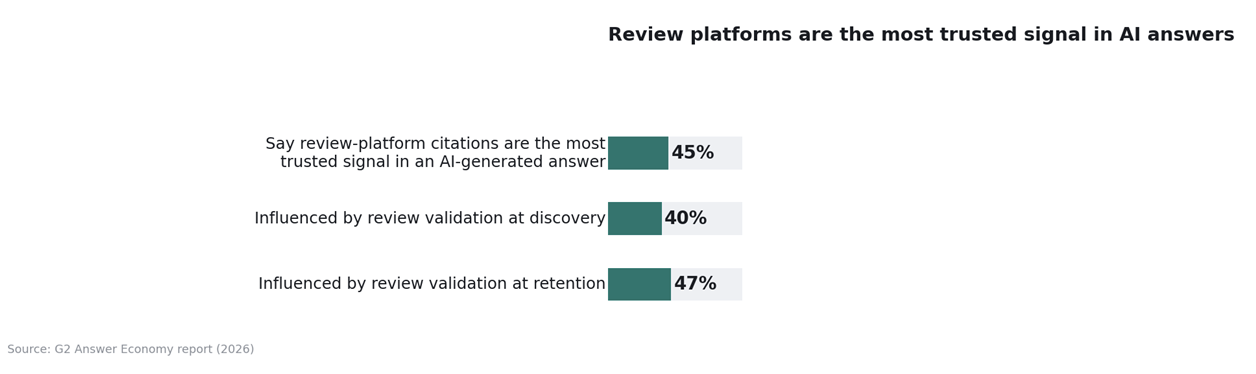
AI assistants shape the shortlist, but they do not close the purchase. Buyers still validate what the machine suggests before money moves, and the validation runs through people. Asked which signal inside an AI-generated answer gave them the most confidence, buyers’ top response, at 45%, was citations from software review platforms, and review-based validation is the only research input that gains influence as deals progress, rising from 40% of buyers at discovery to 47% at retention. The assistant assembles the options, and verified peers confirm which ones are safe to buy.
Forrester’s research on AI-era purchasing reaches the same conclusion from the seller’s side: buyers expect evidence rather than promises, and they turn to peers precisely because they have learned not to trust AI claims alone. BCG’s AI at Work survey of nearly 12,000 employees completes the picture, finding that regular AI use is now the norm for frontline white-collar workers while the gap between access and value still comes down to human judgment about where the tools fit. The pattern is consistent at every layer: machines accelerate the process, humans still gate it.
Which enterprise AI agents are companies actually buying?
Customer support agents lead the shopping list. Among the 3,235 leaders in the Deloitte survey, agentic AI is expected to deliver its largest impact in customer support, followed by supply chain, R&D, knowledge management, and cybersecurity, and the enterprises it interviewed are already running agents in each of those functions. The purchases follow a consistent pattern: enterprise AI agents are bought for defined workflows where the output can be checked, with a person approving the result.
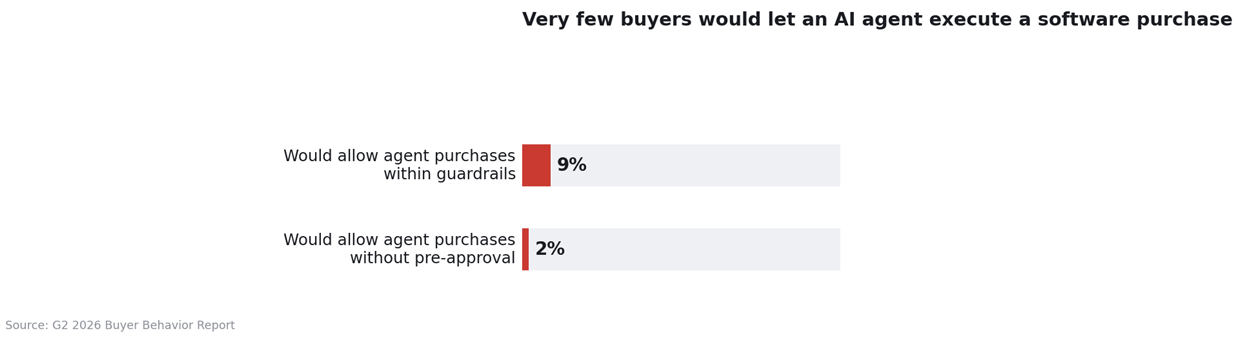
Purchasing authority itself stays with people. In the 2026 Buyer Behavior Report, 9% of buyers said they would let an AI agent execute a software purchase within guardrails, and 2% without pre-approval. Enterprises buy agents to do the work and keep approval human, the same division of labour they apply to the shortlist.
What does the 2026 AI adoption curve look like?
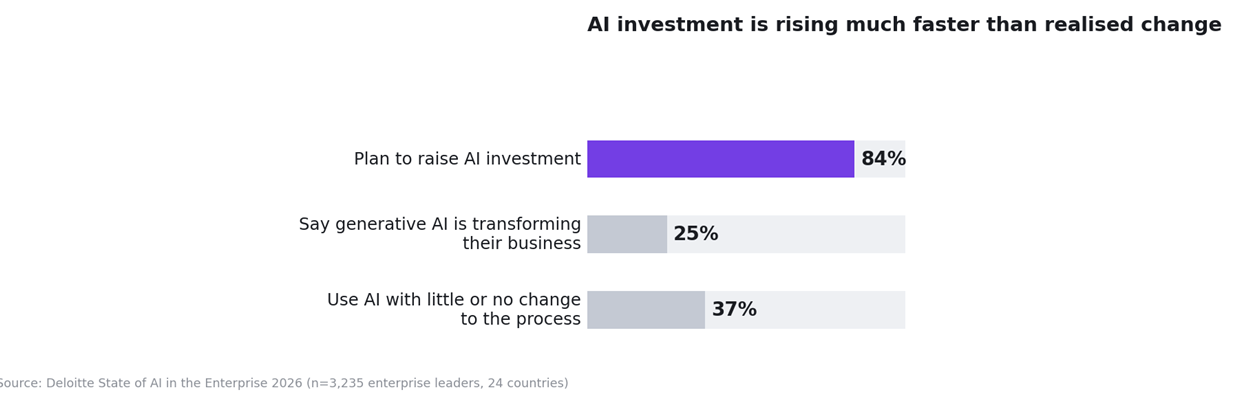
The 2026 enterprise AI adoption curve has split into two lines that no longer move together, and the chart below shows the gap. The investment line points up: 84% of enterprises intend to raise AI spending. Realised change lags well behind it: only 25% of leaders say generative AI is already transforming their business, and 37% of organisations use AI with little or no change to the underlying process. That gap explains the scrutiny buyers now face internally. The 2026 Buyer Behavior Report found 49% of buyers saw a CFO overturn an approved purchase in the past year, and internal resistance to AI adoption nearly doubled in twelve months, from 16 to 29%.
The economics explain who closes the gap. According to Ramp and Revelio Labs, tracking AI spending across 21,559 US firms, found heavy adopters grew headcount 10.2% in the two years after adoption, while light adopters saw no significant change. Value follows operationalisation, not spend, and the buyers writing the reviews appear to know it. The practical AI adoption framework the data suggests is unglamorous: fund from the operating budget, assign a named owner, define the commercial outcome before signing, and treat generative AI procurement like any other capital decision with a proof clock attached.
The buying process, before and after
| Buying stage | The old process | What the 2026 data shows |
| Discovery | Analyst reports, vendor outreach | 51% start with an AI assistant more often than Google |
| Shortlisting | Incumbents and known brands | 69% switch vendors on AI guidance; a third buy from unknowns |
| Validation | Vendor references, case studies | Review-platform citations are the top trust signal (45%) |
| Investment | Optimistic transformation cases | 84% raising spend, but only 25% report transformation so far |
| Sign-off | Committee consensus | 49% saw a CFO veto; 9% would let an agent buy within guardrails |
Sources: G2’s Answer Economy report, the 2026 Buyer Behavior Report, and Deloitte’s State of AI in the Enterprise 2026.
Frequently asked questions
How is enterprise AI adoption changing software buying in 2026?
Research now starts in AI assistants, with half of buyers preferring them to Google and 69% switching vendors on AI guidance, per the Answer Economy report. Validation still runs through humans, with review-platform citations the most trusted signal in AI answers.
Are enterprises actually seeing AI transformation?
Investment intent and realised transformation have split: 84% plan to raise AI spending but only 25% say generative AI is transforming their business, and 37% run AI with little process change, per the 2026 survey of 3,235 enterprise leaders.
Would enterprises let AI agents make purchases?
Not yet. Just 9% of buyers would let an agent execute a purchase within guardrails, and 2% without pre-approval, per 2026 Buyer Behavior Reports.
What is slowing generative AI adoption inside enterprises?
Process, not technology: 37% of organisations use AI with little or no change to the underlying workflow, and internal resistance nearly doubled in a year, from 16 to 29%.
Who blocks AI purchases now?
The CFO, increasingly: 49% of buyers saw a finance veto on an already-approved software purchase in the past year. The veto is how the proof requirement gets enforced.
The bottom line
The industry message and the buyer research point to the same standard: AI now earns its place through measurable outcomes. For buyers, that standard already operates at every stage of the purchase, from the shortlist an assistant drafts, through the verified reviews that confirm it, to the budget review that ends deployments without proof. Vendors that build for this process, with verifiable customer evidence and outcomes a finance team can check inside two quarters, will keep their place on shortlists they never see being made. Vendors that keep selling to the old process will keep losing those deals, and the research suggests they will rarely learn why.
Learn more on why 2026 is a make-or-break year for your company’s AI strategy