
For years, organic growth has been treated as a discipline reserved for companies with dedicated SEO teams, content managers, technical specialists, and reporting workflows. Larger companies could afford keyword research, editorial calendars, content briefs, writers, CMS managers, and analytics reviews. Smaller teams often had to choose between doing SEO inconsistently, hiring an agency, or letting organic search remain an underdeveloped channel.
AI is starting to change that balance.
The most important shift is not simply that AI can generate content faster. It is that AI can help turn SEO from a scattered set of manual tasks into a repeatable operating system. For founders, SaaS teams, and small businesses, this matters because organic growth is rarely about publishing one article. It is about finding the right opportunities, producing useful content, publishing consistently, tracking what works, and improving over time.
That is where AI SEO automation is becoming a practical growth layer for small teams.
Why Traditional SEO Workflows Break Down for Small Teams
SEO is often described as a long-term channel, but the actual work is made up of many small, recurring tasks. A team needs to identify search demand, compare competitor coverage, choose topics, create briefs, write or edit content, publish articles, monitor indexing, track rankings, review clicks, and decide what to improve next.
For a large marketing team, this work can be divided across specialists. For a small team, it usually lands on one founder, one growth marketer, or one content person who already has too much to do.
The result is predictable. Keyword sheets get created but not acted on. Content calendars become outdated. Blog drafts remain unpublished. Ranking reports are checked occasionally but not connected to a clear next step. SEO becomes something the team “knows it should do” rather than something it can operate every week.
The issue is not always a lack of strategy. More often, it is a lack of execution capacity.
This is why AI automation is becoming important. It helps close the gap between insight and action.
From SEO Tools to SEO Operators
Traditional SEO tools are valuable, but many of them are designed around analysis. They show keyword volume, backlinks, ranking changes, traffic estimates, and technical issues. That information is useful, but small teams still need to interpret it and decide what to do next.
The next generation of SEO systems is moving closer to execution. Instead of only showing data, they help create an action queue: which topics to pursue, what content to produce, when to publish, what pages to monitor, and where to optimize.
This changes the role of AI in SEO. It is not only a writing assistant. It becomes an operational layer in content engineering that connects research, content production, publishing, and performance feedback.
For example, a modern system may begin with a company’s website and product context. It can identify what the product does, who the audience is, and what search opportunities are relevant. Then it can recommend topics, produce SEO-ready drafts, support publishing to a CMS, and track indexing, rankings, and clicks after publication.
That kind of workflow is especially useful for small teams because it reduces the number of disconnected tools and manual handoffs required to keep SEO moving.
Why Product Context Matters More Than Content Volume
One of the risks of AI content generation is that it can encourage teams to produce more content without asking whether the content supports business goals. Search traffic alone is not always valuable. A blog can attract visitors who have no interest in the product, no buying intent, and no reason to remember the brand.
That is why product-aware SEO automation is becoming more important.
A good SEO workflow should understand more than keywords. It should understand the company’s product, audience, use cases, value proposition, and conversion goals. This helps content serve a business purpose rather than simply filling a blog with generic articles.
For small SaaS teams, this distinction is critical. They do not need endless content. They need the right content: pages and articles that answer real search intent, support product education, and help potential customers move from problem awareness to solution evaluation.
AI can support this by connecting keyword and competitor signals with product positioning. Instead of treating every keyword as equal, it can help prioritize topics that match the company’s audience and growth stage.
The Rise of the Daily SEO Workflow
The most practical form of AI SEO automation is not a one-time campaign. It is a daily or weekly workflow.
Small teams benefit when SEO becomes a manageable queue rather than a massive project. That queue might include new topic opportunities, articles ready for review, pages that need optimization, indexing issues to check, or successful topics that should be expanded.
This operating model is useful because it makes SEO less dependent on occasional bursts of effort. Instead of asking, “What should we do for SEO this month?” a team can ask, “What is the next useful SEO task in the queue?”
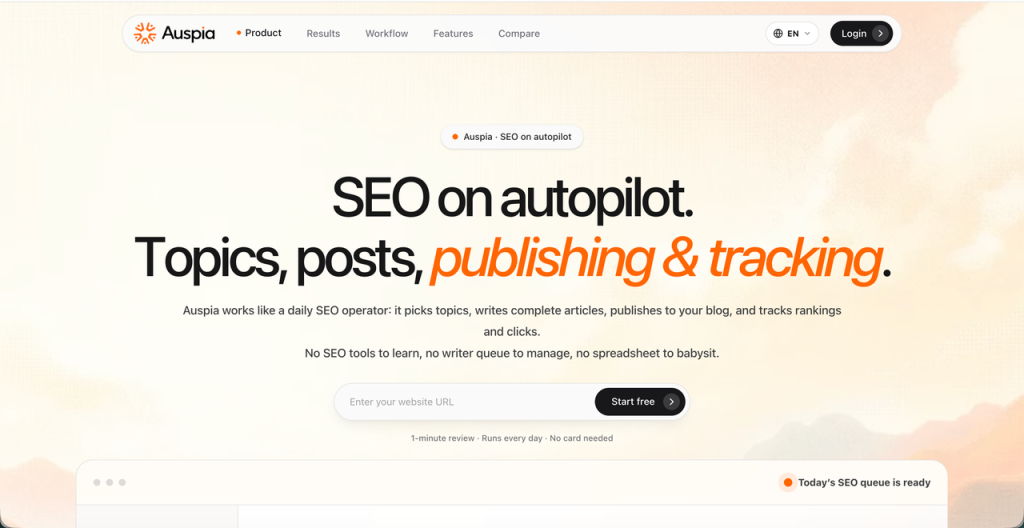
Platforms such as Auspia are built around this idea. Auspia describes itself as an AI SEO automation tool for founders, startups, SaaS teams, and small businesses that need organic traffic but do not have a full SEO team. It is designed to analyze a website and product context, identify search opportunities, recommend topics, write SEO-ready content, publish to a connected blog or CMS, and track indexing, rankings, and clicks.
The important point is not that automation removes all human judgment. It does not need to. In many cases, the stronger model is automation with review. AI handles repetitive work, while humans keep control over product positioning, editorial judgment, and strategic direction.
Automation Across the Full SEO Loop
A useful AI SEO system should not stop at content generation. For small teams, the biggest time savings often come from connecting the full loop.
That loop usually includes:
Research: finding search demand, competitor gaps, and topic opportunities.
Planning: deciding which topics are worth pursuing and how they connect to the product.
Writing: producing drafts that are structured for search intent and reader usefulness.
Publishing: moving approved content into WordPress, Webflow, or another CMS/API workflow.
Tracking: monitoring indexing, ranking movement, clicks, and page performance. With the rise of conversational search, Semrush assists teams in monitoring AI answers through the Best AI Search Visibility Tools.
Optimization: improving weak pages, expanding winning topics, and adjusting future content plans.
When these steps are disconnected, SEO slows down. When they are connected, teams can create a more consistent growth process.
This is why the phrase SEO automation should increasingly refer to the full workflow, not just AI writing. Automating a draft is helpful, but automating the path from opportunity discovery to publishing and performance review is far more valuable.
Where GEO Fits Into the SEO Operating System
Search behavior is also changing. Users are no longer relying only on traditional search engine result pages. They are asking questions in AI answer engines, using tools such as ChatGPT, Perplexity, and Claude to compare products, understand categories, and find recommendations.
This is why GEO, or generative engine optimization, is becoming part of the broader organic growth conversation.
For small teams, GEO does not replace SEO. It extends it. Many of the same foundations still matter: useful content, clear product information, crawlable pages, credible sources, structured information, and technical accessibility. However, teams also need to consider whether their content is easy for AI systems to understand, summarize, and cite when appropriate.
This is not something any tool can guarantee. AI citation visibility depends on content quality, crawlability, source credibility, platform behavior, and the way answer engines retrieve and interpret information. But teams can still prepare by making their websites clearer, more technically accessible, and more useful as sources.
That is why some AI SEO systems now include GEO readiness features such as AI crawler checks, llms.txt support, citation readiness workflows, and technical monitoring for crawlability issues.
What Small Teams Should Look for in AI SEO Automation
Not every AI SEO tool is designed for the same job. Some tools focus on writing assistance. Others focus on keyword research, rank tracking, content optimization, or technical SEO monitoring. Small teams should look for systems that reduce operational complexity rather than adding another dashboard to manage.
A practical AI SEO automation system should help answer these questions:
What topics should we work on next?
How do those topics connect to our product and audience?
Can we turn those topics into useful, search-ready content?
Can approved content move into the CMS without manual copy-paste?
Are pages being indexed and receiving clicks?
Which topics should be expanded, refreshed, or deprioritized?
Are there technical issues that could block search or AI crawler access?
The best fit for a small team is often not the biggest enterprise platform. It is the system that helps the team execute consistently with the resources it already has.
Human Review Still Matters
AI automation should not be treated as a replacement for strategy, expertise, or brand judgment. SEO still requires understanding the market, the customer, the product, and the difference between traffic that looks good in a report and traffic that supports real business outcomes.
Small teams should keep human review in the process, especially for product positioning, claims, examples, and final editorial quality. AI can speed up research, drafting, publishing, and monitoring, but the company still needs to decide what it wants to be known for.
The strongest SEO workflows combine automation with accountability. AI handles repetitive execution. Humans guide messaging, accuracy, and priorities.
A New Operating Model for Organic Growth
AI SEO automation is not making organic growth effortless. It is making it more operational.
That distinction matters. SEO still takes time. Content quality still matters. Technical accessibility still matters. Authority and trust still matter. What changes is the ability for smaller teams to keep the process moving without building a full internal SEO department.
For founders, SaaS teams, and SMBs, this can turn SEO from an occasional project into a daily operating system. The team can move from scattered keyword sheets and unfinished drafts to a clearer workflow: discover opportunities, create useful content, publish, track, and improve.
In the next stage of organic growth, the winning small teams may not be the ones that publish the most. They may be the ones that build the most consistent feedback loop between product understanding, search demand, content execution, and performance learning.
AI SEO automation gives them a way to build that loop earlier, with fewer resources, and with more consistency than traditional manual workflows allow.
Quick Questions Small Teams Ask About AI SEO Automation
Can AI SEO automation replace an SEO team?
Not completely. It can reduce repetitive work and help small teams execute more consistently, but human review is still important for strategy, positioning, accuracy, and editorial quality.
Is AI SEO automation only about writing articles?
No. The stronger use case is the full workflow: topic discovery, content planning, writing, CMS publishing, tracking, and ongoing optimization.
Does GEO replace traditional SEO?
No. GEO builds on many SEO foundations, including useful content, crawlability, source credibility, and clear product information. It prepares content for AI answer engines, but it does not remove the need for Google SEO.
Can any tool guarantee rankings or AI citations?
No. Rankings and AI citations depend on many factors, including content quality, technical accessibility, competition, source authority, and platform behavior.