Coastal zones are the frontlines of climate change. Home to nearly half the world’s population, they concentrate economic activity, transport routes, and biodiversity that societies cannot afford to lose. Yet rising seas, intensifying storms, erosion, and land subsidence are escalating, and climate adaptation needs are increasing as a result.
Climate adaptation and nature conservation are inseparable: protecting and restoring ecosystems such as mangroves, seagrass, and coral reefs delivers immediate risk reduction (wave attenuation, surge buffering, erosion control). They also safeguard biodiversity and livelihoods, so the smartest adaptation plans are also strong conservation plans.
The urgency is undeniable. The World Bank estimates that mangroves alone provide more than $65 billion in annual flood protection benefits, shielding over 15 million people every year. Without coral reefs, annual flood damages would more than double. As sea levels rise, the number of people exposed to severe flooding is projected to increase dramatically.
Yet despite these stakes, adaptation remains piecemeal. Fragmented governance, outdated baseline data, and underfunded planning processes mean that many coastal nations are underprepared. Traditional approaches – slow studies, siloed datasets, and static maps – are no match for dynamic, interconnected coastal hazards. What’s needed is a step change in how coastal risk is assessed, planned, and managed.
That’s where artificial intelligence (AI), combined with advances in geo-data and digital modelling, is beginning to make a real difference.
AI as the Engine of the Digital Coast
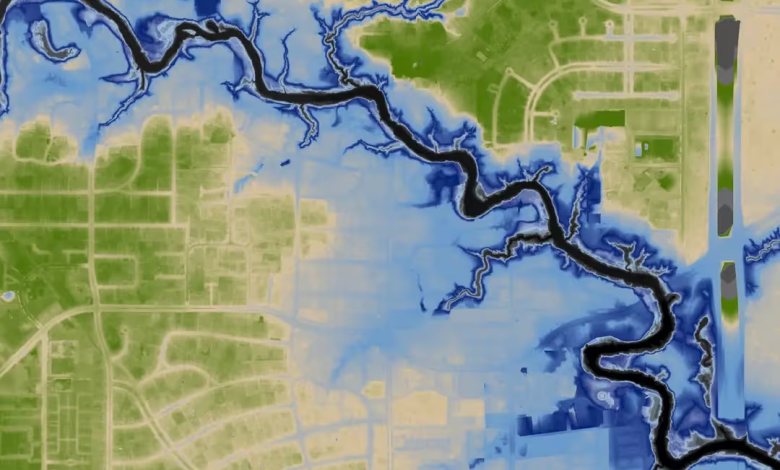
Recent advances in artificial intelligence, data integration, and predictive modelling are creating the conditions for a new era of digital coastal zone management. At the heart of this discipline are virtual replicas of coastal ecosystems – dynamic, data-rich models from which decision makers can then use to pull out specific characteristics and aspects, and make predictions about the future.
Broadly speaking, AI is having an impact on coastal zone management in three ways. When combined with suitable datasets, it is very effective at drawing new conclusions from seemingly unconnected data, and automatically extracting particular features. Coastal hazards are rarely isolated: erosion, flooding, water quality, and biodiversity shifts interact in complex ways. Looking at each of this in isolation misses vital context.
From there, we come to AI’s second powerful impact on coastal resilience work – using it for prediction. It can take large datasets and make reasonable assumptions based on the overall direction of travel, with or without certain interventions. This can be a big help with planning future investment.
Thirdly, AI makes these large and often complex datasets on coastal ecosystems more accessible. Thanks to Large Language Model-based chatbots, an end user does not need to be expert in technical disciplines such as bathymetry, or be able to interpret complex maps, to benefit from the conclusions a virtual replica can offer. Simply type in a query and the chatbot does the heavy lifting to interpret the map.
It is an exciting time for the application of AI in this climate-oriented work. Through the simple, intuitive format of a conversation, users can explore scenarios, request bespoke insights, and drill down into complex maps to get answers – whether they are technically-minded or not. The result is a single source that policymakers, engineers, and communities can work from to test interventions, align decisions, and accelerate action.
Picture a coastal planner, weeks after Hurricane Beryl devastated Grenada, typing a plain‑language question into a chatbot: “Show me where Beryl caused the worst mangrove loss and what that means for future storm‑surge risk.” Within seconds, the chatbot overlays satellite damage assessments with flood‑risk projections, highlighting critical vulnerability zones. It then suggests priority restoration sites and models how replanting specific areas of mangroves could reduce 30‑year flood losses by millions—turning what used to take months of GIS analysis into an actionable briefing for cabinet in a single morning.
This example demonstrates how transformative AI can be to decision making by bringing down delays and barriers to entry – but it is important to say experts are still required. Verifying the final plans and checking the output from the AI still relies on human intuition and judgement. Instead of those experts having to do the heavy lifting of combing through large and complex datasets themselves, they can put their expertise to work in more efficient and effective ways adding value where it matters most.
Better Governance Through Modelling
This alignment through a single source is particularly important because the nature of coastal work involves a wide range of stakeholders: ministries of environment, transport, and housing; local authorities; development banks; engineering firms; and community groups. Too often, they operate with different datasets, inconsistent assumptions, and conflicting priorities.
A virtual replica, accompanied by an LLM to quickly draw out specific data, creates a shared reference point – a transparent platform where all parties can see the same evidence, understand trade-offs, and align on action. This reduces duplication of studies, streamlines permitting, and accelerates consensus. Governments, consultants, and partners can then co-design strategies in real time, supported by scenario models that show the likely outcomes of different interventions.
The payoff is both efficiency and legitimacy: when stakeholders are working from the same dataset, it becomes easier to justify decisions to funders, regulators, and communities alike.
Unlocking Finance and Delivery
Perhaps the most critical barrier to coastal resilience today is finance. Development banks and climate funds are inundated with proposals, but too many lack credible evidence of impact. According to the Global Center on Adaptation and Climate Policy Initiative1, the global funding gap – between what’s needed and what’s available – for adaptation is widening, with analysis indicating that developing countries will need USD$212 billion per year up to 2030, and USD$239 billion per year between 2031 and 2050.
Another area that highlights how coastal ecosystems are often overlooked is with the UN Sustainable Development Goals (SDGs). Of all of them, SDG 14 – Life Under Water receives the least funding, and while these Goals are about more than just climate adaptation, the World Economic Forum suggests that $175 billion is needed per year to meet SDG14 by 2030. Projects need transparent data and clear monitoring frameworks to successfully attract investment, and so finding ways to accelerate the deployment of that investment into coastal and marine ecosystems is crucial.
Here, AI-enabled virtual replicas can provide quantifiable evidence of resilience outcomes thanks to the predictive capabilities in place. They offer transparent monitoring and verification, ensuring that funders see not only promises but performance. This aligns closely with the needs of institutions like the World Bank, Asian Development Bank, and UNDP, which are under pressure to demonstrate the effectiveness of their climate finance portfolios.
By linking data-driven insights with financial credibility, virtual replicas can play a key role in building the case for buy-in, justifying projects and donor funding that currently sits on the sidelines.
A Turning Point for Coastal Resilience
For too long, coastal adaptation has been reactive – rebuilding after disasters, patching erosion hotspots, and planning in silos. The convergence of AI, geo-data, and digital modelling offers a chance to change course.
A virtual replica of the coast – and especially one that is paired with a chatbot to help pull out specific data – equips decision-makers of any technical level to anticipate risks, design smarter interventions, and justify the investments needed for long-term resilience.
As seas rise and storms intensify, the stakes for coastal communities could not be higher. Thanks to the power of AI, we have new tools to move from fragmented responses to coordinated, evidence-based action. The question now is not whether we can model the coast – but whether we can mobilise fast enough to protect it.
Call to action: Governments, multilateral development banks, and delivery partners should (1) pilot these advanced AI-enabled digital coastal zone management tools with SIDS and least‑developed coastal nations; (2) finance open, regularly updated coastal datasets; (3) embed AI governance, transparency, and human‑in‑the‑loop review; (4) build local capacity so planners, engineers, and communities can use these tools; and (5) measure resilience and biodiversity outcomes together—because the most sustainable path to climate safety at the coast is to protect and restore nature, at scale, with AI accelerating every step.