Artificial intelligence (AI) is no longer a concept of the future. It has already begun to embed itself deeply into the foundations of modern medicine. With the integration of AI into diagnostics, the industry is moving from reactive treatment to proactive, predictive care. From wearable biosensors to AI-enhanced imaging platforms, these technologies are enabling clinicians to detect diseases earlier and with greater precision than ever before.
All of this will be crucial as most of the baby boomer generation retires amid an ongoing shortage of health care providers and a simultaneous increase in demand. Effective use of AI/ML technologies will likely be key to resolving this imbalance.
Today, AI’s influence is evident in the exponential rise of regulatory approvals and the transformative ways it is reshaping healthcare, particularly diagnostics.
AI-enabled Diagnostic Devices: From Simple Monitoring to Smart Detection and Feedback
Over the past five years, wearable devices have evolved from basic fitness monitors to sophisticated diagnostic tools. With AI-integrated software and predictive algorithms, these devices can now detect major health risks before symptoms appear, flag early signs of disease and prompt timely medical intervention.
Devices such as smartwatches, biosensor patches and rings now incorporate machine learning algorithms to track heart rate variability, oxygen saturation, sleep patterns and even biochemical markers. These data streams allow for early detection of conditions like atrial fibrillation, sleep apnea and metabolic disorders.
Clinical trials have demonstrated that personalized, data-driven interventions enabled by wearables can outperform traditional intermittent clinical assessments. For example, AI-powered wearables are being used to monitor seizure activity, quantify episodes, and reduce the risk of sudden unexpected death in epilepsy patients. AI-enabled technologies thus continue to enhance preventative health care, improving patient outcomes while reducing the burden on health care systems, both in terms of costs and resources.
AI is increasingly being utilized to address a crucial need for improved diagnostic accuracy and treatment efficacy. Because AI can analyze vast datasets with unprecedented precision, it is especially valuable in complex diseases like cancer, where early, accurate detection and precise treatment decisions are crucial.
A recent study revealed that AI systems outperformed traditional radiologists in detecting lung nodules, achieving a diagnostic accuracy rate of 94%, compared to just 65% for human experts. Similarly, in Germany, the PRAIM study demonstrated that AI improved breast cancer detection rates by 18% without increasing false positives.
Accelerated Approvals and Life-Saving Innovations
Medical devices powered by AI are receiving regulatory approvals at an unprecedented pace.
AI has been particularly transformative in the field of diagnostics, especially in cardiovascular care and radiology, which has become a cornerstone of AI integration. Algorithms trained on vast datasets can now detect tumors, fractures, and vascular abnormalities to supplement diagnostic accuracy and efficiency. Imaging products make up most of AI-related medical devices cleared by the U.S. FDA, underscoring the value of AI in this domain.
The cardiovascular space has seen notable development, including the recent U.S. FDA approval of next-generation wearable defibrillators designed for patients at high risk of sudden cardiac arrest, which continuously monitor heart rhythms and automatically deliver a life-saving shock if a dangerous arrhythmia is detected, restoring normal cardiac function instantly.
In the radiology and diagnostic imaging markets, there have been considerable manufacturer efforts to integrate AI-powered offerings with numerous FDA approvals obtained by major players in this space in recent years. Market leaders have been able to pull away from the competition by participating in the race for AI integration. Recent launches claim significantly improved scan speeds and superior image quality owing to AI integration. Similarly, other ultrasound systems are purported to enhance image quality and offer faster scan times.
Market collaborations have been underway to support innovation in this space, especially between Medtech market leaders and tech giants. Examples include recent partnerships to develop AI programs for general radiography system product lines. Collaborations also extend beyond MedTech firms to global academic and healthcare institutions, with recent multi-year initiatives establishing AI hubs to advance diagnostic and workflow innovations.
In particular, the tools have significantly impacted clinical decision-making, leading to modifications in treatment plans for patients undergoing coronary computed tomography angiography (CCTA), helping to reduce the risk of cardiac events.
Unlike traditional CCTA techniques, advanced AI tools quantify plaque burden by type, enabling clinicians to tailor treatment strategies more precisely. This advancement underscores how AI can elevate imaging from static snapshots to dynamic, data-driven insights that support faster and more informed clinical decisions.
How Are AI-Enabled Devices Performing in the Market?
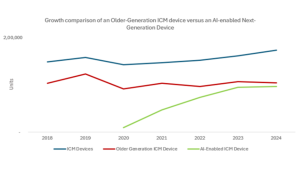
According to Clarivate data, which analyzes hospital purchasing records across the U.S., AI-enabled medical products are experiencing significantly faster market adoption compared to their traditional counterparts.
Between 2018 and 2024, Clarivate data showed the momentum which underscores a market pivot toward intelligent diagnostics, highlighting the accelerating demand for AI-enabled cardiac monitoring solutions.
Source: Clarivate
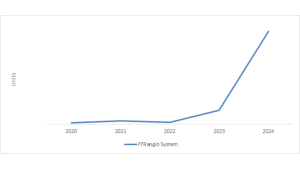
Similarly, systems that leverage AI and computational science to derive fractional flow reserve (FFR) data noninvasively are reshaping the coronary diagnostics landscape. By eliminating the need for traditional guidewires, the system offers clinicians a safer, faster, and more efficient alternative.
While the U.S. market for FFR guidewires is growing at a modest 1.6% from 2020 to 2024, Clarivate data show purchasing behavior in 2025 continues to reflect this shift, demonstrating that AI-driven technologies are not just enhancing clinical workflows—they’re redefining market dynamics.
Source: Clarivate
In the diagnostic imaging space, multiple AI-enabled offerings across imaging modalities are outgrowing unit volumes in the U.S. ultrasound market, which is the fastest-growing segment in the U.S. diagnostic imaging system market.
This pattern of accelerated adoption illustrates a clear inflection point in the medical device industry. As AI capabilities continue to mature, their integration into diagnostic and therapeutic tools is not only enhancing clinical outcomes but also reshaping purchasing behavior across U.S. hospitals.
What Does the Future Hold for AI in Healthcare?
The increasing integration of AI disrupts traditional healthcare by revolutionizing patient care through personalized treatments and improved outcomes. AI algorithms analyze patient data to predict treatment responses, guiding clinicians in selecting optimal therapies.
By embedding artificial intelligence into wearables and imaging platforms, healthcare is becoming more predictive, personalized, and accessible. The increasing integration of AI technology is already producing clinically significant differences in healthcare outcomes.
Going forward, however, health care systems and industry stakeholders must evolve processes to reflect the ongoing adoption of AI and the need for better regulatory oversight. Although policies and perspectives vary worldwide and are influenced by dynamic societal, political, and ethical considerations, regulators and politicians recognize the need for some level of standardization across geographies.
Postmarket surveillance of AI-enabled solutions is also critical given that the algorithms used in these technologies are designed to continuously learn and adapt over time, making ongoing monitoring of quality and performance a vital part of regulating these technologies.
As regulatory bodies and industry leaders collaborate to shape standards and advance AI technologies, market adoption is expected to accelerate, positioning AI as a crucial part of modern diagnostics.