Global operations require clarity, speed, and cultural precision. As companies expand across continents, communication tools that deliver accuracy at scale are becoming essential. The world no longer relies solely on traditional interpreters in physical rooms. It expects an AI interpreter that keeps conversations moving without delays or scheduling barriers.
This shift reflects how multilingual translation tools quietly reshape language workflows. It is not a sudden disruption but a natural response to rising operational demands, hybrid teams, and remote decisions. International operations need systems that work across time zones without added costs or friction. As virtual collaboration grows, scalable and reliable interpretation becomes central to global communication.

How Do AI Interpreters Lower Operational Costs Across Global Teams?
Live AI interpreters lower operational costs across global teams by removing the need for scheduled professionals and eliminating hourly billing tied to meeting length. Traditional setups often require managing availability, handling transition times, and absorbing costs from delays or rescheduling.
With a live AI interpreter that activates the moment a meeting starts, teams avoid idle hours and unnecessary spending while maintaining communication quality. This becomes especially helpful in multilingual environments that rely on steady support for every discussion.
Long-term savings grow as international operations hold frequent training sessions, compliance reviews, and cross-border conversations. Human interpreters introduce budgeting unpredictability that increases as teams scale.
AI-based live interpretation tools offer predictable usage patterns and dependable access across time zones, including support for Zoom translation when needed. This consistent availability helps teams plan communication budgets with clarity and supports sustainable multilingual collaboration.
Cost Comparison Table: Human Interpretation vs. AI Interpretation
Choosing between a human and live AI interpreter can have a significant impact on costs, availability, and operational efficiency. The table below compares key factors to help businesses understand these differences:
| Factor | Human Interpretation | AI Interpretation |
| Availability | Depends on scheduling and timezone | Available instantly |
| Cost Structure | Hourly rates, overtime fees, and rescheduling costs | Predictable usage-based structure |
| Scalability | Requires multiple interpreters for multiple languages | Scales across languages without additional staffing |
| Meeting Length Impact | Charged even for unused booked time | No cost for waiting or overruns |
| Long-Term Budgeting | High fluctuations month to month | Stable and forecast-friendly |
As businesses expand, these cost differences become more visible. Interpretation shifts from a high overhead expense to a standard operational tool that supports smoother collaboration. With barriers reduced, more teams can join international discussions and contribute confidently to shared decisions.
How Does AI Improve Accessibility for International Meetings and Remote Workflows?
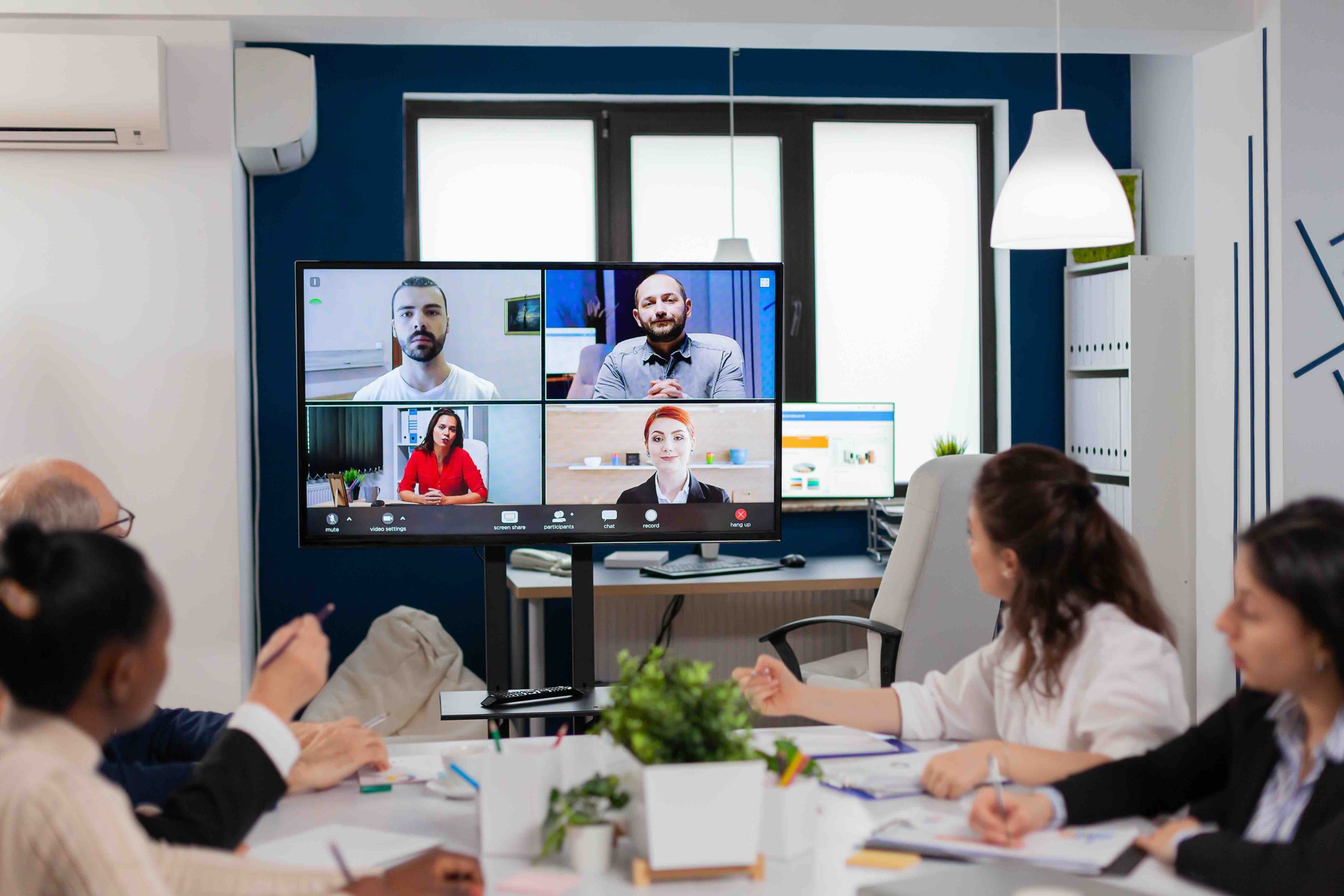
AI improves accessibility for international meetings and remote workflows by ensuring every participant can understand and contribute without language barriers. Live AI interpreters remove scheduling limits and enable real-time participation for employees with different linguistic backgrounds.
As the global AI market is projected to grow from USD 279.22 billion in 2024 to over USD 3,497.26 billion by 2033, organizations are increasingly adopting AI solutions to enhance collaboration and productivity.
When interpretation activates instantly, multilingual translation becomes a natural part of the meeting experience. This creates a more inclusive environment for hybrid teams working across regions.
Key Accessibility Advantages
- Less Reliance on Scheduled Support: When interpretation is available instantly, meetings can start without delays caused by scheduling or last-minute cancellations. This keeps discussions moving smoothly in fast-paced environments where timing is crucial.
- Equal Participation Across Languages: Live AI interpreters ensure that every participant can express ideas clearly, understand complex details, and follow the conversation without language-related hesitation. This creates a fair and confident space for diverse teams.
- Works Inside Familiar Platforms: Seamless integration means interpretation appears directly within tools people already use. Participants do not need extra software or support staff, which makes communication feel natural during remote or hybrid collaboration.
- Supports Affordable Global Training: With automated interpretation, organizations can run workshops, onboarding sessions, and compliance training across regions without needing multiple interpreters. This makes education more scalable, predictable, and budget-friendly.
- Raise Confidence for Smaller Teams: Smaller teams gain the capability to present, negotiate, and contribute in global conversations without relying on external language services. This levels the playing field and expands their ability to participate in higher-value discussions.
- Stays Consistent in Varied Conditions: AI systems adapt in real time to accents, unclear speech, background noise, or unstable network connections. This ensures conversations stay understandable, even when conditions are less than ideal.
As these capabilities strengthen, accessibility becomes a built-in part of global collaboration. Teams engage more naturally, avoid workflow disruptions, and stay aligned across time zones with dependable multilingual translation.
What Makes AI Interpretation a Sustainable Choice for Long-Term International Operations?
Live AI interpretation is a sustainable choice for long-term international operations because it adapts to changing business needs without requiring constant restructuring. As organizations enter new markets or add new languages, the system continues to function reliably.
The global virtual meeting software market is projected to grow from $19.04 billion in 2023 to $157.96 billion by 2032. Businesses are increasingly relying on digital platforms for collaboration. Live AI interpretation integrates seamlessly into these tools, providing a communication layer that grows with teams instead of creating friction or requiring frequent upgrades.
Sustainability Markers in AI Interpretation
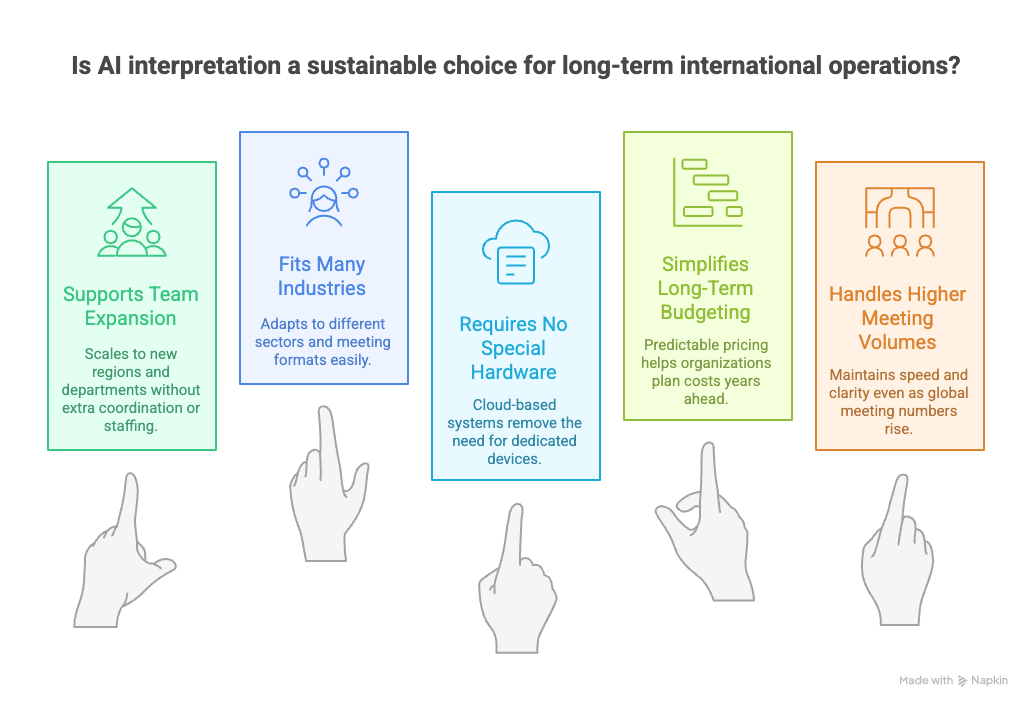
- Supports Team Expansion: As companies hire globally, live AI interpretation scales to new regions and departments without extra coordination or staffing. Communication stays consistent as teams grow.
- Fits Many Industries: Live AI interpretation adapts to different sectors and meeting formats, from finance to manufacturing. Employees can use it easily without specialized training.
- Requires no Special Hardware: Cloud-based systems remove the need for dedicated devices. Teams can access interpretation from laptops or mobile devices anywhere in the world.
- Simplifies Long-Term Budgeting: Predictable pricing helps organizations plan language-support costs years ahead, reducing the uncertainty tied to hourly or per-session services.
- Handles Higher Meeting Volumes: Live translation tools maintain speed and clarity even as global meeting numbers rise. Growing operations do not require extra equipment or staffing.
These markers help leaders see if their AI interpretation and multilingual transcription systems can reliably support long-term growth and global communication needs.
Conclusion
Global operations depend on communication systems that keep up with fast decisions, diverse teams, and constant movement. Live AI interpreters provide cost stability, cross-platform accessibility, and seamless collaboration without geographical limits. By removing friction from everyday communication, teams work more efficiently and confidently, making international meetings inclusive and easier to manage.
The true value of live AI interpretation lies in its consistency amid growth and change. It adapts to expansion, unexpected transitions, and urgent discussions, supporting teams without interrupting workflows. This reliability allows organizations to plan long-term while maintaining clear global communication.
With stronger AI-driven systems, language stops being a barrier and becomes a shared pathway for international collaboration, enabling teams to operate boldly across regions.