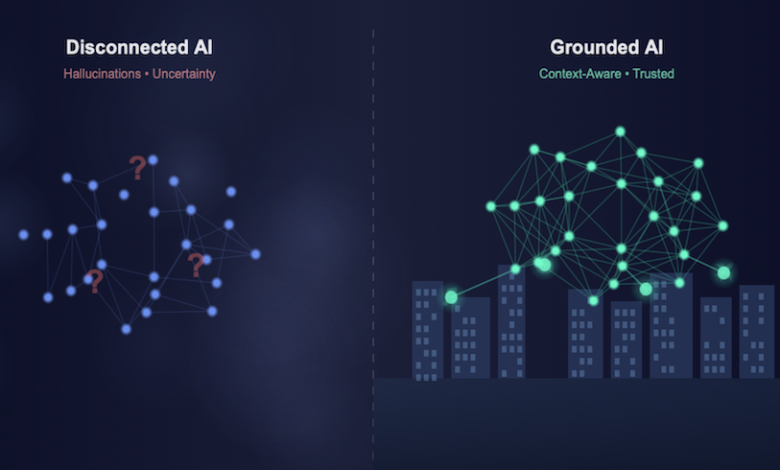
Grounding AI in real-world context and measurable accuracy turns probabilistic models into trusted business tools.
The Trust Problem
Every executive I meet asks the same question: if AI is so powerful, why can’t I trust what it tells me? AI is reshaping industries, from emergency room forecasting in healthcare to dynamic pricing in retail, yet most C-suite executives see pilots stall short of production. The problem isn’t ambition, it’s accuracy. Models delivering confident but wrong outputs, known as hallucinations, erode trust. A 2025 MIT study found 95 percent of enterprise AI pilots never make it to production, largely due to unreliable outputs and low stakeholder confidence. Gartner predicts that by 2026, over 80% of enterprises will deploy generative AI, up from under 5% in 2023—but hallucinations threaten this momentum.
We’re now entering what analysts and commentators call the “sorting phase” of AI: the shift from experimentation to execution. Hallucinations aren’t going away, but their impact can be managed. The way forward is grounding AI in real-world context and measuring its performance with the same rigor we apply to any other business system.
The Myth of Perfect AI
AI was sold as a flawless brain, but hallucinations are inherent to probabilistic systems like large language models, which predict likelihoods, not truths. Expecting perfection is like expecting a weather forecast to pinpoint rainfall’s exact minute, it is useful for planning, but not infallible.
The consequences of this gap between promise and reality are costly. A QSR chain understocks 47 locations during March Madness weekend because their AI model treated it like any other Saturday, leaving millions on the table. A bank’s fraud detection system flags legitimate international purchases during the Olympics without market context, frustrating customers and eroding trust in the entire system.
These failures share a common cause: the AI is optimizing for historical patterns while being blind to the real-world events that drive actual outcomes.
Why Internal Data Isn’t Enough
Most AI systems are trained on historical patterns that assume the past predicts the future. But economies don’t run on averages, they run on exceptions.
A retailer might know that Saturdays generate 30% more foot traffic, but it can’t know that this Saturday has a Taylor Swift concert two blocks away that will drive 300% more traffic. A supply chain model understands typical delivery times but misses the transportation strike that will delay shipments by a week. Without real-world context, models optimize for the average and miss the outliers that drive actual results.
The challenge is that unlike historical training data that sits static in a warehouse, real-world context is dynamic: events get cancelled, postponed, relocated; attendance estimates shift; new disruptions emerge daily. This “living data” cannot be pre-trained into models, it must be consumed continuously, creating an ongoing need for verified external signals.
Context Makes AI Real-World Aware
Context is the missing ingredient that transforms AI from statistically informed to situationally intelligent. External signals like concerts, holidays, strikes, sports events, severe weather, and conferences explain the “why” behind demand patterns that internal data alone cannot capture.
Consider a hospitality company forecasting demand. Historical data shows their properties average 75% occupancy in March. But this March, there’s a major medical conference in Chicago, a tech summit in Austin, and NCAA tournament games across eight cities. Without this context, the AI underprices rooms and misallocates staff. With context, it optimizes pricing by location and ensures appropriate staffing levels, potentially improving revenue per available room by 10% or more.
The principle extends across industries. Retailers can anticipate inventory needs around local events. Delivery platforms can pre-position drivers before demand spikes. Healthcare systems can staff emergency rooms based on community gatherings. The common thread: AI becomes useful when it understands not just what happened historically, but what’s happening now and what’s coming next.
From Probabilistic to Practical
Operationalizing AI depends on measurement. Every enterprise needs consistent accuracy metrics borrowed from proven disciplines. In forecasting, metrics like MAPE (Mean Absolute Percentage Error) or WAPE (Weighted Absolute Percentage Error) show how predictions align with reality. In language models, BLEU scores and confidence calibration serve similar purposes.
When executives and data teams share clear accuracy metrics, they can compare models objectively and decide which are production-ready. In our work with enterprise clients, we are often coming into a situation where models have never consumed real-world context. So whilst this unlocks something net new, it also reveals how much AI/ML models fall short in dealing with the real-world.
Feedback loops close the gap between prediction and outcome, making each cycle smarter. This governance discipline of defining metrics, assigning accountability, and integrating verified external signals transforms probabilistic systems into practical systems trusted enough to drive staffing, pricing, and investment decisions.
The New Competitive Moat
As hallucinations persist, the next era of competitive advantage won’t come from who trains the largest model, but from who grounds their models in the most relevant data.
Every enterprise holds valuable internal signals like sales histories, foot traffic patterns, and supply-chain rhythms, but these only describe what happened. They don’t explain why. The “why” lives in the world outside the organization: in events, weather, transport disruptions, and cultural moments that constantly reshape demand.
When companies combine their private data with trusted, verified external context, accuracy compounds. Forecasts become explainable, and decisions gain precision. The moat is no longer just in owning data, it’s in how intelligently and securely you connect internal truth with external reality.
Leaders who can fuse those two worlds will build AI systems that are both smarter—because they learn from reality—and safer, because every prediction is traceable, explainable, and grounded in trusted data.
The Path Forward
The executive who asked me “why can’t I trust what AI tells me?” deserves a better answer than “wait for better models.” The answer is: make your AI real-world aware, measure its performance like any other business system, and protect the contextual intelligence that makes it accurate.
Hallucinations aren’t going away. But enterprises that ground AI in verified context, govern it with measurement discipline, and treat contextual data as a strategic asset will realize genuine ROI while competitors chase promise that they can never ship.
The future won’t reward the biggest models, it will reward the most aware ones: systems that understand context, learn from reality, and earn trust through accuracy.