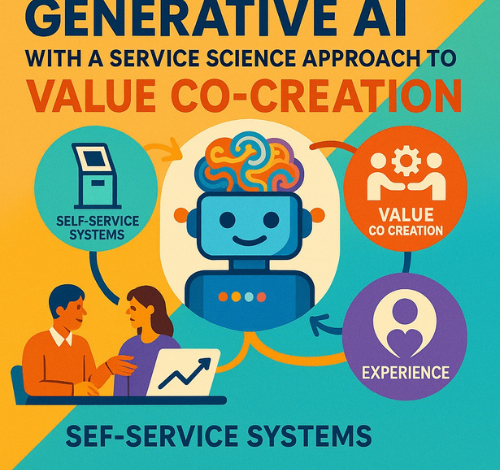
Generative AI (GenAI) has entered the enterprise landscape with extraordinary momentum, often described as a disruptive force comparable to earlier technological revolutions in social media, cloud computing and mobile platforms. Organizations imagine new forms of creativity, automation, and reasoning that promise to reshape business operations. Some recent research studies reveal a persistent challenge: despite widespread enthusiasm, more than seventy percent of enterprise AI initiatives fail to progress beyond prototypes, and some analyses report failure rates approaching ninety-five percent. These failures are rarely due to computational deficiencies or weak algorithms. Instead, they stem from a conceptual misunderstanding. Modern artificial intelligence, particularly generative models, behaves less like a traditional product and more like a service. Treating GenAI as a product rather than a service creates misaligned expectations, risks and governance structures that ultimately prevent organizations from realizing value.
This article argues that GenAI must be designed, deployed and managed as a service system grounded in service science, where value is continuously co-created with users and stakeholders. By reframing generative models as intangible, adaptive and interactive services, organizations can better manage their lifecycle, align development with user needs, and integrate GenAI into complex environments such as global airline call centers. This approach draws on principles of service-dominant logic, value co-creation, and service innovation, which offer robust frameworks for making AI reliable, scalable, and meaningful within real organizational settings.
Generative AI as a Continuously Learning Service System
A generative model does not reach completion at deployment. Rather, deployment marks the beginning of it’s operational life. Once the model is placed into production, its performance becomes tightly coupled to continuous processes such as data ingestion, model retraining, validation, monitoring, and human feedback. These activities are often framed as auxiliary tasks in traditional IT projects, but for AI systems they constitute the core service engine.
A GenAI system operates like an engine embedded within a workflow. It responds to environmental stimuli, user behavior, data drift and contextual change. It requires ongoing calibration to preserve accuracy, fairness, and resilience. In this sense, a generative model resembles a sociotechnical organism more than a static artifact. This distinction is essential for understanding why many AI projects deteriorate shortly after launch. Without an operational architecture that supports continuous learning and feedback loops, a generative model will inevitably drift away from optimal performance.
They must maintain situational awareness – not only of data distributions and task requirements, but also of shifting user expectations, regulatory conditions, and organizational priorities. When organizations fail to implement such structures, model quality degrades, trust erodes, and adoption stalls.
Two Foundational Concepts: AI-as-a-Service and Value Co-creation
To achieve reliable, scalable, and high ROI GenAI deployments, two concepts from service science are indispensable: Generative-AI-as-a-Service (AIaaS) and value co-creation.
AI-as-a-Service (AIaaS)
In this model, generative capabilities are delivered through cloud platforms, APIs, or domain-specific applications. The provider maintains the underlying infrastructure, including GPU clusters, data pipelines, and maintenance routines. This configuration shifts the enterprise’s role from managing infrastructure to integrating capabilities into workflows.
Key characteristics include scalability, outcome-based economics, operational abstraction, and flexible integration. This service-oriented framing reflects the reality that GenAI is not a deliverable but an ongoing capability requiring continuous support.
Value Co-creation
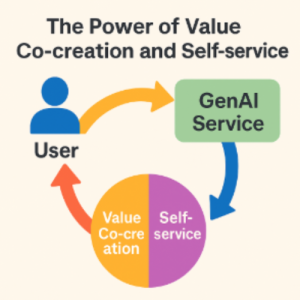
Value co-creation emphasizes that customers, users, and AI systems jointly create value through interaction. A GenAI system does not produce fixed outcomes. It produces context-sensitive, dynamically generated responses shaped by user prompts, feedback, and surrounding workflows.
Users influence system behavior through prompt design, iterative corrections, contextual constraints, policy feedback, and evolving needs. Thus, GenAI solutions must be designed as collaborative environments rather than one-directional tools.
Why Treating GenAI Output as a Product Leads to Failure
Despite the inherently dynamic behavior of generative systems, many organizations continue to treat GenAI output as a product – a fixed entity that can be evaluated, packaged, and delivered in isolation. This framing produces several harmful consequences.
A product framing implies stability rather than drift, determinism rather than probabilistic variability, completeness rather than continuous improvement, and isolated outputs rather than system-wide effects. These assumptions collapse in complex environments such as global airline call centers, where interactions span languages, emotional states, regulations, and unpredictable travel disruptions.
A service framing, by contrast, acknowledges that GenAI learns from interactions, adapts to cultural and linguistic variation, supports real-time tuning in response to demand surges, enhances system-wide performance, and performs ongoing cognitive work such as triage, routing, translation, and sentiment detection.
| Service Framing | Product Framing |
| Learns from interactions and adapts in real time | Fixed and unable to continuously improve |
| Delivers ongoing cognitive work (triage, translation, routing, sentiment) | Reduces cognitive work to a static output |
| Uses probabilistic reasoning that matches real-world complexity | Implies deterministic correctness of each output |
| Supports dynamic tuning and operational resilience | Lacks real-time adaptability during disruptions |
| Adapts to languages, tone, and cultural context | Unchanged across languages and cultural expectations |
| Improves system-wide operations such as queue flow, staffing, and customer experience | Limits operational enhancement to isolated outputs |
Why GenAI Output Qualifies as a True Service
Service science defines a service as an intangible, co-created, context-dependent, delivered on demand, perishable and time-sensitive experience. GenAI meets each criterion. The value lies in the transformation from prompt to output, not in the output itself. User intent, domain context, and model reasoning jointly produce the result. The system behaves differently depending on the task, history, data, and environment. Each response is generated at the moment of need. Even unused, the service consumes computational resources; the output cannot be inventoried like a product.
Using the Value Proposition Canvas for GenAI
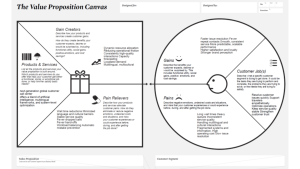
The Value Proposition Canvas (VPC) provides a structured method to ensure GenAI solutions remain customer-centric, outcome-aligned, and scientifically grounded. By mapping customer jobs, pains, and gains, the VPC helps teams clarify how generative capabilities create tangible value. When applied to GenAI, the VPC enables organizations to identify challenges, articulate sources of value, differentiate solutions, align cross-functional teams, and iteratively refine systems as user needs evolve. In below, we depict a very simple value proposition canvas to represent GenAI service for a global call center for an airline.
Bottom Line: The Scientific and Strategic Imperative of Service Thinking
Generative AI is not a product to be installed; it is a service system to be nurtured. Service science provides a rigorous foundation for understanding how generative systems operate, learn, and create value through human–AI interaction. Organizations that continue using product-centric mindsets will struggle with drift, adoption failure, regulatory misalignment, and brittle deployments.
By embracing service thinking and value co-creation, enterprises can unlock GenAI’s true potential – similar to how earlier self-service innovations transformed customer experience through shared control, shared intelligence, and shared value. Generative AI’s potential will be realized not through productization but through the intentional design of adaptive, collaborative, continuously improving service systems.
- Focus on the customer: Instead of starting with the technology, begin with the customer’s perspective. Define their “jobs to be done,” the “pains” they experience, and the “gains” they are looking for.
- Map the AI solution: Then, match the AI project’s “products and services” to the customer’s needs. For a Gen AI project, this means thinking specifically about:
- What it generates: The specific outputs the AI will produce.
- How it works: The underlying model and data strategy.
- How it helps: How the AI’s output solves a pain point or creates a gain for the customer.
- Identify unique value: Use the canvas to clearly articulate the unique selling points and competitive advantages of your Gen AI solution, which can be difficult to define without this structured approach.
- Refine the value proposition: The canvas helps you condense the project’s value into a concise statement. For example, “What unique value are we creating with this solution?”.
- Collaborate and align: The canvas is a collaborative tool that forces a conversation between business leaders, technical teams, and end-users to ensure alignment on the project’s goals and how it will deliver value.
- Support iterative improvement: After initial application, the canvas is a living document. It can be combined with testing and Lean Startup principles to iteratively improve the product based on real-world feedback and results.