As generative AI (GenAI) moves from novelty to infrastructure across higher education, universities are rethinking how to deliver teaching that is both scalable and human-centred. The clearest shift is the rise of course-aware assistants, chatbots that can securely reference lecture slides, transcripts, readings and assessment briefs to help students make sense of concepts in context.
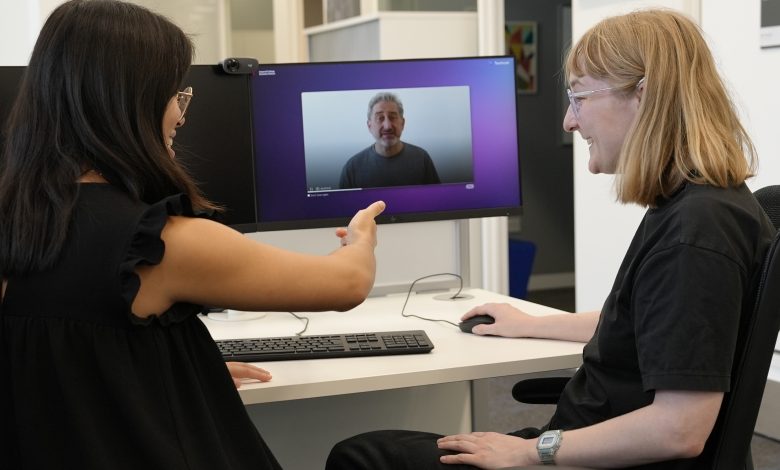
A second, rapidly growing strand takes this further: audio or visual avatars, sometimes in the form of “digital twins”, AI-generated clones of an academic’s likeness and voice which can interact with students in real time, sustaining a stronger sense of presence online. Across both strands, the most promising work is not about giving faster answers; it’s about designing better learning conversations.
Designing for dialogue
Many first-generation academic chatbots were built to answer frequentlyasked questions. While this may be useful, it is also pedagogically thin. Universities are increasingly utilising AI assistants to guide students back to key ideas, surface alternative viewpoints, and ask clarifying questions rather than closing them down.
In practice, this means retrieval-augmented assistants that cite relevant resources from the course content, but are tuned to guide learners towards understanding instead of simply giving answers. In short, scaffolding rather than solving. They nudge students to work through problems, apply concepts to their own context, or explain their reasoning before offering direct answers. The aim is not to bypass learning, but to deepen it.
In 1984, educational psychologist Benjamin Bloom reported that students tutored one-to-one performed two standard deviations better than peers taught only in a group environment. AI tools with access to course content and pedagogical awareness might one day help us solve the problem of scaling personalised one-to-one tutoring to make it available on demand for all students.
Enhancing teaching through avatars
One persistent challenge in online and blended programmes is a reduced sense of connection, what distance education theory calls “transactional distance.” Avatars address this by bringing voice, tone and, where appropriate, likeness into the interaction. Students often engage more naturally with a face and a voice than with a text box, and many treat a digital twin as an extension of a lecturer’s presence in the classroom rather than an impersonal bot.
Used well, avatars can provide reassurance to students during busy periods, such as before submissions, provide a model of the language of a particular discipline which students can emulate, and help maintain continuity and support with their studies when time zones and schedules make it difficult for lecturers to be available. Used carefully, these avatars can humanise large-scale provision. Crucially, they should be transparent about what they are and are not, built with explicit consent, and governed to prevent misuse of likeness.
Supporting flexible on-demand learning
For students who are balancing careers, family and study, support that is available “whenever I have 20 minutes” can be the difference between momentum and drift. Course-aware assistants and avatars provide immediate support to students’ queries, clarifying outcomes, unpacking theories, and pointing to the most relevant resources, without waiting for the next tutorial. When integrated into the learning environment, they can reduce bottlenecks, make support more equitable across time zones, and free live contact hours for higher-order discussion.
Extending case-based pedagogy
Case-based teaching is a hallmark of management education. GenAI lets cases come alive. Students can now interrogate fictional, but faithful, AI stakeholders: a sceptical CFO, a union representative, a regulator, a marketing lead, even a simulated customer cohort. By adjusting the stakeholder’s brief and constraints, the same case can be explored from multiple angles, helping learners test assumptions, rehearse influence, and experience the consequences of incomplete information.
Well-designed “living cases” blend structured prompts with room for exploration, capture the conversation for debrief, and encourage students to compare how different choices play out. Instead of a single “right” answer, students practice navigating ambiguity.
Practising decision-making and collaboration
Beyond analysis, universities want students to develop the AI skills they need for their next career move. Generative AI helps this process by creating simulations for real-world scenarios. Chatbots can sustain rich, responsive roleplays and games: negotiating a contract, presenting evidence to a mock jury, consulting with a patient, debating a public policy, or coordinating within a multidisciplinary team.
Students can attempt multiple rounds, experiment with strategies, and receive formative feedback on communication, reasoning, ethics, and collaboration before bringing that experience back to class for debrief and reflection.
Where do we go from here?
Any introduction of AI must begin with pedagogy, not technology. Tools like avatars should be designed to enhance, never to weaken or replace, the thoughtful dialogue and interaction between student and teacher that underpins effective learning.
Professional development will be crucial. To ensure academics feel confident using these tools in the classroom, we must offer opportunities to improve both technical skills and pedagogical understanding. This is about more than just learning to operate a new platform; it’s about rethinking how we design and deliver teaching in an AI-enhanced environment.
GenAI will not replace the human elements of education; it will challenge us to rearticulate and amplify them. The opportunity is to extend faculty presence, widen access to formative feedback, and create rich practice spaces where students can safely rehearse vital professional and life skills.
If we start from pedagogy, design for dialogue, and build with responsibility and inclusion in mind, GenAI can help universities deliver learning that is more responsive, more personal, and more deeply connected to the realities of professional work when students need it most.