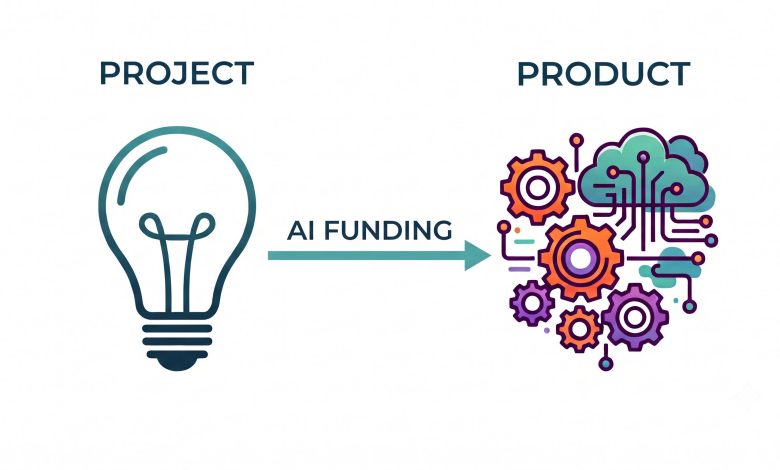
Artificial intelligence has become one of the largest areas of technology investment across modern enterprises. Organizations are investing heavily in compute infrastructure, foundation models, AI platforms, specialized tooling, and new product capabilities. Yet despite this rapid increase in spending, many executives still struggle to answer a surprisingly basic question:
Which AI investments are actually creating business value?
The problem is rarely a lack of financial data. Enterprises have extensive reporting systems, detailed budgets, and sophisticated planning processes. The challenge is that AI investments are often measured using accounting structures designed for traditional technology projects rather than continuously evolving AI products.
As a result, finance leaders, CIOs, and Chief AI Officers frequently have visibility into how much they are spending on AI, but not whether that spending is generating measurable business outcomes.
This is not a technology problem. It is a financial architecture problem.
As organizations move from isolated AI pilots to enterprise-wide adoption, they need a different way of funding, measuring, and managing AI investments. Treating AI as an ongoing product rather than a one-time project provides a far clearer picture of where investment is creating value and where it is simply consuming resources.
The Limits of Project-Based Funding
Traditional enterprise budgeting was built around projects.
A project has a defined beginning, a planned delivery date, and a predetermined budget. Once the project concludes, funding typically ends, and attention shifts to the next initiative.
AI rarely behaves this way.
A machine learning model requires continuous monitoring, retraining, governance, infrastructure optimization, and performance evaluation. Generative AI applications evolve through ongoing prompt refinement, model upgrades, changing business requirements, and user feedback. Even successful AI deployments require constant iteration to remain effective.
Treating these systems as temporary projects creates an immediate disconnect between financial reporting and operational reality.
Instead of understanding AI as a continuously improving business capability, organizations often divide spending across multiple projects, departments, and cost centers that never provide a complete picture of the investment.
The result is fragmented visibility precisely when leadership needs strategic clarity.
Why Visibility Matters More Than Ever
Enterprise AI experimentation is accelerating.
Different business units may independently build similar copilots, deploy overlapping analytics tools, or purchase separate AI platforms to solve comparable problems.
Without comprehensive financial visibility, identifying these redundancies becomes extremely difficult.
Leaders may unknowingly fund multiple initiatives pursuing nearly identical outcomes while high-value AI products compete for limited investment.
At the same time, underperforming pilots can continue receiving funding simply because their costs are dispersed across various departments rather than evaluated as complete products.
The issue is not insufficient innovation.
It is insufficient transparency.
Organizations cannot optimize what they cannot clearly see.
Technology Business Management Offers a Different Perspective
Technology Business Management (TBM) addresses this challenge by changing how technology investments are viewed.
Instead of asking which department incurred a particular expense, TBM asks a more strategic question:
Which business capability does this investment support?
This seemingly simple shift transforms financial decision-making.
Infrastructure costs, cloud services, software platforms, engineering effort, data management, and operational support can all be associated with the business services they enable rather than isolated departmental budgets.
The conversation changes from cost ownership to business value.
For AI initiatives, this distinction becomes especially important because successful AI products often span multiple organizational functions.
Engineering builds the solution.
Operations uses it.
Finance funds it.
Business leaders measure outcomes.
A product-based financial model creates a common language across all of these stakeholders.
AI Products Need Total Cost Visibility
One of the biggest misconceptions surrounding AI investment is that model development represents the majority of costs.
In reality, organizations invest across an entire ecosystem.
Data pipelines require ongoing maintenance.
Infrastructure scales with usage.
Governance frameworks introduce operational requirements.
Monitoring, security, compliance, and continuous improvement all contribute to long-term operational costs.
Looking at only one component provides an incomplete picture.
A Total Cost of Ownership perspective allows organizations to understand the complete financial footprint of an AI capability throughout its lifecycle.
More importantly, it enables meaningful comparisons between different AI initiatives.
Instead of asking which model costs less to build, leaders can evaluate which AI product delivers greater long-term business value relative to its complete operational investment.
That perspective supports better strategic decisions than development costs alone ever could.
Connecting AI Spend to Business Outcomes
Perhaps the greatest advantage of product-based funding is its ability to connect technology investment directly to business outcomes.
When AI spending is fragmented across multiple cost centers, measuring return on investment becomes difficult.
Success may be discussed in terms of completed milestones or implementation timelines rather than measurable organizational impact.
A product-based model changes the conversation.
Instead of asking whether a project finished on schedule, leadership can evaluate whether an AI capability improved operational efficiency, accelerated customer service, enhanced decision-making, reduced manual effort, or increased organizational agility.
This creates accountability around outcomes rather than activity.
For executive leadership, that distinction is invaluable.
Funding decisions become driven by demonstrated value instead of organizational momentum.
Finance and Technology Need a Shared Framework
One of the recurring challenges in enterprise AI is that finance and technology teams often evaluate investments differently.
Technology leaders prioritize capability, scalability, and innovation.
Finance leaders focus on accountability, sustainability, and measurable returns.
Neither perspective is incorrect.
However, organizations need a framework that allows both groups to evaluate investments using shared information.
Technology Business Management provides that bridge.
With standardized cost models and transparent allocation methodologies, finance gains confidence in the numbers while technology leaders gain greater flexibility to manage evolving products.
Rather than competing priorities, innovation and fiscal discipline become complementary objectives.
This alignment becomes increasingly important as AI investment expands across every business function.
Supporting Experimentation Without Losing Control
Some executives worry that introducing additional financial governance could slow innovation.
In practice, the opposite is often true.
Clear visibility allows organizations to experiment more confidently because leaders understand exactly where resources are being allocated and which initiatives are producing meaningful outcomes.
Successful AI products can receive additional investment quickly.
Underperforming initiatives can be retired before accumulating unnecessary costs.
Overlapping capabilities become easier to identify.
Resources can be redirected toward higher-value opportunities without disrupting ongoing innovation.
Financial transparency does not reduce experimentation.
It improves the quality of experimentation.
AI Investment Is Becoming a Portfolio Decision
As AI adoption matures, organizations will manage dozens—or even hundreds—of AI capabilities simultaneously.
These systems will evolve continuously rather than through isolated implementation projects.
That shift requires a portfolio mindset.
Every AI capability competes for infrastructure, engineering capacity, operational support, and executive attention.
Leaders therefore need more than budget reports.
They need a comprehensive understanding of which AI products contribute the greatest strategic value and how investment decisions influence the broader technology portfolio.
Product-based funding provides that visibility.
Instead of evaluating isolated expenditures, executives can optimize an entire ecosystem of AI investments.
Looking Ahead
The next phase of enterprise AI will not be constrained by access to models alone.
Organizations already have access to increasingly powerful AI technologies.
The greater challenge is determining where continued investment creates sustainable business value.
Enterprises that continue measuring AI through traditional project accounting may find themselves funding disconnected initiatives without understanding which ones deserve to scale.
Those that adopt a product-centric financial model will be better positioned to evaluate performance, eliminate redundancy, and direct resources toward AI capabilities that consistently deliver measurable outcomes.
Ultimately, successful AI adoption depends on more than technical excellence.
It requires financial visibility that evolves alongside the technology itself.
By treating AI as an enduring product rather than a temporary project, organizations create a foundation for smarter investment decisions, stronger collaboration between finance and technology leaders, and a more sustainable path toward enterprise-wide AI transformation.