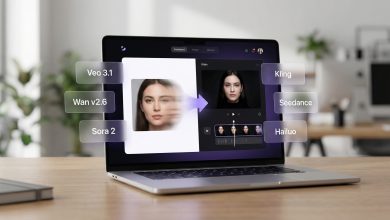
Cinema Wakes Up in a New World
Rotterdam at dawn looks like a film set waiting for direction. The cranes resemble giant camera rigs; the Maas glides like a tracking shot. Yet the real film set today doesn’t sit along the river — it sits behind the screen. Artificial intelligence has begun rewriting the grammar of cinema from the inside out, quietly bending workflows, reshaping production logic, and reframing what it means to build a world.
According to the MIT Media Lab (https://www.media.mit.edu/), filmmaking ranks among the creative industries most disrupted by generative AI because of its hybrid structure of image, sound, and narrative. What once required physical infrastructure now unfolds across distributed computation.
Cinema hasn’t disappeared. It has multiplied.
The Film Set Used to Be a Fortress
For over a century, the film set was a place of ritual: cables underfoot, generators humming, crews in motion. It was also a fortress. Entry depended on access, budgets, and institutional approval. The British Film Institute (https://www.bfi.org.uk/) notes that production costs have steadily risen, increasing economic barriers for emerging creators.
AI doesn’t dismantle the fortress.
It expands the map around it.
Generative tools allow filmmakers to test ideas long before capital is involved. They shift creativity from scarcity to possibility, letting images be born in experimentation rather than in fear of wasting resources.
When the Ground Started to Move
AI began with small tasks — denoising, upscaling, automated masking. Then generative models appeared capable of interpreting prompts, simulating camera movement, and building environments.
The Stanford Human-Centered AI Institute (https://hai.stanford.edu/) describes this leap as “intent-driven cinematography,” where a filmmaker expresses a conceptual direction and the model interprets it visually.
Once intention becomes executable, the walls of the film set begin to dissolve.
The result is something subtle yet profound:
you can create worlds faster than you can describe them.
The Camera That Walks Through Walls
A single impossible shot revealed how far things had shifted: a camera gliding through a window, across reflective surfaces, bending perspective like a ribbon of light.
Traditionally, this required stunts, rigs, or heavy post-production.
In synthetic cinematography, it requires a line of text.
Research from Carnegie Mellon University (https://www.cmu.edu/) on neural scene synthesis shows how generative models create “non-Newtonian spatial transitions,” allowing perspectives and physics that break real-world constraints.
Impossibility becomes an artistic tool, shifting the filmmaker’s question from how do we do this? to why should this exist in the story?
The Quiet Collapse of Permission Culture
For decades, filmmaking depended on permission, access to equipment, locations, funding, schedules. AI weakens this dependency, it gives hope and self-sufficiency.
The USC Entertainment Technology Center (https://www.etcenter.org/) reports that AI-assisted previsualization can shorten early development timelines by nearly 60%, lowering the cost of experimentation.
When the cost of failure drops, risk-taking increases.
Cinema becomes playful again.
This doesn’t replace physical sets; it simply restores creative freedom long before the first location scout or rental invoice.
The Distributed Film Set
The modern film set is no longer defined by a single location. It now exists as a constellation of systems: cloud rendering, generative models, motion simulation, neural lighting design, AI-assisted editing, and adaptive audio engines.
A 2024 report by McKinsey & Company (https://www.mckinsey.com/) calls this shift “modular, multi-agent creativity,” where humans guide systems rather than micromanage them.
A typical workflow might include:
- AI-generated environments for scene ideation
- simulation tools for camera choreography
- neural renderers for synthetic lighting
- AI-assisted score generation
- cloud systems for rapid iteration
The set becomes a network of creative decisions rather than a physical space.
This makes filmmaking more inclusive, faster, and more iterative.
Ethics Moves to the Front Row
As synthetic cinema grows, so do ethical questions.
According to the Partnership on AI (https://www.partnershiponai.org/), urgent issues include dataset transparency, representational bias, and the responsible use of human likeness.
Ethics becomes a creative material not an afterthought.
Every filmmaker working with AI must confront questions such as:
- What biases shape the model’s understanding of faces and bodies?
- Which cultural narratives get amplified or erased?
- How do we ensure consent in synthetic likenesses?
The answers shape the images we make and the futures we imagine.
Systems That Understand Story
The next frontier is not sharper resolution but deeper understanding.
Early studies from Google Research (https://research.google/) and Stanford NLP (https://nlp.stanford.edu/) explore systems that infer emotional arcs, identify narrative patterns, and anticipate thematic movement.
These tools do not automate storytelling; they extend it.
They let filmmakers think in emotional logic rather than technical constraints.
Imagine systems that:
- test visual metaphors
- propose alternative pacing
- suggest symbolic compositions
- interpret tone as visual direction
This is not about replacing the filmmaker.
It is about expanding their field of vision.
The Render Farm Is a River
The render farm used to be a factory: linear, mechanical, and slow.
Now it functions like a river:
- fluid
- iterative
- unpredictable
- capable of carrying ideas into uncharted territory
Worlds can be built, discarded, rebuilt, and reinvented without material cost.
This changes not just how we film, but how we think.
Cinema becomes less about overcoming constraints and more about exploring intention.
AI does not end filmmaking.
It rewrites the borders of the possible.
Conclusion: The Architecture of Cinema Is Expanding
We are living in the early days of a shift that is aesthetic, ethical, and philosophical. AI has not destroyed the film set. It has multiplied it. It has unshackled experimentation, democratized previsualization, expanded world-building, and encouraged a new mindset grounded in curiosity rather than constraint.
Cinema is not shrinking.
Cinema is stretching.
The render farm is not a threat.
It is an invitation
a new kind of creative geography where filmmakers can imagine first and negotiate reality later.