The Inflection Point: When a Promise Becomes a Problem
A customer configures their dream vehicle online — the color, the package, the interior — and receives a delivery date. That date becomes a promise. Somewhere in a complex web of manufacturing plants, rail networks, distribution centres, and dealer systems, thousands of decisions must align perfectly to honor it.
For decades, the automotive industry has managed this complexity through human expertise, siloed systems, and reactive problem-solving. When a rail network becomes congested, a production line goes down, or a configuration conflict emerges, the response has been entirely manual. Dozens of calls, screen-switching across multiple applications, and hours of investigation precede any resolution.
Global OEMs manage supply chains for millions of vehicles annually, across thousands of dealers and dozens of manufacturing facilities. Real-time demand signals shift by the hour, and the industry needs a fundamentally different approach to keep pace. The lessons from early production deployments are clear: the outcomes are measurable, and the architecture is ready to scale.
The Real Problem Is Not Data — It Is Intelligence
Modern automotive supply chains generate enormous amounts of data: ETA predictions, inventory positions, sold order pipelines, production schedules, logistics events, and configuration validation rules. The problem is not data availability — it is that this data lives across dozens of disconnected systems. Human operators must manually correlate, query, and reason across all of them simultaneously.
Consider a Dealer Sales Manager (DSM) responsible for vehicle inventory and customer orders. On any given day, they might need to check ETA status, validate a configuration, investigate a delivery delay, find an alternative vehicle, and communicate updates to the dealer — all while managing dozens of other accounts. Each of these tasks requires navigating a different system with a different interface.
The operational cost of this fragmentation is significant and measurable. Escalations pile up, customer satisfaction scores suffer, and delivery commitments slip. The solution is not more dashboards or additional reporting layers. It is intelligence — the ability to reason across systems, act proactively, and surface the right answer in natural language, on demand.
What Agentic AI Actually Means for Supply Chain Operations
Agentic AI is a meaningful step beyond conventional AI assistants or chatbots. Where a chatbot retrieves information from a single source, an agentic AI system reasons across multiple data sources, orchestrates actions across systems, and pursues a goal through multiple steps — adapting its approach based on intermediate results.
In an automotive supply chain context, this means a system that receives a natural language query from a DSM, determines which data sources to interrogate, executes those queries in parallel, and presents a recommended action — all within seconds. The user does not need to know which system holds which data.
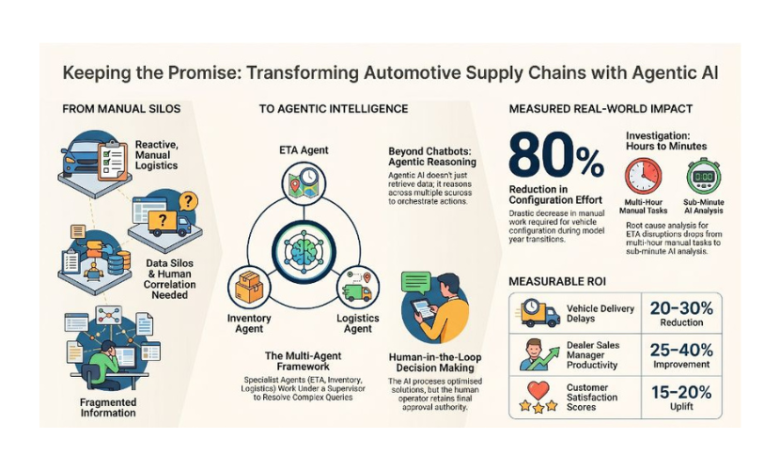
The architecture enabling this is a multi-agent framework. A supervisory orchestration agent understands intent and routes tasks to domain-specific functional agents specializing in ETA intelligence, order management, inventory search, configuration validation, and logistics. These agents communicate with each other and share context through a central knowledge layer.
Critically, this is not a replacement for human decision-making. The agent proposes; the human approves. What changes is the speed, completeness, and quality of the information on which that human decision is made.
“A VIP customer’s vehicle faces a 14-day delay due to rail congestion. The DSM asks whether they can expedite. The system models the best option: 7 days saved — still outside the promised window. Without being prompted, the orchestration agent pivots and searches for an exact configuration match in transit. One is found, projected to arrive three days before the original promised date. The DSM approves the reassignment. The customer never knows there was a problem. Intelligence did not replace the DSM — it gave them a decision they could not have reached alone in time.”
Four High-Value Use Cases for Automotive OEMs
- Conversational Operations Intelligence. The most immediate application is a conversational AI layer for DSMs and distribution operations teams. Domain-specific agents handle inventory search, ETA calculation, order management, and pipeline tracking simultaneously, surfacing unified insights through a single natural language interface. Proactive alerting identifies at-risk deliveries before they become escalations. The operational impact includes measurable reductions in delivery delays and meaningful uplift in customer satisfaction scores.
- AI-Driven Demand and Production Planning. Vehicle production planning is one of the most analytically intensive processes in the automotive enterprise, with planners managing dozens of vehicle series across complex allocation matrices and regional demand signals. An agentic planning assistant ingests demand signals and inventory positions in real time, generates optimized scenario recommendations, and surfaces trade-offs in natural language. Planners shift from building scenarios manually to reviewing AI-generated options, moving from hours to minutes on tasks that previously consumed entire planning cycles.
- Intelligent Vehicle Configuration Management. Vehicle configuration is the foundation of the automotive supply chain and one of its most persistent sources of error and manual effort. Agentic AI transforms this in two ways: automating configuration data ingestion and validation through a conversational interface, and surfacing configuration intelligence to business users who previously had no way to query this data without direct database access. The result is up to an 80% reduction in manual configuration setup effort and the elimination of a category of downstream errors that stem from inconsistent data propagating across planning, ordering, and manufacturing systems.
- Real-Time ETA and Disruption Intelligence. Disruption management — understanding why a vehicle’s ETA has changed and what actions to take — currently requires logistics teams to correlate data across multiple systems. An agentic ETA intelligence platform collapses this into a single conversational interface where operations teams ask natural language questions and receive root cause analysis and recommended actions in seconds rather than hours. Both real-time and predictive ETA intelligence are available through the same interface, enabling proactive rather than reactive disruption management.
Measured Outcomes from Enterprise deployments
Measured outcomes from enterprise deployments are rarer and more valuable. The following results are based on real-world deployment of agentic AI across a major North American automotive OEM’s supply chain operations:
20–30% reduction in vehicle delivery delays through proactive AI-driven issue identification and order reassignment
25–40% improvement in DSM productivity — time reclaimed from manual system navigation and information retrieval
80% reduction in manual effort for vehicle configuration setup during model year transitions
15–20% uplift in customer satisfaction scores driven by faster, more accurate dealer and customer communication
Hrs. → Min’s reduction in ETA disruption root cause investigation time, from multi-hour manual correlation to sub-minute AI-assisted analysis
Why Architecture Matters?
The automotive industry has no shortage of AI pilots — point solutions that demonstrate impressive results in controlled environments, then fail to scale because they were never designed to integrate with the broader enterprise ecosystem. Three architectural principles define the difference between agentic AI deployments that scale and those that stall.
Modularity over monoliths. Domain-specific agents that specialize in a single capability — ETA intelligence, order management, configuration validation — are far more maintainable, governable, and extensible than monolithic systems. New use cases are added by creating new agents rather than rebuilding existing ones.
Governance by design, not retrofit. In regulated, mission-critical environments, responsible AI is not optional. AI governance board approvals, data boundary controls, human-in-the-loop validation gates, and full audit trails must be designed in from the start. Organization’s that treat governance as an afterthought face delays, rejections, and reputational risk.
Open, cloud-native architecture. Agentic AI platforms built on open standards — Agent-to-Agent protocols, Model Context Protocol tool integration, and cloud-native infrastructure — are far more interoperable and future-proof than proprietary, vendor-locked systems. The ability to swap or upgrade foundation model capabilities without rebuilding the application layer is a significant competitive advantage.
Why This Moment Is Different
The difference between previous AI waves and the current agentic AI moment is the convergence of three factors that have not previously aligned. Foundation models are now capable of genuine multi-step reasoning. Cloud infrastructure is mature enough to support production-grade agentic systems at enterprise scale. And supply chain ecosystems are sufficiently digitized that the data required to make these systems valuable exists and is accessible.
The organization’s that build agentic AI platforms now — moving from pilots to production, from single use cases to enterprise-wide intelligence platforms — will accumulate the operational data, institutional knowledge, and engineering capability that makes their advantage durable. Those that wait will find that the leaders have already built the high ground.
The supply chain of the future is not one where AI replaces human expertise. It is one where that expertise is augmented — where a DSM has the intelligence of every system in the enterprise available through a single conversation, where a planner can simulate a month’s worth of scenarios in an afternoon, and where a disruption that would previously have become a broken promise is resolved before the customer ever suspects a problem.
The promise of intelligent supply chain is not a date on a calendar. It is a commitment — and agentic AI is how the industry will keep it.