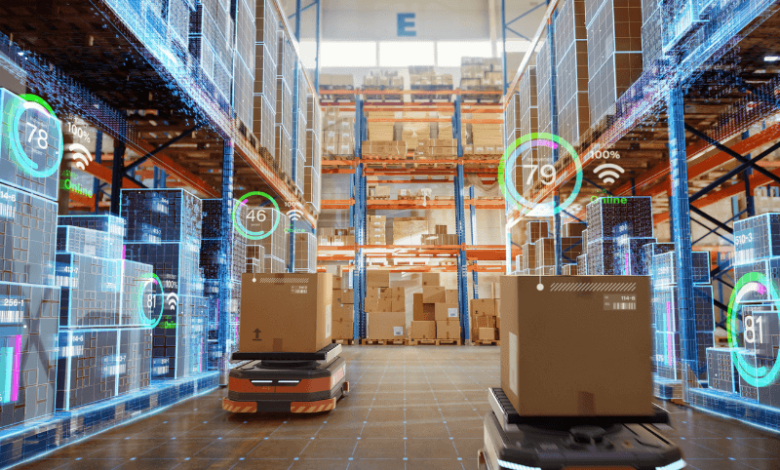
Every major retailer and logistics company now claims to be running AI in their warehouses. The reality is less impressive. Most of these deployments amount to a handful of dashboards, a demand forecasting model that nobody fully trusts, and a lot of manual workarounds when things break. The gap between what executives announce on earnings calls and what actually happens on the warehouse floor is widening. That gap is not a technology problem. It is a maturity problem.
Fulfillment operations sit at the intersection of physical constraints and digital ambition. Orders arrive unpredictably. Inventory moves through pick paths designed decades ago. Labour availability shifts by the hour. Layering AI onto this complexity without a structured progression is how companies end up with expensive pilots that never scale. What the industry needs is not another AI product. It needs a shared language for understanding where an operation sits on the path from manual to autonomous, and what it takes to advance.
The Four Stages of AI Maturity in Fulfillment
Drawing on patterns observed across large-scale supply chain operations, the progression from reactive to autonomous fulfillment follows four distinct stages. Each stage is defined not by which algorithms you deploy, but by how your people, data infrastructure, and decision-making processes change.
Stage 1: Reactive. This is where most operations begin, and where many remain stuck. Decisions are made in response to problems that have already occurred. A shipment is late, a bin is empty, a worker calls in sick. The response is human-driven, relying on tribal knowledge and spreadsheets. Data exists, but it lives in disconnected systems: an order management platform here, a warehouse management system there, an ERP somewhere else. The defining characteristic is that the operation cannot anticipate; it can only respond.
Stage 2: Descriptive. At this level, the organisation has built data pipelines that consolidate information from disparate sources into a unified view. Dashboards show what happened and, increasingly, what is happening. Demand signals, inventory positions, and throughput rates become visible in near real time. The value here is enormous but easily underestimated. Most companies that claim to be doing AI are actually doing Stage 2 well. That is not a criticism. Getting clean, timely, integrated data flowing through an operation is the hardest and most important step in the entire journey. Without it, every subsequent stage collapses.
Stage 3: Predictive. Here, the operation begins to use historical data and machine learning to anticipate outcomes before they materialise. Demand forecasting becomes genuinely useful. Predictive maintenance models flag conveyor belt failures hours before they happen. Labour allocation systems project staffing needs based on inbound order patterns. The critical shift at Stage 3 is not technical but organisational. Predictions are only valuable if someone acts on them, and that means operations managers must trust the models enough to change their behaviour. This is where most AI-in-warehousing projects stall: the model works, but the process around it does not adapt.
Stage 4: Autonomous. At the most advanced level, AI systems do not merely inform decisions; they make them. Pick path optimisation adjusts dynamically based on real-time order composition. Robotic systems coordinate with human workers through AI-driven task allocation. Replenishment orders trigger automatically when predictive inventory models cross confidence thresholds. The human role shifts from decision-maker to exception handler and system tuner. No large-scale fulfillment operation is fully autonomous today. But pockets of Stage 4 are emerging, particularly in goods-to-person robotic cells and automated sortation, and they point clearly to where the industry is heading.
Why Most Companies Get Stuck Between Stages 2 and 3
The transition from descriptive analytics to genuine prediction is where the majority of fulfillment operations stall, and the reasons are rarely about model accuracy. Three structural barriers consistently appear.
First, the data integration challenge is deeper than it appears. Building dashboards requires aggregating data. Building predictive models requires that data to be consistent, timely, and contextually rich. A demand signal that arrives with a two-hour lag might be fine for a morning planning meeting. It is useless for a model trying to dynamically adjust pick wave composition. The infrastructure investment required to move from batch to streaming data, from periodic snapshots to event-driven architectures, is substantial and often invisible to senior leadership.
Second, the talent model is wrong. Many organisations try to advance their AI maturity by hiring data scientists and giving them access to warehouse data. What they actually need is a combination of data engineers who can build reliable pipelines, ML engineers who can operationalise models (not just train them), and operations leaders who understand the physical constraints well enough to validate what the models recommend. Without this triad, companies end up with impressive notebooks that never see production.
Third, trust is a system design problem, not a training problem. Telling operations managers to trust an AI model is futile. What works is building systems that surface their reasoning, that allow humans to override and provide feedback, and that demonstrably improve outcomes in controlled settings before expanding scope. The companies making progress here invest heavily in human-in-the-loop interfaces and decision audit trails. They treat trust as something the system earns, not something the organisation mandates.
Practical Steps for Moving Forward
For operations leaders trying to advance their fulfillment AI maturity, the path forward is less about selecting the right model and more about building the right conditions.
Start by honestly assessing where you are. Most organisations overestimate their maturity by at least one stage. If your operations team still routinely works around the data rather than with it, you are at Stage 1 regardless of what your IT roadmap says. Invest disproportionately in data infrastructure. For every pound spent on AI models, three should go to data quality, pipeline reliability, and integration architecture. This is not exciting, but it is what separates companies that scale AI from those that accumulate pilot projects.
Design for human-AI collaboration, not replacement. The most effective Stage 3 and Stage 4 systems augment experienced operators rather than bypassing them. This means building interfaces that present AI recommendations alongside the context that generated them, and making override mechanisms simple and feedback-rich.
Finally, measure what matters at each stage. At Stage 2, the metric is data freshness and coverage. At Stage 3, it is prediction accuracy weighted by operational impact. At Stage 4, it is the percentage of decisions made autonomously without negative downstream consequences. Using Stage 4 metrics to evaluate a Stage 2 operation breeds frustration and misallocated investment.
Looking Ahead
The fulfillment operations that will define the next decade of retail and logistics are not the ones with the most AI models deployed. They are the ones that methodically build the infrastructure, the talent, and the organisational trust required at each stage of maturity before advancing to the next. The maturity model is not a race. Attempting to leap from Stage 1 to Stage 4, as many well-funded companies have tried, almost always results in expensive systems that operators circumvent and executives quietly write off.
The real competitive advantage belongs to the organisations that recognise AI maturity for what it is: a progression that demands as much investment in people and processes as it does in technology. The warehouse of the future will not be built by the best algorithm. It will be built by the operation that got every stage right.