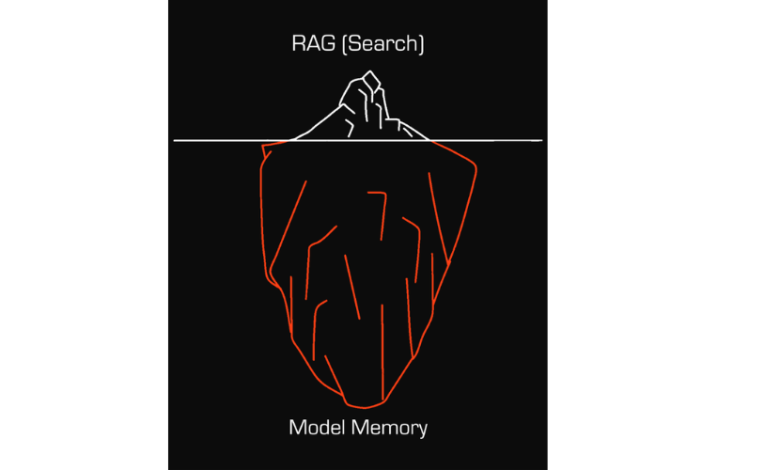
Search built the modern internet economy.
For twenty years, digital visibility meant one thing: ranking. If you appeared at the top of the results page, you won. If you didn’t, you optimised until you did. In truth, it was a simpler time.
Boards measured it. Marketing teams engineered it. Entire companies were built around improving it.
However, that system is now being rewritten.
Generative AI is not simply a faster, more conversational search engine. It is a different class of system altogether. It does not primarily return lists. It returns answers. And those answers are often generated from internal memory – not assembled from a ranked stack of links.
That distinction sounds technical. It isn’t.
It marks the beginning of a structural shift in how businesses are discovered, compared and chosen.
Because when AI stops searching and starts remembering, visibility stops being about position – and starts being about representation.
The collapse of the search metaphor.
It is tempting to think of AI assistants as search engines with better interfaces. They accept queries and they return information. They even cite sources, sometimes. But the internal logic is different.
Search engines retrieve documents at query time. Visibility is explicit. If you are not in the top results, you know why. You can measure impressions, track rankings and improve performance.
Large language models do not operate that way by default. Their first ‘instinct’ is not to search. It is to generate.
When prompted, they draw on patterns, associations and representations learned during training. The response is assembled from what the model already “understands” about how concepts relate.
In other words, the answer often comes from recall, not lookup.
That difference changes everything.
From ranking to representation
In a search driven world, visibility was positional. You ranked first, fifth or fiftieth. Performance dashboards made absence visible. There was page two to scroll to.
In an AI-driven world, visibility is representational. A model either considers your company a natural example when answering a category-level question – or it doesn’t. Simple.
There is no ranking page or scrolling. There is no obvious list of alternatives. If your brand is absent from the generated response, the user sees nothing missing. Yet the answer feels complete.
This creates a new kind of invisibility: silent exclusion.
Why absence does not make the heart grow fonder
When search visibility drops, metrics move. Traffic declines. Positions shift.
Recent data shows just how dramatic that shift already is; AI Overviews now reduce click-through rates for top-ranking results by 58%. In queries where AI summaries appear, 83% end without a single click to any website.
The surface signal is clear: fewer clicks.
When AI visibility changes, the signals are more subtle. A model update alters internal weightings. Associations shift. Some entities become more strongly linked to certain concepts; others fade into the background.
From the outside, nothing appears broken as there is no obvious penalty notification and no obvious indexing issue.
But when customers begin asking AI systems for recommendations, comparisons or explanations, the outputs may no longer include you.
And because generative answers are fluent and confident, omission can be mistaken for irrelevance.
For leadership teams, this is not a technical nuance. It is a strategic risk.
AI does retrieve – but not like you think
None of this means retrieval disappears. AI systems can access live data, browse the web or integrate external tools. And in many cases, they do.
But retrieval is increasingly layered on top of a memory-first architecture.
A recent large-scale study from researchers at the University of Toronto found that generative AI systems consult markedly different domain ecosystems than Google Search, with domain overlap as low as 4% in some models. In other words, AI engines are not simply re-ranking Google’s web.
Whether external sources are consulted depends on the product, the prompt and the system’s confidence in what it already “knows.” Even when retrieval occurs, the model decides how – or whether – to surface those sources.
The distinction between recalled knowledge and retrieved information is often invisible to the user. To the person asking the question, it appears as a single, seamless answer.
That seamlessness is powerful. It is also opaque.
Three questions leaders should now be asking
If generative AI is becoming a primary interface for discovery, the strategic questions shift.
It is no longer enough to ask, “Are we ranking?”
Instead, leadership teams should consider:
- Does AI recognise us as a category-defining player?
- What concepts are we strongly associated with?
- How stable is that representation?
These questions are not solved by more keywords or higher ad spend. Instead they operate beneath the surface of traditional analytics.
They require understanding how systems internalise and reproduce information.
The new competitive layer
Generative AI introduces a layer between businesses and customers.
Historically, users evaluated lists of options themselves. Today, increasingly, they receive synthesised summaries.
AI systems compare vendors, recommend tools and explain categories. In doing so, they compress choice. That compression results in fewer brands mentioned per interaction. Being “one of many” is no longer sufficient. The answer might include only two or three examples.
The competitive set is being algorithmically narrowed. And because the process is probabilistic rather than purely rank-based, the outcome is less predictable.
Memory is dynamic
Another important shift is temporal.
Search rankings change, but the underlying mechanism remains stable. The rules of the system are visible and widely understood.
However, model memory evolves differently. Training data changes. Fine-tuning adjusts priorities. Reinforcement signals reshape outputs. What felt strongly associated in one model version may weaken in the next. Just as a human brain can forget, so can models.
From a business perspective, this introduces volatility. Representation inside AI systems is not static. It can strengthen – or decay – over time.
Understanding and monitoring that representation becomes part of long-term strategy.
Beyond optimisation
For many years, digital visibility has meant optimisation – optimise for keywords, for backlinks or for conversion rates.
In a memory-driven AI landscape, the objective broadens.
It becomes about ensuring your organisation is coherently represented within the conceptual structure these systems learn from. That includes clarity of positioning, consistency of messaging and the strength of associations across public data.
This is not about manipulating outputs. It is about recognising that AI systems form internal pictures of categories and that those pictures influence how they answer.
The companies that understand this will treat AI visibility as a structural concern, not a tactical one.
A shift in how discovery works
I’m not saying search is disappearing. It remains fundamental. However, it is no longer the only gateway.
As generative AI becomes embedded into productivity tools, operating systems and consumer platforms, more decisions will be influenced by summarised answers rather than ranked links.
The mental model of “findability” must evolve.
Visibility in an AI-first environment is not just about being indexed. It is about being remembered.
That shift may feel subtle today but over time, it will reshape how brands are discovered, compared and chosen. The organisations that adapt early will not simply optimise for the interface. They will understand the system beneath it.
And in a world where answers are generated rather than retrieved, that understanding becomes a competitive advantage.