For the past few years, the AI boom has largely been confined to screens. Generative tools changed how people write, code, search and communicate, and understandably attracted enormous attention. But much of that progress has still centred on information: producing it faster, organising it better and making it easier to access.
What is beginning to change is AI’s ability to interact with the physical world. Robotics and autonomous systems are gradually moving out of pilot schemes and into real operations across logistics, agriculture, healthcare and industrial infrastructure. That matters because it extends AI beyond generating information and into carrying out physical tasks in real-world environments, where the economic implications may ultimately prove far more significant.
Moving Beyond Software
The first wave of AI investment flowed naturally into foundation models and generative applications. The technological advances were substantial, adoption came quickly and investors responded accordingly. Yet software markets tend to commoditise over time. Competitive advantages narrow, barriers to entry fall and differentiation becomes harder when the underlying capabilities are widely available.
Physical AI presents a more complex commercial proposition. Combining software intelligence with hardware capable of interpreting its environment and acting in real time creates a different economic model from pure software businesses.
For industries dealing with labour shortages, rising costs and sustained margin pressure, the attraction is increasingly practical rather than theoretical. Automation is no longer simply a long-term ambition or an efficiency upgrade; in some sectors it is becoming necessary to maintain productivity at all.
Why This Is Happening Now
AI models, robotics hardware and edge computing have all improved materially in recent years, while deployment costs have gradually started to fall. But the larger driver behind this transition is economic.
Labour shortages in physically demanding and repetitive roles are not cyclical; they are structural. Many industries are dealing simultaneously with rising wages, supply chain pressure and weaker growth. Taken together, those conditions make automation easier to justify commercially than it might have been only a few years ago.
The scale of investment now moving into the sector reflects that change in thinking. Morgan Stanley estimates that almost $3tn of AI-related infrastructure investment could flow through the global economy by 2028. Increasingly, much of that spending is being treated less as a software trend and more as industrial infrastructure, with pilot projects beginning to translate into commercial deployments where performance and economics can be measured directly.
The robotics market appears to be following a similar trajectory. Barclays estimates that the global humanoid robotics market, currently valued at roughly $2bn to $3bn, could reach $200bn by 2035. The precise figure is open to debate, but the broader direction of travel is difficult to ignore.
Physical AI in Practice
Some of the most consequential AI applications now have little to do with screens.
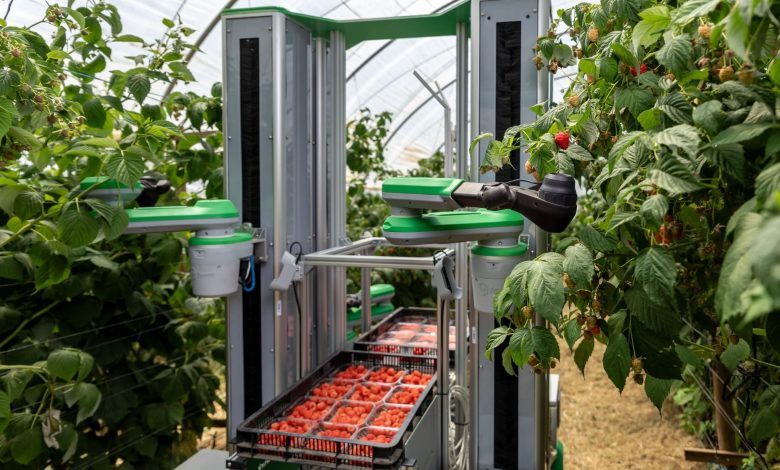
In logistics and warehousing, autonomous systems are already being used to sort goods, move inventory and manage distribution at scale. Agriculture is deploying robotics to address persistent labour shortages during harvest periods. Healthcare is emerging as another important area of adoption as ageing populations place increasing strain on care systems. Industrial inspection, energy infrastructure and defence are also seeing growing levels of investment and deployment.
The labour implications are more complicated than the standard narrative around machines replacing workers. Some forms of work will inevitably be displaced, but many of the industries adopting these technologies most rapidly are already struggling with labour shortages and operational constraints that predate recent advances in AI. In practice, automation is often being introduced because existing systems are already under strain.
Separating Hype From Reality
Like every major technological cycle, physical AI will attract hype alongside genuine innovation. Not every impressive demonstration will translate into a viable business, and some valuations will inevitably prove difficult to sustain. Capital is moving rapidly into the sector, and not all of it will be allocated wisely.
That said, the more important question is not whether parts of the market are overexcited, but whether the underlying trend is real. Increasingly, the discussion is moving away from speculative questions about what AI might eventually be capable of and towards a more grounded assessment of where customers are willing to spend money today.
The strongest opportunities are likely to emerge in sectors facing genuine structural pressure, where the return on investment can be measured clearly and adoption solves immediate operational problems. Backing promising technology in anticipation of future demand is a very different investment proposition.
The Investment Perspective
For investors, the challenge is identifying which companies are approaching commercially meaningful adoption, rather than simply developing impressive technology.
Physical AI is unlikely to scale in the same way software did. Deploying hardware into real-world environments takes time, and commercial adoption often depends on integration with industrial systems that were never designed for this kind of technology. The businesses that succeed will need not only strong engineering capability but also operational expertise and the ability to deploy reliably in difficult conditions.
A critical part of that advantage is access to real-world operational data. In sectors such as construction, machines must deal with changing weather, unstable terrain and site conditions that shift constantly. Autonomous vehicles face a similar challenge, as traffic patterns are unpredictable and heavily influenced by human behaviour that is difficult to model in advance.
As the co-founder of Pony.ai recently argued in the Financial Times, an autonomous vehicle’s behaviour changes how surrounding drivers respond to it, creating feedback loops that cannot be fully understood through historical data alone. The same principle applies more broadly across physical AI. Many of the hardest problems only emerge in live operating environments.
That has direct implications for investors. Companies already running live fleets or deployed systems are building advantages through operational data that competitors without real-world deployments cannot easily replicate. What appears on the surface to be a software race is increasingly becoming an operational one underneath, where deployment capability, regulatory access and unit economics may ultimately matter as much as model performance.
The Bigger Picture
The first phase of AI transformed how information is produced and processed. The next phase is more likely to affect how physical work is carried out.
For most of the history of automation, machines operated in structured and predictable environments. What is changing now is the ability of AI systems to function in less controlled conditions and adapt in real time. That opens the technology to a much wider range of industries than previous generations of automation could realistically reach.
The transition is likely to be slower, and harder operationally, than many expect. But its long-term economic impact may ultimately prove more significant than the first wave of generative AI.
Sources
- Barclays: https://home.barclays/news/press-releases/20260/01/barclays-research-finds-humanoid-robotics-on-track-to-become-a–/
- Morgan Stanley: https://www.morganstanley.com/insights/articles/ai-market-trends-institute-2026