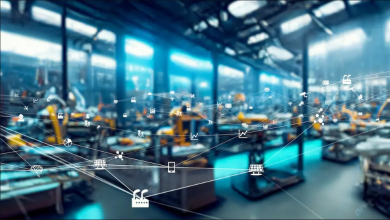
The global industrial sector is hitting a complexity ceiling. As we move toward hyper-connected smart cities, autonomous utility grids, and automated manufacturing, the sheer volume of data has outpaced human capacity to manage it. We have spent the last decade making machines “smart” by connecting them to the cloud. The next decade will be defined by making them agentic.
The Agentic Shift: Moving Beyond Predictive Maintenance
For years, the gold standard in industry was Predictive Maintenance (PdM). We used AI to analyze historical data and tell us when a part was likely to fail. While effective, PdM is still fundamentally a “human-in-the-loop” process: the AI flags a problem, a human reviews a dashboard, and a technician is dispatched.
Agentic AI removes the bottleneck. Instead of a centralized model that merely observes, an AI Agent is an autonomous entity embedded at the edge. It doesn’t just predict a failure; it possesses the reasoning capabilities to act on it.
Why Complexity Demands Autonomy
As infrastructure scales, the cost of downtime scales exponentially. In sectors like wastewater treatment, energy distribution, and maritime logistics, a single hour of unplanned downtime can result in seven-figure losses and significant environmental risk.
Traditional maintenance is firefighting. Predictive maintenance is forecasting. Cognitive maintenance is foresight.
Vertical Impact: Where Autonomy Meets Industry
What we are building today is no longer just physical; it is Cognitive. This transition is currently redefining three critical global sectors:
- FMCG Manufacturing
In high-speed Fast-Moving Consumer Goods (FMCG) lines, a single minute of downtime can result in thousands of units of wasted product and millions lost. Cognitive Maintenance allows for dynamic line optimization, where machines negotiate their own maintenance schedules based on real-time wear-and-tear and production deadlines, ensuring the “always-on” nature of global supply chains.
- Maritime
The maritime industry operates in some of the world’s harshest and most isolated environments. Cognitive Maintenance on vessels and in smart ports acts as a “digital chief engineer.” From pre-emptively detecting misalignment in crane winches to managing engine health in the middle of the ocean, these agents ensure that global trade remains fluid and fuel-efficient.
- Critical Infrastructure
Our fundamental systems, power grids, water treatment, metro networks, and HVAC in super-tall buildings, require absolute reliability.
Utilities: Desalination and power plants that automatically adjust output based on forecasted demand and asset stress.
Railways: Rail networks where train motors flag anomalies and book their own service slots to prevent system-wide delays.
Buildings: Intelligent HVAC and lift systems that self-correct to optimize energy consumption and passenger safety.
The Bottom Line: Uptime as the Ultimate Metric
Industry 4.0 has produced a lot of noise and vanity metrics. But for those on the front lines of industrial AI, the only metric that matters is reliability at scale. The transition to Cognitive Maintenance represents a reputational choice for industries. It signals a move away from reactive “break-fix” cultures toward a future of resilient systems. In this new Cognitive era, the most successful infrastructure won’t just be the biggest or the most expensive. It will be the most intelligent.