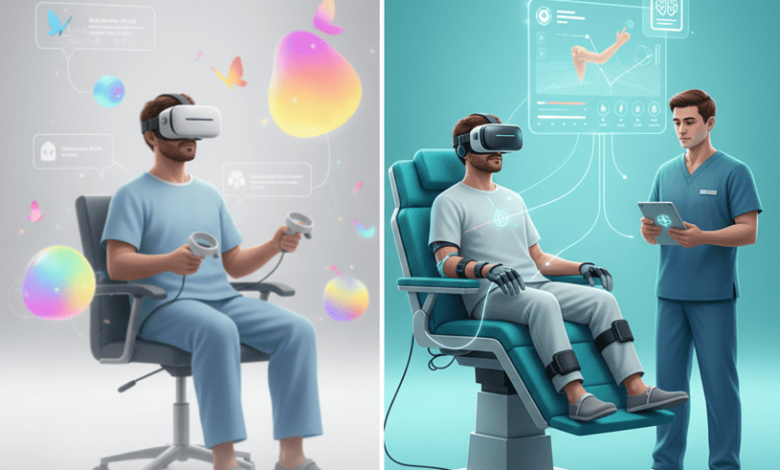
Virtual reality in healthcare has spent years in the “nice to have” category. A surprising demo. A short distraction during a difficult procedure. A pilot that makes people smile, then quietly disappears.
In 2026, that framing is becoming outdated.
The reason is simple. VR is no longer competing with clinical care. It is starting to behave like clinical care. It can be dosed, measured, personalised, and integrated into existing workflows. When it is done well, it becomes a practical layer that supports pain management, rehabilitation, and cognitive recovery, especially where capacity is stretched and where long term recovery is the hardest part to deliver.
The evidence is not perfect, but it is strong enough to justify a serious shift in mindset.
What the research is actually saying
In palliative care, a 2026 systematic review and meta analysis of ten randomised trials in adult palliative care cancer patients found VR significantly reduced pain intensity, with stronger effects seen in longer sessions and interactive content.
In chemotherapy settings, a 2023 systematic review and meta analysis of randomised trials reported that immersive VR reduced anxiety, depression, fatigue, and even systolic blood pressure in adults, and reduced pain and anxiety in paediatric patients. The included studies totalled 607 adults and 257 paediatric patients.
In rehabilitation, a 2024 meta review of systematic reviews concluded that VR is safe and effective as an adjunct to conventional therapy for adults after stroke, with benefits in upper limb, lower limb, gait, and balance, particularly when added to standard rehabilitation.
And in postoperative recovery, a 2024 systematic review and meta analysis in knee replacement found VR improved short term pain relief compared with control interventions, while also highlighting that evidence certainty is still low and protocols vary.
Those caveats matter. The field still struggles with heterogeneity, small sample sizes, and inconsistent outcomes. But the direction is consistent across settings: VR can reduce pain and distress, and it can improve engagement with rehabilitation when implemented with intent.
The real shift for 2026: from experiences to pathways
The mistake hospitals and clinics keep making is treating VR as content. A headset plus a library.
Clinical value comes when VR is treated as a pathway component with five elements.
- A clear clinical aim, not a generic “calming session”
VR works best when the goal is specific and measurable.
Pain modulation during chemotherapy or palliative care
Procedure related anxiety reduction
Motor recovery after stroke as an adjunct to physiotherapy
Post surgical recovery support where pain limits movement and adherence
If your goal is vague, your outcomes will be vague, and VR will be the first thing cut when budgets tighten.
- Dosing that looks like medicine
Session length, frequency, and timing matter. Longer sessions and interactive content can increase effectiveness in pain settings.
A practical approach is to define:
Session duration range
Frequency per week
Total programme length
Trigger points for escalation to clinician review
If you cannot describe the dose, you cannot test the intervention.
- Integration into care, not parallel “wellness time”
The best implementations are boring in the right way. VR becomes part of the routine.
Chemo infusion chair protocols
Physio sessions where VR supports repetitions and motivation
Post op recovery plans where VR is tied to mobility targets
Home based extensions for continuity, where appropriate
When VR lives outside the care plan, it becomes optional. Optional means inconsistent. Inconsistent means no data. No data means no future.
- Outcomes that cliniciansactually trust
Healthcare does not need more dashboards. It needs outcomes that map to clinical reality.
Pain scores before and after sessions
Functional outcomes in rehab such as gait, balance, range of movement
Patient reported anxiety and distress measures
Adherence measures such as completed sessions and drop off points
This is where AI becomes more than a buzzword.
A rapid review in JMIR Rehabilitation and Assistive Technologies summarised six ways AI based digital rehabilitation improves adherence, including motivation and engagement features, better communication between clinicians and patients, and personalised solutions tailored to cognitive styles.
In other words, AI helps VR move from “one size fits all” to adaptive programmes that respond to how the patient is actually progressing.
- Governance that makes infection control and safetynon negotiable
This is the part people skip until something goes wrong.
A 2025 paper in Infection Control and Hospital Epidemiology lays out practical considerations for cleaning and disinfection of extended reality equipment in healthcare settings, aligned with existing CDC cleaning and disinfection principles. It recommends involving local infection control experts, preferring non porous surfaces, and ensuring cleaning protocols between users.
If your implementation plan does not include infection control, contraindications screening, and staff training, it is not ready for scale.
What makes VR plus AI genuinely innovative right now
Innovation is not “more immersive.” Innovation is precision.
In 2026, the most useful systems will do three things:
- Personalise difficulty and pacing so rehabilitation stays challenging but achievable, reducing dropout and frustration. That is how you protect adherence, which is where rehab programmes succeed or fail.
https://rehab.jmir.org/2025/1/e69763 - Capture meaningful behavioural signals inside the session, such as response time, movement consistency, fatigue patterns, and attention drift, and translate them into a clinician friendly view. Not as a replacement for judgement, but as a better feedback loop than memory based self report.
- Close the loop into care teams so VR is not a standalone intervention. It becomes a monitored component with clear thresholds for follow up.
This is why I believe VR is moving into its second era. The first era was distraction. The second era is recovery design.
A practical checklist for healthcare leaders considering VR in 2026
If you are evaluating a programme, ask these questions:
What is the clinical goal and the primary outcome measure
What is the dosing plan and what evidence supports it
How will you integrate it into existing workflows without adding burden
What data will be captured and who reviews it
What are your safety protocols, including cleaning and contraindications
https://www.cambridge.org/core/journals/infection-control-and-hospital-epidemiology/article/applying-principles-to-practice-cleaning-and-disinfection-of-extended-reality-equipment-used-in-healthcare-settings/FDBFF1A43EC5183C167DEEDDBFEC75C3 What is the plan for scaling beyond a pilot, including staff training
If the answers are vague, the project is fragile.
Closing thought
Healthcare has invested heavily in tools that diagnose and predict. Recovery is where systems still under invest, even though recovery determines long term outcomes, quality of life, and resource use.
VR is not a magic solution. But the evidence is now strong enough to treat it seriously, and AI makes it far more practical to personalise, measure, and scale.
In 2026, the organisations that win will be the ones that stop asking whether VR is impressive, and start asking whether it is integrated.