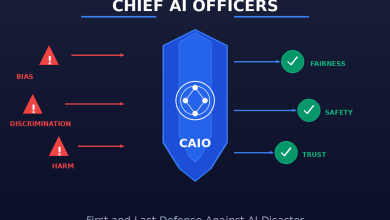
Artificial intelligence has moved from research curiosity to operational infrastructure at extraordinary speed. In the past two years alone, generative AI tools have been adopted across enterprises for software development, customer engagement, analytics, and operational efficiency.
Yet while many organisations are still figuring out how to govern generative AI, the technology ecosystem is already moving toward something far more consequential: autonomous AI systems capable of making and executing decisions.
This shift, from machines that generate content to systems that initiate actions, represents a fundamental change in how digital environments operate. It also introduces a new class of cybersecurity and governance challenges.
The uncomfortable reality is that security architecture is not evolving at the same pace as AI capability.
According to Gartner, more than 80% of enterprises will have used generative AI APIs or models by 2026, yet fewer than 30% currently have formal governance frameworks for AI systems. Meanwhile, global cybercrime costs are projected to exceed £9.5 trillion annually, with attackers increasingly using AI to accelerate their operations.
In other words, the industry is embedding increasingly powerful automation into environments that already struggle with foundational security weaknesses.
When organisations deploy intelligent systems without first addressing identity governance, data management, and operational oversight, they are not creating smarter infrastructure.
They are automating risk.
The Shift from Generative AI to Autonomous Systems
Generative AI models primarily produce outputs, text, code, images, or analysis. They operate as assistants within human workflows. Humans remain responsible for interpreting results and deciding how they should be used.
Autonomous AI systems are different. They are designed not just to recommend actions but to execute them.
Financial platforms are experimenting with AI-driven credit decisions. Cybersecurity teams are deploying automated response systems capable of isolating infrastructure in seconds. Customer service platforms can now resolve complex interactions without human involvement.
In each case, decision authority is shifting, at least partially, from humans to machines. That shift raises important questions. Who is accountable when an automated system makes a wrong decision? How do organisations maintain control when systems operate faster than human oversight? How do security teams verify the behaviour of systems capable of adapting continuously to new data?
These are not theoretical concerns. Autonomous decision systems already exist in trading platforms, logistics optimisation, cybersecurity response engines, and fraud detection environments.
The difference between assistance and autonomy is subtle but critical. A generative AI system may recommend an action. An autonomous AI system may take the action itself.
Once machines begin acting within operational environments, the consequences of security weaknesses expand dramatically.
AI Does Not Fix Weak Security Foundations
There is a persistent belief that artificial intelligence will improve cybersecurity by identifying threats faster and automating responses.
AI can certainly enhance detection and efficiency. But it does not solve the structural weaknesses already present within most enterprise environments.
In many cases, it amplifies them.
Most organisations still struggle with core security fundamentals: identity sprawl, inconsistent access control, fragmented data governance, and fragile infrastructure.
When AI systems are deployed in these environments, they inherit the same weaknesses.
Consider identity and access management. Machine identities, service accounts, automation credentials, and API tokens, already outnumber human identities in most large enterprises. Research from CyberArk suggests that machine identities can exceed human identities by 45 to 1.
Autonomous systems rely heavily on these identities to interact with enterprise infrastructure. If those credentials are compromised, attackers may gain indirect control over automated systems operating across multiple platforms.
Data governance presents another challenge. AI models rely on large datasets for training and operation. If those datasets are poorly governed—lacking clear ownership, classification, or integrity controls, the resulting models may produce flawed or biased outcomes.
In an automated system, those errors can be executed repeatedly at scale.
API security also becomes increasingly critical. Many AI systems interact with enterprise platforms through APIs that retrieve data, trigger workflows, or update records. Weak authentication or insufficient monitoring can allow attackers to manipulate automated decision engines.
Automation changes the scale and speed of impact.
A vulnerability that might affect dozens of transactions in a manual environment could affect millions of automated decisions in minutes.
AI does not create entirely new security problems. It magnifies the consequences of the ones we already have.
Where Early Failures Are Most Likely to Occur
The first major failures involving AI will likely look less like science fiction and more like familiar cybersecurity incidents, only faster and larger.
One obvious area of risk is AI-enabled fraud.
Cybercriminal groups are already using generative AI to automate phishing campaigns, generate synthetic identities, and bypass identity verification systems. As financial institutions introduce automated decision engines for lending and onboarding, those systems become high-value targets.
Automation allows attackers to scale operations dramatically.
Another risk lies in automated decision systems operating without sufficient oversight. Organisations seeking efficiency may deploy AI-driven systems that approve transactions, allocate resources, or optimise operational workflows.
If those systems are poorly monitored, a flawed model or corrupted dataset could produce thousands of incorrect decisions before anyone notices.
Perhaps the most subtle risk is automation bias.
Studies from the National Institute of Standards and Technology (NIST) show that humans often place excessive trust in machine-generated outputs. When automated systems provide recommendations, operators frequently defer to them—even when conflicting information exists.
In regulated sectors such as financial services, healthcare, and critical infrastructure, that tendency can create systemic risk.
Importantly, these failures are unlikely to stem from rogue superintelligence.
They are far more likely to emerge from governance gaps: unclear accountability, weak oversight, and insufficient operational controls.
Preparing Security Architecture for Autonomous System
Artificial intelligence will be essential for improving productivity, strengthening cyber defence, and enabling new digital capabilities.
The solution is not to slow AI adoption. It is to ensure that security architecture evolves alongside it.
The priority is identity security. As organisations deploy automated systems, the number of machine identities interacting with infrastructure will grow rapidly. These identities require strong authentication, privilege management, and lifecycle governance.
Second, organisations must treat data governance as a strategic control layer. Without clear visibility into data ownership, classification, and lineage, it is impossible to ensure that AI systems behave reliably or ethically.
Third, enterprises must develop oversight frameworks for automated systems. Autonomous decision engines should operate within defined policy boundaries supported by monitoring, audit logging, and escalation mechanisms.
Fourth, security teams must expand threat modelling and red-team exercises to include AI systems themselves. These assessments should examine how automated systems could be manipulated through adversarial inputs, data poisoning, or model exploitation.
Security should not be treated as a constraint on AI adoption.
It is what makes autonomous systems trustworthy in the first place.
The Human Dimension: Why AI Safety Engineers Will Become Essential
Technology shifts of this magnitude inevitably reshape the cybersecurity workforce.
Traditional security roles focus on protecting infrastructure, networks, and applications. As AI becomes embedded in decision systems, security professionals must increasingly understand the behaviour of intelligent systems themselves.
This shift is giving rise to a new hybrid role: the AI Safety or AI Security Engineer.
These professionals operate at the intersection of cybersecurity, data science, and governance. Their responsibility is not only to secure infrastructure but also to ensure that AI systems behave safely, transparently, and within defined policy boundaries.
In many ways, the role resembles the early emergence of cloud security architects, specialists who understood both the technology and the governance required to operate it safely.
But AI introduces entirely new attack surfaces.
Security teams must understand how models are trained, how automated decisions are executed, and how adversaries might manipulate machine behaviour.
Core Skills of an AI Safety Engineer
Key capabilities for this emerging discipline include:
- Adversarial machine learning defence – identifying how models can be manipulated through prompt injection or adversarial inputs
- Secure AI pipeline architecture – protecting training, deployment, and update processes
- Machine identity governance – managing credentials used by automated systems
- AI system observability and explainability – monitoring how models reach decisions
- Automated decision oversight frameworks – ensuring autonomous systems operate within defined policies
- Threat-informed AI red teaming – testing AI systems against realistic adversarial scenarios
Over time, these capabilities may form the foundation of an entirely new discipline within cybersecurity focused on machine-driven decision systems.
Looking Ahead: The Near Future of Intelligent Systems
While much of today’s discussion focuses on generative AI, the technological trajectory points toward a far more complex landscape.
Over the coming decade, organisations are likely to encounter a convergence of several powerful technologies: increasingly autonomous AI systems, advances in quantum computing, and early forms of biological or organoid computing.
Artificial General Intelligence remains a debated concept, but the direction of travel is clear. AI systems are gradually gaining the ability to reason across domains, plan multi-step actions, and operate with increasing independence.
At the same time, quantum computing is expected to transform how complex optimisation and cryptographic problems are solved. When combined with AI, quantum-enabled systems could accelerate machine learning processes, allowing models to analyse vastly larger datasets and explore decision pathways beyond the reach of classical computing.
For cybersecurity, this convergence introduces both opportunity and risk. Quantum-enabled AI could dramatically improve threat detection and resilience modelling. But it could also accelerate adversarial capabilities, including automated vulnerability discovery and large-scale attack orchestration.
A third frontier is emerging through organoid computing, biological neural structures grown in laboratory environments and used as computational substrates. Early research suggests these systems may eventually enable highly energy-efficient learning models with capabilities that differ fundamentally from traditional silicon-based computing.
While still experimental, the research illustrates a broader reality.
The future of intelligence infrastructure will likely involve multiple computing paradigms working together.
Yet despite these developments, the frameworks designed to govern intelligent systems remain immature. Regulatory models are still emerging, security standards for AI are evolving, and many organisations lack even basic oversight for automated decision systems already in operation.
The industry is building increasingly powerful intelligence systems without fully understanding how they should be controlled.
That gap between capability and governance is where the next generation of cybersecurity challenges will emerge.
Security Must Lead the Next Phase of AI
Artificial intelligence is entering a new stage, one where machines will increasingly participate in operational decision-making.
History offers many examples of innovation outpacing governance. Cloud computing, mobile platforms, and social media ecosystems all expanded rapidly before security frameworks fully caught up.
The transition toward autonomous AI presents an opportunity to avoid repeating that pattern.
For CISOs and technology leaders, AI adoption should not be treated as a simple tooling upgrade. It represents a structural shift in how organisations operate, make decisions, and manage risk.
Identity governance, data management, oversight frameworks, and workforce skills must evolve accordingly.
Artificial intelligence will undoubtedly reshape digital environments over the coming decade, but the defining factor will not be how intelligent machines become. It will be whether organisations build the resilience required to control them.