Artificial intelligence has become part of agency workflows faster than any other tool in recent years. What began as experimentation quickly turned into everyday use — not through large transformation programmes, but through practical adoption by teams who saw immediate value.
Industry data reflects this shift. McKinsey’s State of AI 2025 reports that 88% of organisations now use AI in at least one business function, with marketing, content, and knowledge work among the most active areas. Salesforce research shows that nearly three-quarters of marketing professionals already use or plan to use generative AI, primarily to reduce time spent on drafting, research, and coordination. Deloitte Digital estimates that generative AI can return over ten hours per week per employee when applied to early-stage work.
At CAPSBOLD, a global creative marketing agency, AI is already embedded across departments — accelerating processes while raising a crucial question: how to leverage AI without compromising creativity, critical thinking, or responsibility.
Where AI Brings the Most Value Today — and Why It Looks Different Across Teams
In practice, AI brings the most value in areas that sit between intention and execution.
Across teams at CAPSBOLD, AI is used to:
- generate early drafts of text, concepts, visual directions, and creative ideas,
- assemble moodboards and internal references for design and video production,
- translate and adapt materials for multilingual collaboration,
- summarise research and surface patterns at early stages of analysis,
- automate internal reporting and operational updates.
This aligns closely with industry research. IBM found that 29% of IT professionals say AI tools save employees time by automating routine tasks, allowing them to focus on higher-value work. Internally, this shows up less as “doing more” and more as working with less friction.
But what surprised us most was how differently teams use the same tools.
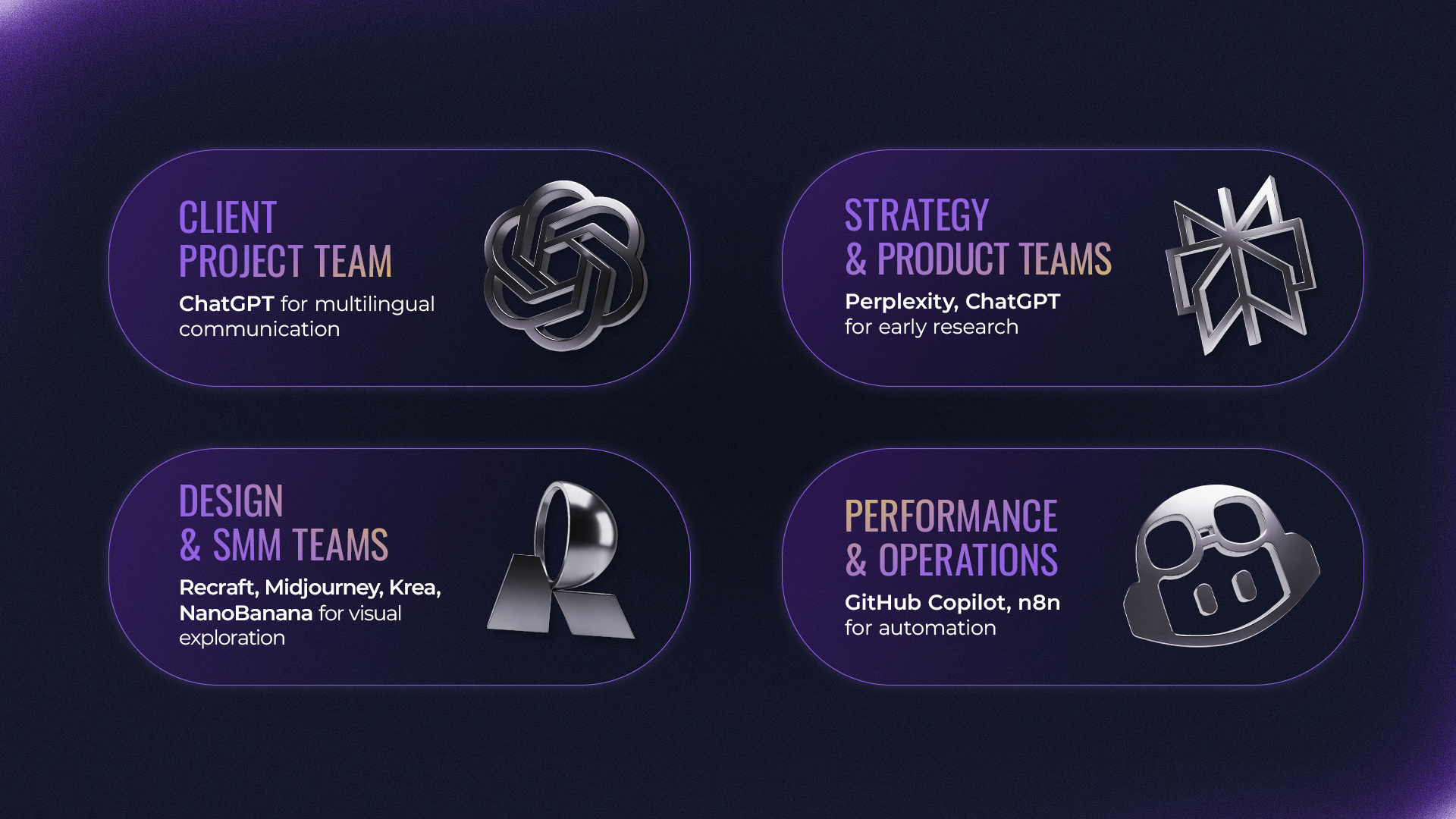
For client and project teams, tools like ChatGPT are used to structure communication. Aleksandra Osina, Account Director, highlights its role in working with multilingual clients and aligning tone of voice across markets. Drafting technical briefs in different languages, clarifying complex explanations, and adjusting messaging before it reaches clients helps teams communicate more clearly and consistently. AI does not replace client judgement, but it supports it by making intent, structure, and tone easier to align early on.
For strategy and product teams, tools such as Perplexity and ChatGPT support early research. Oksana Baykova, Senior Brand Strategy Manager, points to AI’s value in rapid market overviews and high-level landscape scans. In practice, this allows teams to gather and structure large volumes of information quickly, then shift focus to interpretation, prioritisation, and recommendation-building — areas where experience and context remain critical.
For creative and design teams, AI is integrated directly into early ideation and content production. T. Reznichek, Art Director, describes GPT as a multifunctional assistant that reduces operational load, while tools such as Midjourney, Krea, and NanoBanana are used to explore visual directions, test formats, and build creative references for both static and video content. AI accelerates ideation and production workflows, but structure, authorship, and final creative judgement remain human-led, ensuring speed does not come at the expense of clarity or craft.
For PR teams, AI is embedded in everyday workflows as a speed and structuring tool. Olga Loktionova, PR Director, notes that tasks such as research, media mapping, and pitch preparation have become around 35% faster with the use of tools like ChatGPT, Manus, Grammarly, and Perplexity. These tools help process large volumes of information and shape ideas more efficiently, while decision-making, nuance, and final meaning remain firmly human-led.
For performance and operations, AI primarily serves as an efficiency layer. Sergey Tarasov, Head of Performance, notes that AI rarely directly improves campaign results, but significantly reduces time spent on routine work. Tools like GitHub Copilot support development tasks, while automation platforms such as n8n connect internal systems, trigger notifications, and streamline reporting across projects. He notes that, with AI support, the team spends 13% less time on routine tasks. The value here lies in freeing specialists from manual processes so they can focus on decisions rather than execution mechanics.
Across departments, AI works best when it supports necessary steps without deciding outcomes.
Balancing Efficiency and Creativity
One of the most common concerns around AI is whether efficiency comes at the expense of creative depth. In our experience, this depends entirely on where AI sits in the process.
At CAPSBOLD, AI is used primarily at the beginning of creative work, not at the point of final decision-making. This is especially important in a large, multi-disciplinary team working across SMM, strategy, performance, design, and client service. We work with brands and products that operate across multiple markets, often in performance-driven or regulated environments, where clarity, consistency, and context matter. AI helps explore directions, test variations, and surface options early, while final decisions are made by people who understand the business, the audience, and the market constraints.
Salesforce research supports this approach, reporting that 70% of marketers say AI reduces the administrative burden, allowing a deeper focus on thinking and decision-making.
Internally, this has led to a stronger emphasis on prompt literacy. Writing clear, structured prompts has become an important skill, particularly for creative and strategic roles. Teams have learned that AI output quality depends heavily on how tasks are framed. Vague prompts yield generic results; precise inputs yield useful material.
AI accelerates exploration, but creative responsibility remains human. Taste, judgement, and cultural sensitivity are not delegated to tools.

Risks, Limitations, and How We Manage Them
AI adoption also introduces real risks, which are deliberately addressed rather than ignored.
Common challenges include:
- inaccurate or fabricated information,
- generic tone and stylistic repetition,
- visual artefacts and inconsistencies,
- over-reliance on outputs that sound convincing but lack depth.
These issues are well documented. The IAB’s 2025 research shows that over 70% of marketers have already encountered AI-related incidents, including off-brand or incorrect content. The Salesforce report mentioned earlier also states that 39% of marketers are unsure how to use generative AI safely, while 70% say they receive no formal AI training from their employers.
At CAPSBOLD, risk management is built into daily practice:
- sensitive client and project data is anonymised before being used in AI tools,
- outputs are reviewed by specialists in the relevant field,
- AI-generated content is treated as a draft, never a finished result,
- responsibility always remains with the person using the tool.
There is a shared understanding that AI does not create expertise. Without domain knowledge, outputs remain surface-level. Human review, critical thinking, and accountability are therefore non-negotiable.
How Roles Are Evolving
AI is not replacing roles at CAPSBOLD, but it is reshaping them.
New hybrid skill sets are emerging — professionals who combine strong domain expertise with the ability to work effectively with AI tools. This includes framing tasks clearly, evaluating outputs critically, and integrating AI into workflows without compromising quality.
We see this internally already. Designers spend less time on repetitive production and more time on conceptual development. Client teams focus more on structuring communication and decision-making. Strategists move faster through research and spend more time on synthesis and judgement.
AI changes how work is done, not why it is done.
Conclusion: How AI Fits Into CAPSBOLD’s Way of Working
Across teams, there is strong alignment on one point: AI is a tool, not a substitute for thinking.
At CAPSBOLD, we use AI to support speed, structure, and scale — while keeping judgement, meaning, and responsibility firmly human. In practice, AI works best when it supports thinking, operates before decisions are made, and is guided by experienced specialists rather than juniors or automation alone.
This balance matters in a large agency working with brands across multiple markets. While AI helps us align faster internally and work more consistently across languages and regions, it does not replace live human communication. Trust and understanding with clients are built through real conversations, which we deliberately balance with AI-supported processes inside our workflows and creative production.
AI is not a promise for the future for us. It is part of our present, shaped by the way we choose to use it.

CAPSBOLD is an award-winning creative marketing agency working across strategy, creative, SMM, performance, and production for international brands.
Follow CAPSBOLD for more insights on creativity, technology, and marketing innovations:
https://www.instagram.com/capsbold.group/
https://www.linkedin.com/company/capsbold/posts/?feedView=all
https://www.youtube.com/@capsboldgroup
https://www.facebook.com/capsbold.group