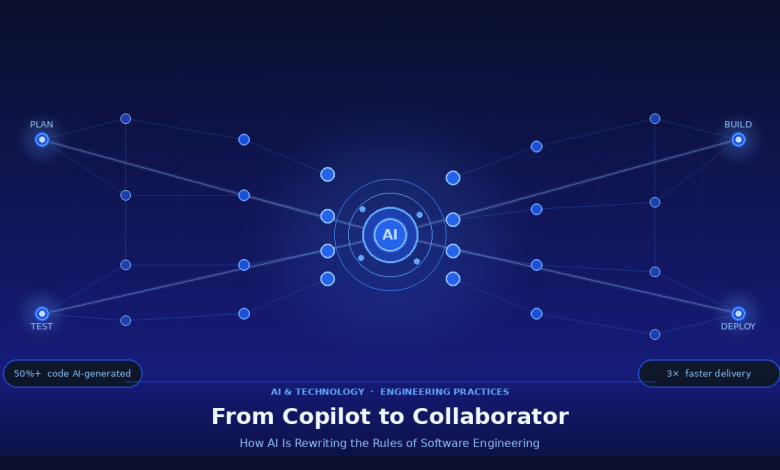
Artificial intelligence is no longer a productivity add-on for developers — it is becoming the cognitive backbone of the entire software delivery lifecycle.
Software engineering has always been a discipline shaped by its tools. From punch cards to object-oriented programming, from waterfall to agile, each era produced a new set of practices that redefined what it meant to build software professionally. We are now in the opening chapters of another such era — one defined not by a framework or a methodology, but by a collaborator that never sleeps: artificial intelligence.
The shift is already visible. GitHub’s data shows that more than half of all code in certain developer environments is now written or suggested by AI assistants. Tools like GitHub Copilot, Amazon CodeWhisperer, and Cursor are no longer novelties reserved for early adopters — they are embedded in the daily workflows of engineering teams at organisations of every scale. But the real transformation goes far beyond autocomplete. AI is beginning to touch every phase of the software development lifecycle (SDLC), from requirements gathering to production monitoring, fundamentally altering the practices, roles, and expectations that have defined the profession for decades.
The Old SDLC Meets Its Match
For most of computing’s modern history, the software development lifecycle has been a largely human-sequential process. A product manager distils user needs into specifications. Architects design systems. Developers write code. QA engineers test it. Operations teams deploy and maintain it. Each handoff introduced delay, miscommunication, and accumulated technical debt.
AI-driven development is compressing and, in some cases, collapsing these boundaries. Natural language interfaces allow engineers to describe intent rather than just transcribe logic. Large language models can generate boilerplate, scaffold entire modules, propose architecture patterns, write unit tests, and explain legacy code — tasks that collectively consumed enormous engineering hours. The result is a workflow where the developer’s primary role is shifting from author to editor, from coder to critical thinker.
Rethinking the Developer Role
The fear that AI will simply replace software engineers has, at this stage, proven premature. What the evidence suggests instead is a significant redistribution of cognitive labour. In a 2024 McKinsey study, developers using AI coding assistants reported spending less time on repetitive implementation tasks and more time on system design, architecture decisions, and cross-functional collaboration. This realignment is not trivial — these happen to be the exact skill areas that differentiate good engineers from great ones.
The new breed of AI-augmented engineer is emerging as someone who combines traditional technical fluency with a new literacy: the ability to prompt effectively, evaluate AI output critically, understand the limits of generative models, and architect systems where human and machine responsibilities are clearly delineated. Prompt engineering, once dismissed as a passing fad, is increasingly recognised as a genuine technical discipline — one that determines how much value an engineering team can extract from its AI toolchain.
“The developer’s primary role is shifting from author to editor, from coder to critical thinker — and this changes everything about how we hire, train, and build teams.”
AI Across the Full Lifecycle
The most transformative impact of AI on software engineering is not in code generation alone — it is in the breadth of the SDLC it now touches:
WHERE AI IS CHANGING THE SDLC
▸ Requirements & Planning
AI tools can analyse product briefs, identify ambiguities, and surface edge cases that human teams frequently overlook. Some platforms are beginning to auto-generate user stories and acceptance criteria directly from conversational inputs.
▸ Code Generation & Review
Beyond autocomplete, AI models now generate entire functions and modules, identify security vulnerabilities in real time, and perform contextual code reviews that surface issues human reviewers often miss under time pressure.
▸ Testing & Quality Assurance
Generative AI can produce comprehensive test suites from functional requirements, dramatically reducing the time between code commit and validated test coverage. AI-powered mutation testing is also emerging as a way to evaluate the quality of the tests themselves.
▸ Documentation
One of engineering’s most neglected disciplines is being revived by AI. Models that understand code semantics can generate inline documentation, API references, and even architectural decision records — maintaining documentation as a living artefact rather than a one-time afterthought.
▸ Incident Response & Observability
AI-assisted operations tools can detect anomalies in production telemetry, correlate errors across distributed systems, and even propose root-cause hypotheses — compressing mean time to resolution (MTTR) significantly.
The Engineering Culture Shift
Technology transitions succeed or fail at the level of culture, and AI-driven engineering is no exception. The teams extracting the most value from AI tools tend to share a common characteristic: they treat AI as a junior collaborator to be mentored, not a magic oracle to be trusted unconditionally. Senior engineers review AI-generated code with the same rigour they would apply to a new hire’s pull request. Teams have introduced new code review practices specifically designed to catch hallucinated logic, plausible-but-incorrect APIs, and quietly introduced security anti-patterns.
Engineering leaders are also grappling with important questions around ownership and accountability. When a bug originates in AI-generated code that a developer approved without full comprehension, who bears responsibility? How should organisations attribute intellectual authorship? These are not merely philosophical puzzles — they have real implications for software liability, audit trails, and the professional standards of the engineering discipline itself.
Challenges and Responsible Adoption
The adoption of AI in software engineering is not without risk. Over-reliance on AI-generated code can erode deep technical understanding in junior engineers who never fully grapple with underlying concepts. There are legitimate data privacy concerns when proprietary codebases are submitted to third-party AI services. And AI models trained on public code repositories can inadvertently reproduce copyrighted patterns or introduce subtle algorithmic biases.
Responsible adoption requires intentional governance. Organisations should define clear policies on which AI tools can access what code, establish review protocols specific to AI-generated contributions, and invest in training programmes that build the critical evaluation skills developers need to work safely alongside AI. The goal is not to restrict AI’s role, but to harness it within a framework that preserves engineering integrity.
What Comes Next: The Agentic Horizon
The current generation of AI coding tools, impressive as they are, is likely to look primitive within a few years. The frontier is agentic AI — systems capable not merely of answering a question or completing a line, but of autonomously executing multi-step engineering tasks. Early examples already exist: AI agents that can take a failing test, trace the root cause through multiple files, propose a fix, verify it, and open a pull request — with no human intervention at any step.
This trajectory raises profound questions about the future shape of software teams. Will engineering organisations shrink, with smaller, higher-leverage human teams directing fleets of AI agents? Or will the productivity multiplier simply enable organisations to build more, faster — expanding the frontier of what software can do without reducing headcount? The honest answer is that both outcomes are plausible, and the determining factor will be business strategy, not technical capability.
The Paradigm Has Already Shifted
A paradigm shift is rarely visible to those living through it. The engineers who first adopted version control, automated testing, or cloud-native architectures were not always celebrated as visionaries — they were often simply solving immediate problems with the best tools available. The same is true today.
The developers and engineering leaders who treat AI as a genuine collaborator — studying its capabilities, understanding its failure modes, and adapting their practices to work with it thoughtfully — will define what professional software engineering looks like in the decade ahead. The rules are being rewritten. The engineers who thrive will be those who help write them.