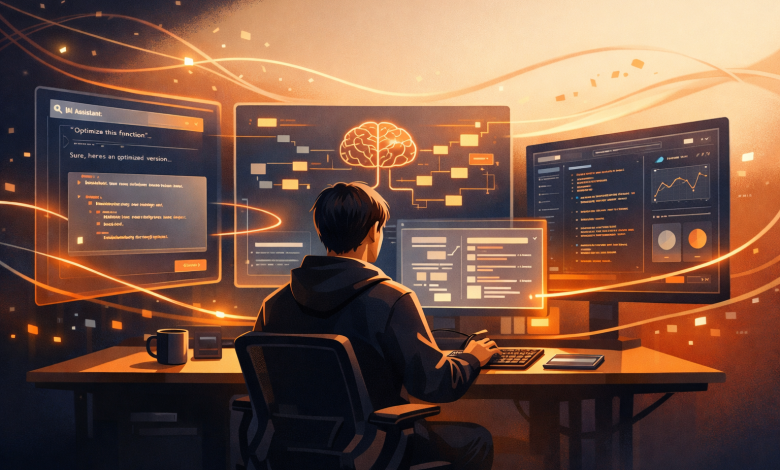
Artificial intelligence has already changed how developers write code. But a quieter shift is now underway, one that is less about model capability and more about how developers interact with those models.
The first wave of AI-assisted development was defined by conversational tools. Developers asked questions, generated snippets, and iterated manually. These tools excelled at explanation, rapid prototyping, and learning. But as systems grew more complex, a limitation became increasingly clear: software development is not a single-file activity, and it is rarely context-free.
A new generation of tools is emerging to address that gap. These are AI-native development environments — systems designed not just to answer questions, but to understand codebases, retain context, and operate across multiple files and workflows.
By embedding AI directly into the development environment, these tools allow models to interact with entire projects rather than isolated prompts. The distinction is subtle but significant — marking a shift from AI as an assistant to AI as an embedded participant in the development lifecycle.
The Limits of Chat-Based Development
Conversational AI tools have proven highly effective for:
- Explaining concepts
- Generating code snippets
- Troubleshooting isolated issues
- Accelerating onboarding and learning
In structured workflows, they provide fast and clear responses. For example, when asked to generate logic for hierarchical task assignment in enterprise systems, conversational models can quickly produce working code along with assumptions and trigger conditions.
However, these tools operate with constraints that become more visible in real-world development:
- No persistent memory across sessions
- Limited awareness of full codebases
- Manual transfer of context between interactions
- Single-file or localized reasoning
These limitations are not flaws. They are simply a reflection of the interface. A chat window is optimized for dialogue, not for system-wide reasoning.
The Rise of Context-Aware AI Development Environments
AI-native development environments take a different approach. Instead of treating AI as an external tool, they embed it directly within the developer workflow.
These systems introduce capabilities such as:
- Local codebase awareness
- Multi-file reasoning and dependency tracking
- Persistent memory across sessions
- Structured project outputs and auto-saving
- Integration with development tools and repositories
AI powered context aware IDEs illustrate how this works in practice. By operating within an IDE, they can read local files, track relationships across modules, and apply changes directly within a project. This enables developers to move beyond prompt-response workflows toward continuous, context-aware interaction with their codebase.
The result is a shift in how problems are solved. Instead of asking, “What should this function do?”, developers can ask, “How does this change affect the system?”
This distinction becomes especially important in enterprise development environments, where workflows span multiple layers, including business logic, data models, UI configurations, and integrations.
Where the Difference Becomes Clear: Real Workflows
The contrast between conversational tools and AI-native IDEs becomes most visible when applied to real development workflows.
- Code Generation and Automation
Conversational tools excel at quickly generating scripts with clear assumptions and readable logic. They are particularly effective for initial drafts or learning-oriented tasks.
AI-native environments, however, extend beyond generation. They:
- Incorporate best practices and logging strategies
- Handle exception scenarios such as recursive hierarchies
- Maintain awareness of execution flow across components
- Enable direct execution and in-line modification
This transforms code generation from a static output into a dynamic workflow. For example, in some of the IDE-native systems, generated code can be immediately integrated into the existing codebase, tested, and refined without leaving the development environment.
- Testing and Edge Case Coverage
For unit testing, conversational tools provide structured test cases and clean documentation. They are effective for standard validation scenarios.
AI-native environments go further by:
- Identifying edge cases such as circular dependencies
- Enforcing safeguards (e.g., hierarchy limits)
- Aligning tests with real execution paths
The difference is not in correctness, but in completeness under real-world conditions.
- Documentation and Knowledge Capture
Documentation highlights another important distinction.
Conversational tools produce:
- Clear, readable summaries
- General-purpose documentation
- Easily digestible explanations
AI-native systems generate:
- Structured developer artifacts (README files, knowledge articles)
- Context-aware documentation tied to actual implementations
- Visual workflows and diagrams derived from system behavior
This reflects a broader shift, from explaining systems to documenting living systems.
- Debugging and Incident Resolution
Debugging is where workflow differences become most pronounced.
Conversational tools are highly effective for:
- Isolated issues
- Root cause explanations
- Quick diagnostics
AI-native environments enable:
- Multi-file debugging
- Detection of cascading changes (e.g., variable renames across files)
- Real-time tracking of system behavior
As systems grow in complexity, debugging shifts from understanding a problem to tracing it across interconnected components.
In AI-native IDEs, this can include tracking how a change in one file propagates across dependent modules, surfacing inconsistencies that would be difficult to identify through isolated prompts.
- Consistency and Long-Term Development
Over time, consistency becomes a defining factor.
Conversational tools:
- Provide strong guidance on best practices
- Support learning and standardization
- May produce variability across sessions
AI-native environments:
- Retain memory of past decisions
- Enforce naming conventions and coding standards
- Maintain continuity across projects
This introduces a new capability: institutional memory embedded in the development tool itself.
A Shift in Developer Experience
The comparison between these approaches is not about replacement. It is about alignment with different types of work.
- Conversational AI is optimized for thinking and exploration
- AI-native environments are optimized for execution and continuity
This leads to a hybrid model:
- Developers use conversational tools to learn, design, and reason
- They use AI-native environments to build, maintain, and scale systems
The Broader Implication
What is emerging is not just a new category of tools, but a new model of software development.
As systems become more distributed and interdependent, the cost of losing context increases. Tools that can retain, interpret, and act on that context will define the next generation of developer productivity.
The key shift is this:
AI is no longer just answering questions. It is participating in systems.
Conclusion
The evolution from chat-based AI to context-aware development environments reflects a deeper change in engineering practice. Software development is moving toward workflows where context, continuity, and system awareness matter as much as speed.
Conversational tools will remain essential. They are unmatched in accessibility and clarity. But as development environments grow more complex, the center of gravity is shifting toward systems that can operate within that complexity rather than outside it.
In that future, the most effective teams will not choose one tool over another. They will build workflows that combine both, using AI not just to accelerate development, but to stabilize it at scale.