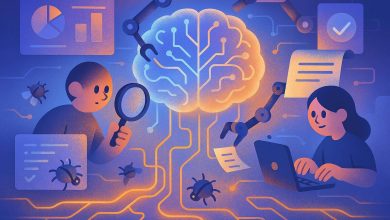
Every few months a new headline warns of disruption, job loss, and the unstoppable march of artificial intelligence. But when you strip away the noise, what’s really happening isn’t a takeover, it’s a test.
AI is holding a mirror up to how we think, communicate, and make decisions. And if what it reflects back looks messy, inconsistent, or rushed, the fault isn’t in the algorithm. It’s in the leadership behind it.
Most organisations aren’t being replaced by AI, they’re being exposed by it.
We don’t have an AI problem. We have a leadership problem.
For decades, businesses have built systems around speed, efficiency, and volume. The unspoken rule was simple: the faster you move, the more successful you’ll be. But that mindset doesn’t work in a world where every word, prompt, and dataset feeds something smarter than you. AI thrives on clarity, rewards reflection and exposes chaos.
And that’s uncomfortable for a lot of leaders because clarity takes time, and time is the one thing they think they don’t have. So instead of slowing down, they rush the process. They plug AI into old systems, old thinking, and old priorities then wonder why it doesn’t deliver.
If your business doesn’t know how to communicate clearly, no AI tool can fix that.
If your strategy changes every week, your prompts will contradict themselves.
If your culture rewards noise over nuance, your data will reflect it.
AI is not magic. It’s a mirror. And what it reflects back can either clarify your thinking or magnify your confusion.
From tools to teammates
Right now, most companies are still treating AI like a digital assistant, a useful but ultimately mechanical presence. But we’re moving towards something more human: autonomous agents that don’t just complete tasks but collaborate, reason, and anticipate.
That shift sounds exciting, but it raises a harder question: are we ready to work with AI, not just through it?
Autonomous AI will challenge leadership at every level because it requires the same things we ask of great teams: trust, transparency, and communication.
You can’t bark orders at an AI agent and expect brilliance. You need to give it context, purpose, and permission to adapt. In other words, you have to lead it. And that’s where most organisations fall short. They expect AI to provide answers before they’ve done the work of defining the right questions.
AI exposes culture
If you want to see the health of a company’s culture, look at how they’re implementing AI; a business that values reflection will experiment with AI thoughtfully, using it to test ideas and strengthen decision-making.
A business that values speed over sense will chase every new trend, automating everything until nobody knows why they’re doing it.
AI doesn’t break culture but it does make the cracks visible. In small and micro-businesses, those cracks can be easier to see but also easier to fix. Because in a ten-person company, culture isn’t a PowerPoint slide. It’s the way people talk to each other, the decisions they make under pressure, and how they respond when things go wrong. AI amplifies all of that.
If communication is clear, AI will strengthen it but if accountability is weak, AI will mask it until it fails.
So before you install another plugin or sign up for another platform, ask the harder question: what kind of culture am I training my AI to learn from?
The Four Pillars of AI Leadership
In coaching small business owners and senior leaders, I talk about four pillars that build progress: Communication, Accountability, Time, and Strategy.
The same principles apply to AI, because these are the foundations that determine whether your systems serve you or sink you.
- Communication, clarity over command
AI works best when it’s given clarity, not chaos. Most of the “AI doesn’t get it” complaints come down to poor communication. We expect the machine to interpret half-formed thoughts and fix our uncertainty. But like people, AI performs at the level of our input.
Good leaders don’t just speak clearly, they think clearly. They know what success looks like before they hit “generate.” They understand tone, intent, and context.
In practice, this means training your teams to write better prompts, document processes, and give feedback that’s useful, not vague. It’s the digital equivalent of a good brief. Without it, even the best AI becomes another noisy coworker.
- Accountability, owning the outcome
One of the biggest leadership traps with AI is delegation without ownership. We hand off decisions to tools, then blame the output when it’s wrong. But accountability can’t be automated.
Leaders must remain responsible for outcomes, even when technology executes the work. That means reviewing data critically, questioning biases, and owning mistakes early. The leaders who thrive in the AI era aren’t the ones who know every tool, they’re the ones who know how to interpret what the tools tell them.
- Time reflection as a competitive edge
When you use AI well, it buys you time to think and that time is where leadership happens. The pause between input and output is where you ask, “Is this what we really need?”
The best leaders will use AI not to move faster but to move better. They’ll take the two steps back needed to see the full picture before deciding what to do next. Those who skip that step will stay busy while getting nowhere.
- Strategy, direction over distraction
AI can automate a process, but it can’t give it purpose. Without a clear strategy, your tools will pull you in a dozen directions and all of them will look productive.
Strong strategy keeps AI aligned with your goals. It helps you decide what to automate, what to keep human, and where the two should meet. This is especially critical for small business owners who risk drowning in “shoulds” – they should use AI for marketing, for finance, for HR without asking what problem it’s actually solving.
Real-world examples: the human edge
Take a small design studio that adopted AI for client briefs. At first, they used it for faster copy generation. But when they started using AI to analyse client tone and highlight contradictions in brand messages, the real value emerged. The technology didn’t replace the creative team; it challenged them to clarify the message before a campaign went live. Their clarity went up, their revisions went down, and their clients noticed the difference.
Or consider a regional retailer which introduced AI into weekly team reviews. Instead of manually compiling sales and feedback data, the AI flagged anomalies and patterns the team could discuss. That freed time for conversation, not just reporting. The store’s communication improved, accountability rose, and the team actually began looking forward to Monday meetings. That’s what good AI integration looks like: less admin, more alignment.
These are not stories about machines taking over. They’re stories about humans thinking better because the noise was removed.
Responsible AI starts with responsible leadership
“Responsible AI” has become the industry phrase of choice. We hear about bias, fairness, and ethics all important conversations. But at its heart, responsible AI begins with responsible humans.
If you want ethical algorithms, build them from ethical decision-making and if you want transparent data, start with transparent communication.
The temptation for many leaders is to implement AI to look progressive rather than be progressive. But integrity isn’t built in the tech stack. It’s built in the boardroom. The hardest work in AI isn’t writing code, it’s redefining culture.
The mindset shift: from fear to curiosity
The leaders who will thrive in the next decade aren’t the ones who shout the loudest about innovation. They’re the ones who stay curious. Curiosity fuels better prompts, better products, and better people. It’s the mindset that turns AI from a threat into a teacher, a way to understand your business, your habits, and your blind spots more deeply.
When you approach AI with curiosity, you stop asking, “What can this replace?” and start asking, “What can this reveal?” That’s the difference between panic and progress.
AI will not replace leadership. It will reveal it.
We’re entering a stage where every business decision will involve some level of automation, insight, or prediction. That doesn’t make leadership redundant, it makes it more necessary than ever. Because no matter how powerful the system, someone still has to decide what matters most.
The future of AI isn’t just technical. It’s human. It’s about how clearly we think, how honestly we communicate, and how responsibly we act.
Those who use AI to amplify their best qualities clarity, empathy, accountability will build stronger teams and more sustainable businesses. Those who use it to hide their weaknesses will see them magnified in every output.
So before you rush to scale, automate, or integrate, take two steps back. Look at how you lead. Look at how you decide. Look at what kind of example your business sets because that’s the blueprint your AI will learn from. The question isn’t whether AI can think like us. It’s whether we’re ready to think clearly enough for it to follow.