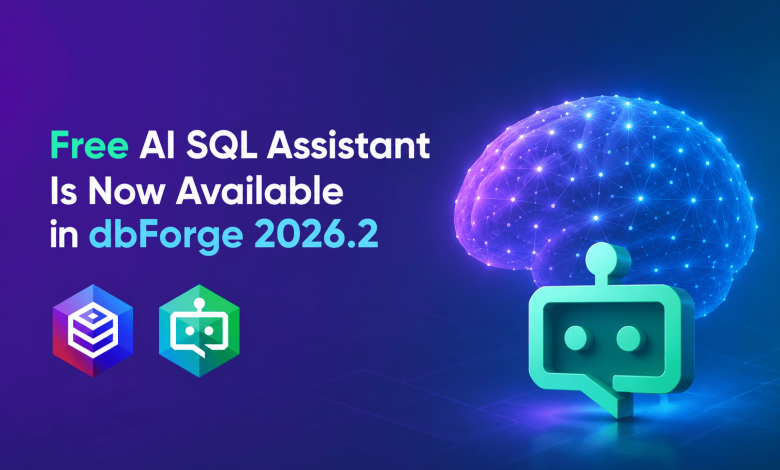
dbForge AI Assistant is free now. The new Express edition in dbForge 2026.2 brings AI right into the same environment where you write, fix, and make sense of SQL.
Most free SQL AI tools just give you a query and call it a day. Then the real work begins. Does it fit your schema? Is the dialect correct? Will it return anything like what you actually asked for?
That’s why people searching for the best free AI for SQL query work need more than a generator. dbForge maintains the Assistant within the database environment, where you can give it context, question the answer, transfer the SQL into the editor, and test it. It can generate, explain, fix and review queries without turning your workflow into copy, paste, and pray.
That is the part to pay attention to if you are looking at the best SQL AI tool for your everyday work.
Summary
- Get an initial query from a plain English request.
- See what an unfamiliar query is doing or where it’s going wrong.
- When it needs more to work with, give the Assistant files or database details.
- Try the Express edition to see if it covers the SQL work you do.
What changed for dbForge AI Assistant in release 2026.2?
dbForge 2026.2 releases free Express edition of dbForge AI Assistant. It has a small token limit and retains chats for 14 days. This gives you some time to try out the SQL work you do before committing to whether the paid plan is worth it.
The free one is the Assistant, not dbForge in its entirety. However, dbForge Studio itself is also available as a free Express Edition. Paid Assistant plans have a much larger token allowance, and the chat history remains there with no time limit.
The other big update is Context. You can auto-attach the document you are working on, instead of copy pasting the same code in each prompt. You can also attach files, keep multiple databases in one chat or compare two scripted databases. That context can be application code, a database project or diagram, sample code, or your own instructions, so the Assistant has more to go on before it begins answering.
Why are developers looking for free AI SQL tools?
Developers generally want free AI for SQL when they are stuck on a query. Maybe they need a place to start. Maybe the syntax is not making sense. Maybe they hit an error, have a query that is starting to take forever, or need to move code from one database to another.
A free SQL AI generator can start the ball rolling. You write what you need and it gives you a draft. The problems start when that draft has to work against a real database. “Show customers who had orders over a certain amount last month” is pretty vague. Are paid orders saved in Orders, or in a Payments table? What about the returns? What time zone is applicable? And this is for SQL-Server, MySQL or PostgreSQL?
That’s why you can’t run a free AI tool for SQL queries on a single sentence. You need table and column names, relationships, the desired result and the correct dialect. The value of free AI for SQL isn’t in getting a smart first draft. It is having something you can check, change, run.
What makes dbForge AI Assistant different from an online SQL generator?
The key difference is not that dbForge AI Assistant can produce SQL. There are many tools to do that. What makes the Assistant different is that it is context-aware and can work with your database schema. It is also a part of dbForge, so you can see the database, ask about a query, and take the answer into the SQL editor without switching to another tool.
An online generator is a good way to get a quick first go. However, if the query is based on a real schema, the process takes longer. You explain the tables in the prompt. Copy the result. Paste it into your database tool and see if it actually runs.
With dbForge, you can attach a database, describe your needs, read the answer and modify or test the query in the editor. In 2026.2 you can also add files and multiple databases to the same chat.
| Criterion | Standalone online SQL generator | dbForge AI Assistant |
| Where it runs | Web browser | Inside a compatible dbForge product |
| Context | Entered in the prompt | Attach schema metadata, files, and databases |
| What it can help with | Usually generating a query | Generating, explaining, fixing, and optimizing SQL |
| After it responds | Copy the SQL into another tool | Move it into the SQL editor and test it |
| Database support | Depends on the service | SQL Server, MySQL, MariaDB, Oracle, and PostgreSQL |
| Product questions | Usually not available | Can answer questions about dbForge features |
What can you do with the free AI SQL Assistant?
SQL work can start with a blank editor, a query you do not understand, or one that just will not work. The free Assistant can help with all three.
Generate SQL from natural-language requests
If you tell the Assistant the result you need it can draft a query. If you attach the database schema , it can utilize tables and relationships that are already in your database. Alternatively, you can upload files or example code to provide more context. For instance, “List the total paid order value for August 2026 for each customer.” “List highest totals first and omit other statuses.”
It can provide a first query. However, you still need to check what “paid” means, whether refunds are included and what time zone it relates to.
A free AI SQL code generator is more useful if it’s inside of the database tool. You can review the query and make changes and run it in the SQL editor.
Explain and troubleshoot existing SQL
The Assistant can explain an unfamiliar query, break down its clauses, and help identify likely syntax or logic errors. You only need to provide the query, database dialect, error message, and expected result.
Those details matter because a query can run successfully and still be wrong. A join may multiply rows, a filter may exclude valid records, or a group may be at the wrong level. Asking for the smallest possible correction and an explanation of the change gives you a clearer basis for review.
If you are looking for a SQL AI helper free of charge, use the Express plan to test this kind of focused troubleshooting. Validate the revised query on safe data before using it in a report, application, or production process.
Optimize queries and review SQL performance
In this way the Assistant can evaluate a query and suggest ways to reduce extraneous work, streamline its structure or consider indexing issues. The database context has the right index and metadata.
Remember, these are hypotheses, not performance results. Ask what the purpose of each rewrite is, what filter or join an index would help on and whether an existing index already covers it. Indexes speed up reads but consume space and slow down writes.
Then compare the original query and the revised query under the same conditions. First look at returned rows, then look at execution plans, elapsed time and resource consumption. Free SQL AI tools can help you to do a better investigation. But only measured behavior can show whether the change makes a difference.
Ask questions about SQL and dbForge tools
The Assistant is also a SQL-centric chat interface. You are welcome to ask questions about syntax, database concepts and approaches to writing queries, and features in the dbForge product that you use.
You can pick a model in Tools > Options > AI Assistant > General in the 2026.2 release. Options include Anthropic Claude Haiku 4.5, Sonnet 4.6, and Sonnet 5, as well as OpenAI GPT-5.4 and GPT-5.5. You can even share code snippets or custom instructions when you want responses to adhere to the conventions of a project.
This means the Assistant is more than a free AI SQL generator. This free SQL AI tool can also tell you how a query works, compare database scripts, or even find the right dbForge feature before you start clicking through menus.
Who can benefit from a free AI SQL Assistant?
The free Express edition is useful for developers, DBAs, analysts and learners. Start with work where you can tell whether the output is correct.
- SQL and database developers are able to write queries, explain unknown code, and discuss fixes, all from their development environment.
- DBAs can use suggestions as a way to start troubleshooting or review queries, then validate them with execution plans and workload evidence.
- Data analysts can take a reporting request, and immediately see how joins, filters and grouping change the result and generate draft SQL. Students & SQL learners can ask for an explanation, change a part of a query and compare the result in a practice database.
No assistant can eliminate the need to understand database structure, permissions, transactions, or execution impact. A schema change, delete or update generated deserves special care. The best free AI tool for SQL query work is still one the user reviews before executing.
Which databases does dbForge AI Assistant support?
dbForge AI Assistant supports SQL Server, MySQL, MariaDB, Oracle, PostgreSQL, and cloud services based on these database engines. Even if you are trying to get the same result a query written for SQL Server can break in PostgreSQL. Dates, row limits, quoted names, procedures, supported features all differ.
You do not use the Assistant as a stand-alone app . It is integrated into compatible dbForge products: dbForge Studio for SQL Server, MySQL, Oracle and PostgreSQL; dbForge SQL Complete; dbForge SQL Tools; and dbForge Edge. The database-development products are the Studios. dbForge SQL Tools and dbForge SQL Complete are compatible with SSMS and Visual Studio. Edge connects the four Studios for those working across databases.
When syntax depends on your database and version, specify these to the Assistant. This gives the first draft a better chance of fitting, but you still have to test it where the query is going to run.
Final thoughts
With the release of dbForge 2026.2, AI-assisted SQL is made easier with a free Express edition of dbForge AI Assistant. It is not only a way to get a query from a sentence. The Assistant is also able to explain, troubleshoot, review, optimize and answer product questions inside compatible dbForge tools.
Test the free offer with a known query or problem, and analyze the result closely, then check if its token allowance and chat-history limit fit your SQL workflow.
Frequently asked questions
Can dbForge AI Assistant use context from database schema?
Attach a database and the Assistant will be able to work with its meta data (e.g. schema and index information). You can also add more than one database to a chat or compare two scripted databases .
How can AI help to explain and fix SQL queries?
It could help. Give it the query, database dialect, error message, and what you expected. It can describe what the query is doing, identify likely problems and suggest a correction. Test the result before using it.
Can I upload a file to dbForge AI Assistant?
You can add application code, database projects, diagrams, sample SQL, and your own instructions. You can also configure it to attach the document you are working on.
Can I select which AI model dbForge AI Assistant uses?
Sure you can. Go to Tools > Options > AI Assistant > General and select the Anthropic and OpenAI models that are available in dbForge 2026.2.