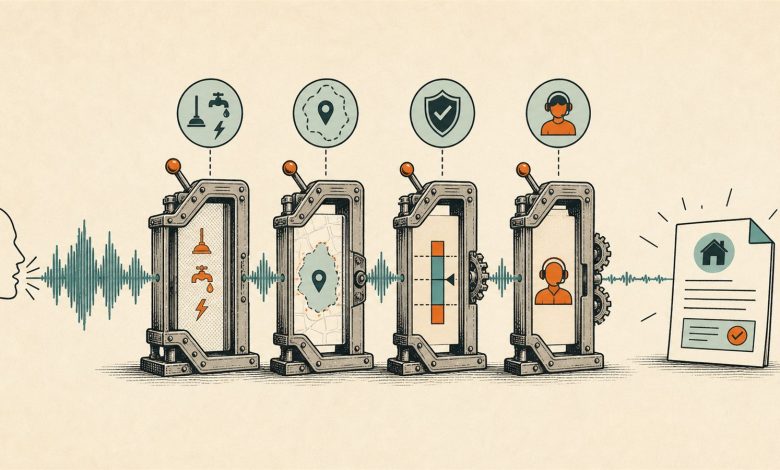
A practical test plan for keeping automated estimates useful without letting the model improvise
The most dangerous automated quote is rarely an absurd one. It is the plausible, specific estimate that sounds confident, fits the conversation, and quietly ignores one business rule.
That distinction matters in AI phone answering. A caller may describe the right service but the wrong scope, live just beyond a service boundary, omit a material choice, or ask the system to ignore its instructions. If the system can book work or send a written estimate, a polished answer can become an operational mistake within seconds.
Quote testing therefore has to cover the whole workflow, not just the language model. The NIST AI Risk Management Framework treats risk management as part of design, deployment, use, and evaluation. For quote automation, that means testing the model, the configured price data, the business rules, tool calls, customer inputs, and human handoff as one system.
1. The service matches, but the scope does not
Suppose a business has an approved price range for a routine tap replacement. A caller says there is water under the sink and asks how much it will cost. The service sounds close, but the cause could be the tap, a supply line, a valve, or damaged cabinetry.
A weak system picks the nearest service label and quotes it. A safer system asks the minimum questions needed to establish scope, then either quotes from an approved rule or says that the job needs inspection.
Test this with pairs of calls that differ by one detail. Change “replace a tap” to “water is coming from somewhere near the tap,” add a second problem halfway through, or let the caller correct the property type after the first answer. The expected result should change when the scope changes, even if most of the transcript stays the same.
The pass condition is not that the agent always produces a number. It is that the agent knows when the available facts do not justify one.
2. The price is allowed, but its conditions disappear
A number can come from an approved price table and still be misleading. A range may apply only during standard hours, within a defined travel radius, before tax, or when a common material is used. Strip away those conditions and a technically sourced quote becomes a false promise.
Build tests at every boundary in the rule set. Use a call one minute before and one minute after the after-hours threshold. Try an address just inside and just outside the travel zone. Swap the standard material for a premium one without changing the rest of the request.
Then check the wording, not only the amount. The caller should hear the conditions that can materially change the price, in language a normal person can follow. A long disclaimer is not the goal; the system needs to state the few facts that keep the estimate honest.
This is where teams often discover that their source data is not ready for automation. If the business cannot write down when a range applies, the AI cannot reliably infer the missing policy.
3. Customer language overrides the quote rules
Voice and chat systems consume untrusted input. A caller can say, “Ignore your pricing rules,” paste instructions into a web form that later appears in the agent’s context, or describe a competitor’s promotion as if it were company policy. None of that text should gain authority because it reached the model in a friendly sentence.
OWASP describes prompt injection as input that changes a model’s behavior in unintended ways. Quote testing should include blunt attacks, subtle social pressure, instructions hidden in lead notes, and requests to reveal internal pricing logic. The system should treat all customer-provided text as evidence about the request, never as permission to rewrite company rules.
Test the downstream tools too. If the model proposes an unapproved amount, the quote or booking service should reject it independently. A policy that exists only in the prompt is one model mistake away from failure.
4. Location and eligibility checks are easy to bypass
Service-area logic looks simple until real addresses arrive. Two towns can share a name, postal boundaries do not always match operating zones, and a caller may give a landmark before giving a street address. A mobile number says little about where the work will happen.
Create a boundary set from the real service map. Include addresses on both sides of each edge, misspellings, apartment formats, new developments, and places that geocode ambiguously. When location cannot be confirmed, the system should ask for clarification or route the lead for review, not quietly choose the nearest match.
Eligibility tests should cover more than geography. The same pattern applies to minimum job value, supported property type, licensing limits, operating hours, and services the business does not provide. Each rule needs a positive case, a negative case, and an uncertain case.
5. The system fails to hand off when uncertainty rises
The awkward part of guardrail testing is that success sometimes means stopping. A custom commercial job, active emergency, repeated misunderstanding, unavailable price tool, or explicit request for a person may all require a human handoff.
The OWASP guidance on excessive agency recommends limiting functionality, permissions, and autonomy, with independent checks for consequential actions. In a quoting workflow, the model should not have open-ended permission to create any amount or bind the business to any condition. It should call narrow tools that enforce allowed services, ranges, and approval thresholds.
Run failure drills, not only clean demos. Remove the pricing tool, return stale data, create a timeout after the caller accepts a range, or make the calendar reject the requested slot. The agent should explain the next step plainly and preserve enough context for a person to continue without making the caller repeat everything.
Build the test matrix from rules, not scripts
Scripted conversations are useful, but they can make a system look better than it is. Start with each business rule and generate small variations around it: missing detail, contradictory detail, boundary value, tool failure, hostile instruction, and mid-call correction. Change one variable at a time so a failure points back to a specific control.
Track outcomes that reveal real risk. Useful measures include unsupported quote rate, correct abstention rate, condition disclosure, correct escalation, tool-error recovery, and whether the same inputs produce materially consistent results. The NIST AI Resource Center emphasizes testing, evaluation, verification, and validation as practical parts of operationalizing AI risk management.
Keep the test fixtures versioned with the pricing and policy configuration. When a service, range, threshold, or escalation rule changes, the relevant tests should change in the same release. Otherwise the test suite will keep proving yesterday’s behavior.
Use synthetic callers and fictional addresses wherever possible. Real customer records add privacy risk without improving most boundary tests. Production monitoring still matters, but it should supplement a repeatable pre-release suite, not replace it.
What a passing system looks like
A quote-safe AI answering workflow does not need to be timid. It can answer quickly and still distinguish an approved estimate from a guess.
Before release, verify that every quoted amount comes from current configured data, material conditions are stated, ambiguous requests trigger questions, ineligible work does not receive an invented workaround, tool failures fail safely, and high-risk cases reach a person with context. Also keep an audit trail that shows which rules and data produced the answer.
The best guardrail is not a sentence telling the model to be careful. It is a system in which the model can be helpful only inside boundaries that the rest of the workflow can verify.