An AI agent can produce an answer in seconds. Making sure the enterprise data behind that answer is current can be a much more expensive problem.
That’s the opportunity Feldera is going after. The startup today announced $21.5 million in Seed and Series A funding from Inovia Capital, Costanoa Ventures Battery Ventures, and Databricks and Anyscale co-founder Ion Stoica.
Feldera’s pitch is that enterprises spend too much money repeatedly computing answers they already know. When a relatively small amount of underlying data changes, rebuilding an entire analytical result can mean paying to process a much larger volume of unchanged information.
The company wants to replace that cycle with a system that maintains results continuously. It says its technology can reduce compute costs by 95% or more and turn analytical pipelines that take hours into updates that arrive in less than a second.
Consider an agent checking whether a transaction should be approved, whether a shipment needs intervention, or whether a user has permission to access a particular resource. A fast response is useful only if the information supporting it reflects the relevant state of the business.
Refreshing that information more frequently can require more computation. Refreshing it less frequently leaves a gap between what has happened and what the system knows.
Feldera is betting that enterprises will increasingly need to close that gap without accepting a proportional increase in their infrastructure bills.
“Making timely decisions against massive amounts of fast changing data using traditional methods requires an immense amount of compute,” said Lalith Suresh, Feldera’s CEO and co-founder. “AI agents are only as good as the data they can access. So if that data is too stale because it is too expensive to compute, companies will burn tokens on agents that are just going to be wrong all the time.”
The mechanism behind Feldera’s product is called incremental view maintenance. The name is technical; the basic idea is fairly intuitive.
Imagine keeping a running sales total. When another order comes in, you can add its value to the existing total instead of reading every previous order and calculating the sum again. If an order is canceled, you adjust the total accordingly.
Feldera aims to apply that principle to the much more complicated SQL programs enterprises use to turn raw data into useful answers.
Rather than repeatedly executing a query from scratch, its engine converts the query into a program that maintains the result as the underlying data changes. The objective is to compute the effects of those changes while avoiding redundant work.
The challenge is moving beyond a simple running total. Enterprise queries can combine information from multiple tables, calculate aggregates, and feed other calculations. A change in one place can affect results elsewhere. Making that process automatic, and preserving the intended meaning of the original query, is central to Feldera’s proposition.
Its technical foundation is DBSP, short for Database Stream Processing, a mathematical framework developed by members of the founding team. Feldera describes the research as the basis for translating complex SQL into incremental computation with formal correctness guarantees.
In practical terms, the intended guarantee is that maintaining a result incrementally produces the same result as recomputing the corresponding query over the updated data.
The company is also trying to make adoption straightforward for teams that already have substantial investments in SQL and existing data infrastructure.
Feldera says its platform connects to enterprise data lakes, warehouses, and pipelines, allowing customers to bring their SQL workloads into the engine without rebuilding the surrounding architecture. It advertises migration without SQL code changes and positions the product as a way to avoid writing and maintaining custom streaming logic.
That matters because a faster engine has limited appeal if adopting it requires months of engineering work. Feldera’s commercial argument combines the potential savings from incremental computation with the prospect of making that computation accessible through tools and queries customers already understand.
The performance numbers span several measures. Alongside its claim of compute-cost reductions of 95% or more, Feldera reports that customers have reduced infrastructure costs by a factor of 10 on average, with reductions exceeding a factor of 100 for some workloads.
The company also says its engine can process millions of records per second and that certain workloads previously requiring a cluster can run on a single laptop.
Feldera says the product is already operating beyond demonstrations. According to the company, customers use it in production to maintain live views of data for fraud detection, logistics operations involving billions of dollars, and fine-grained authorization for AI agents.
Feldera’s broader proposition is that the same infrastructure can support human decisions and automated ones. Fraud analysts, operations teams, and AI agents may consume information differently; each can benefit from results that update promptly as the business changes.
The company’s founders arrived at that problem through systems research.
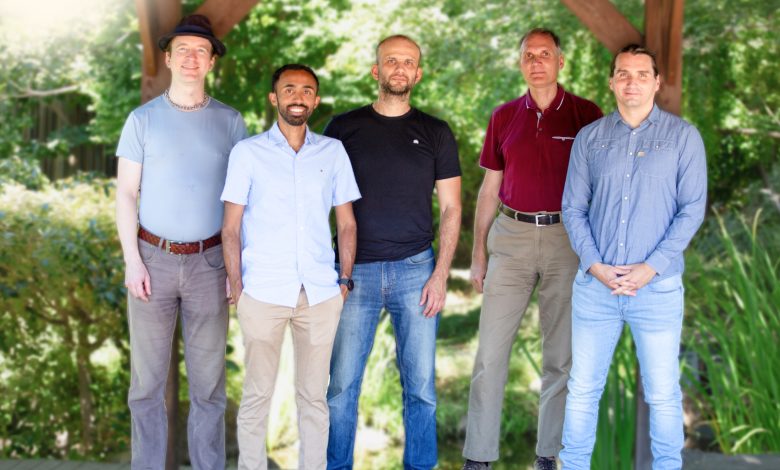
Suresh founded Feldera in 2023 alongside Leonid Ryzhyk, Mihai Budiu, Ben Pfaff, and Gerd Zellweger. All five previously worked at VMware Research. According to Feldera, the team collectively has published more than 200 research papers spanning database internals, distributed systems, and operating systems.
The company traces its origins to the researchers’ experience watching engineers build fragile, bespoke solutions for incremental processing. Instead of constructing another workaround for a particular workload, the group pursued a mathematical foundation that could support a broader approach.
That work became DBSP, which Feldera is now commercializing.
The investment thesis is that the research can translate into a meaningful change in the economics of enterprise data processing.
“The team at Feldera solved a 50-year-old fundamental database problem with rigorous mathematical proof,” said Taha Mubashir, a partner at Inovia Capital. “As enterprises scale their real-time AI initiatives, the cost and latency of traditional data compute become unsustainable. Feldera provides the foundational compute layer that enables companies to run continuous, complex analytics at a fraction of the cost.”
Companies can learn more today at https://www.feldera.com/