For years, organizations have invested in endpoint security solutions with one primary objective: to detect and prevent threats.
The World Economic Forum’s Global Cybersecurity Outlook 2025 reveals that 72% of organizations are seeing a climb in organizational cyber risks, with ransomware still a leading concern. Faced with an increasingly complex threat landscape, security teams have invested heavily in products that leverage advanced detection technologies, threat intelligence feeds, behavioural analytics, and machine learning models designed to identify malicious activity as quickly as possible. As a result, modern organizations generate thousands of security alerts every day.

Yet, the sheer volume of alerts has shifted the challenge from detection to investigation. The reason is straightforward. Detection is no longer the primary bottleneck in security operations. Threat investigation is.
The growing investigation gap
Most security teams aren’t struggling with a lack of visibility. They’re struggling with too much data and not enough context. Despite investments in advanced detection technologies, many security operations centers (SOCs) continue to struggle with alert fatigue, analyst burnout, slow incident response, and growing security risk.
A typical SOC analyst may receive hundreds of alerts during a shift. While many alerts point to legitimate concerns, each one raises a series of questions:
-
Is this activity truly malicious?
-
How did the incident start?
-
Which endpoints are affected?
-
Has the attacker moved laterally?
-
What is the root cause?
-
What action should be taken next?
Finding answers often requires analysts to jump between multiple consoles, review endpoint activity logs, correlate events, and manually reconstruct what happened.
This investigation process consumes significantly more time than the initial detection itself. As threat volumes continue to grow, investigation bottlenecks are becoming one of the biggest barriers to effective security operations.
Why every alert feels like a rabbit hole
Alert fatigue is often viewed as an issue of volume. In reality, it is largely an issue of effort. An SOC team can handle a high volume of alerts if the triage process is fast and clear. The real problem arises when every alert requires extensive manual analysis.
Analysts spend hours correlating endpoint telemetry, validating indicators of compromise (IoCs), tracing process execution, and reconstructing attack activity to determine whether an alert represents a real threat or a false positive. This leaves little time for proactive activities such as threat hunting and risk reduction. The result is a familiar cycle: investigations slow down, response times increase, critical alerts are missed, and analyst burnout follows.
Adding more detections to an already overloaded SOC does not solve this problem. Providing better investigative context does.
Turning scattered events into a clear incident story
An isolated alert says something suspicious happened. A complete investigation describes why it happened, how it unfolded, and what needs to happen next.
This is where attack timeline analysis becomes essential. Instead of forcing analysts to piece together individual events manually, modern EDR platforms can reconstruct the full sequence of actions tied to an attack. Analysts can quickly see how a threat entered the environment, which processes were executed, which users and accounts were involved, and how the activity evolved.
Similarly, incident correlation helps analysts connect related activities across endpoints and identify patterns that might otherwise remain hidden. Instead of investigating alerts individually, security teams gain a unified view of the incident as a whole.
The outcome: faster investigations, sharper decisions, and more accurate responses.
The clock starts after detection
Mandiant’s latest M-Trends 2026 report indicates that the global median attacker dwell time increased to 14 days. This means attackers are remaining in compromised environments longer, giving them more time to move laterally, escalate privileges, and achieve their objectives.
Every minute spent investigating an incident is a minute an attacker may still be active inside your environment. Whether the threat involves ransomware, credential theft, privilege escalation, unauthorized access, fileless malware, or living-off-the-land attacks, delays in investigation directly impact mean time to respond (MTTR). Many organizations focus heavily on improving detection rates, yet overlook the fact that response speed depends on investigation speed.
If it takes analysts hours to determine the scope and root cause of an intrusion, containment is delayed. And in that window, attackers can expand their foothold, access sensitive data, or disrupt operations entirely.
Reducing MTTR isn’t just about responding faster. It’s about enabling security teams reach conclusions faster through investigation-led workflows, not detection-led ones.
The investigation foundation of proactive security
Threat hunting is now a core part of modern security operations. But effective hunting depends on the ability to validate suspicious activity rapidly and correlate findings across the environment.
Without adequate context, threat hunting becomes slow and resource-intensive. Investigation-led EDR platforms help security teams connect related events, examine behavioural patterns, and trace attack paths without manually gathering data from multiple sources. Analysts can spend more time identifying emerging threats and less time assembling evidence.
This shift improves both SOC efficiency and analyst productivity while enabling a more proactive security posture.
The rise of investigation-led EDR
As cyberthreats evolve, the value of EDR is no longer measured by the number of detections it generates, but by how effectively it helps security teams investigate and respond to threats.
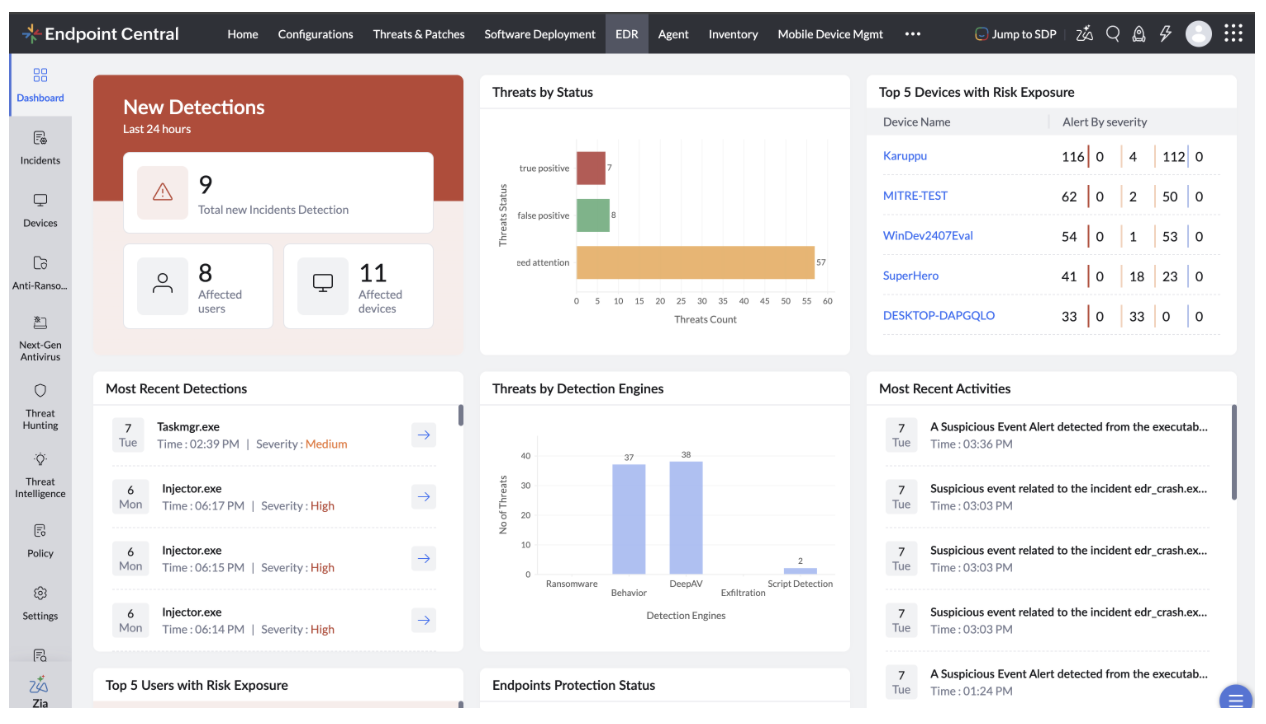
Endpoint Central EDR is built around this reality. Beyond threat detection, it delivers the context needed to accelerate investigation and response. Attack timeline reconstruction, root cause analysis, and deep attack chain visibility help analysts understand how an attack originated, unfolded, and spread. By correlating telemetry across processes, files, registry activity, and network connections mapped to the MITRE ATT&CK® framework, it delivers a comprehensive view of every incident. Zia AI streamlines investigations with AI-powered alert triage, natural language investigations, contextual threat insights, and threat hunting, while automated response helps reduce investigation time, lower MTTR, and improve SOC efficiency.
Jeyarani S is a Product Marketer at ManageEngine who believes technology is easier to trust when it’s easier to understand. She writes about endpoint protection and cybersecurity in simple, human language for everyday readers.