
Behind every 60-second VIN check is one of the messier applied-data problems in consumer tech: reconciling 70+ sources that disagree about the same car.
The vehicle history report looks like one of the internet’s most boring products: type in a code, get a PDF. Underneath, it’s a genuinely hard applied-data problem — one that has quietly become a showcase for the unglamorous side of AI: entity resolution, anomaly detection, and probabilistic reconciliation of sources that contradict each other constantly.
Consider what a single report actually asserts. This specific physical object — one of roughly 290 million registered vehicles in the US — was assembled in this plant, titled in these states in this order, crashed here, recalled for these defects, sold at this auction, and has driven this many miles. No single database knows all of that. Assembling it means merging federal recall data, fifty-plus state DMV title systems with fifty-plus different schemas, insurance-industry theft and total-loss records, and a churn of auction and dealer feeds. Consumer platforms like Zilocar reconcile more than 70 such sources per vehicle and process over 30,000 VIN checks a day, returning a structured report in under a minute.
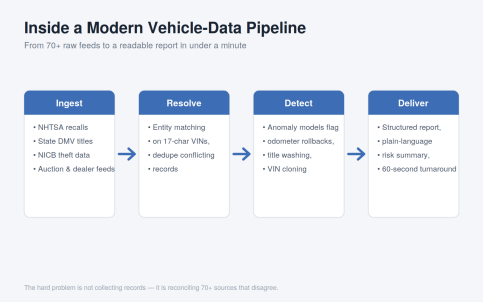
Collection is the easy part — the value is created in the resolve and detect stages.
The join key that makes it possible
The system works because the automotive industry accidentally built one of the world’s best entity identifiers back in 1981: the 17-character VIN. It encodes manufacturer, specifications, model year, plant, and a unique serial — and, critically, position nine is a check digit, so the identifier validates itself. That’s a luxury most entity-resolution problems in healthcare or finance would kill for.
But a clean join key doesn’t mean clean joins. Records arrive with transposed characters from manual entry, mileage in conflicting units and formats, dates that disagree across systems, and — the adversarial case — deliberately cloned VINs, where a stolen vehicle wears a legitimate car’s identity. Resolution logic has to decide when two conflicting records describe the same event twice, two different events, or one real event and one fabrication.
Fraud detection is the actual product
The report’s consumer value concentrates in a few adversarial detections, and each is a pattern-recognition problem over the assembled timeline. Odometer rollback is a monotonicity violation: mileage must never decrease across the event sequence, so a drop — or an implausible flatline on an aging vehicle — flags fraud. Title washing is a graph problem: branded titles (salvage, flood) that traverse states with weaker brand-carryover rules and re-emerge clean form a recognizable path through the title chain, often with a temporal signature clustered around named storm events. VIN cloning surfaces as geographic impossibility — one identity generating simultaneous records in distant states.
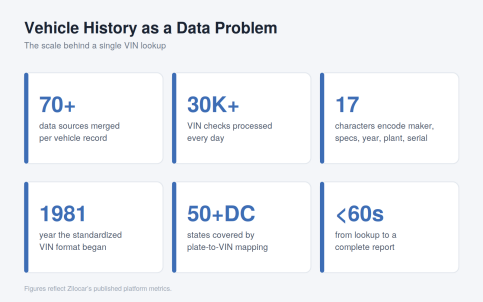
The scale of the problem behind a single consumer lookup.
These detections reward exactly the toolkit the ML community has spent a decade refining for fraud in payments: sequence modeling over event timelines, anomaly scoring against fleet-level priors, and graph analysis of transfer chains. The domain twist is data sparsity per entity — most cars generate a few dozen lifetime events, so models lean on population-level patterns rather than deep per-entity histories.
Coverage itself behaves like a network effect. Each additional source added to the pipeline raises the probability that any given fraud pattern leaves a detectable trace somewhere — a washed title is only invisible if every state it touched is missing from the corpus. Breadth, not any single premium source, is what makes the adversary’s job hard, which is why source count has become the category’s headline metric.
The LLM layer: from data product to answer product
The newest shift is at the presentation layer. A history report is a dense, jargon-heavy artifact — brand codes, event taxonomies, coverage caveats — and the emerging pattern across consumer data products applies here: use language models to translate the structured output into a plain-language risk narrative and to answer the buyer’s actual question, which is never “enumerate the records” but always “should I worry about this car?” Summarization over verified structured data is also the low-hallucination-risk end of the LLM deployment spectrum: the facts are retrieved, not generated.
There’s a market-structure effect too. Report quality is now legible to comparison: independent evaluators like Best Vehicle History Report benchmark providers on coverage depth, auction-data access, and accuracy, which pressures the industry on the data problem itself rather than on brand recognition — historically the moat of the category’s incumbents.
The privacy boundary as a design constraint
One underappreciated aspect of the category is that its data governance is legislated, and the systems are architected around it. The Driver’s Privacy Protection Act draws a hard line: a consumer VIN or plate lookup may return vehicle facts — title status, accident events, specifications — but never the registered owner’s identity, address, or license data, which remain gated behind DPPA-qualifying purposes at the state DMV level. For AI practitioners this is a live case study in privacy-by-architecture: the pipeline deliberately resolves entities at the vehicle level while refusing to join to the person level, even though the joins are technically trivial. As regulators circle consumer data products generally, categories that solved the where-is-the-line problem decades ago repay study.
The constraint also shapes model design. Risk scoring must work from vehicle-event features alone — usage patterns, transfer cadence, geographic history — without demographic signal. It turns out that’s sufficient: the vehicle’s behavior over time is predictive enough, an encouraging data point for anyone arguing that useful consumer AI doesn’t require maximal personal data collection.
Why this niche matters beyond cars
Vehicle history is a preview of a broader class of consumer AI product: high-stakes decisions (a used car is most households’ second-largest purchase), fragmented authoritative sources, adversarial data pollution, and a user who needs a verdict rather than a database dump. Healthcare records, property history, and background screening all share the shape. The lesson from the VIN-check world is that the differentiator isn’t any single model — it’s the unglamorous pipeline: ingest everything, resolve entities ruthlessly, detect adversarial patterns, and only then let a language model do the talking.