The economic misalignment at the heart of how we build – and buy – transformation, and why AI is finally ending it
Picture the modern enterprise operations center: dashboards surfacing anomalies in real time, AI flagging supply constraints before they become shortages, analytics predicting customer churn weeks before it happens. More signal than any previous generation of executives could have imagined.
And yet.
Across nearly fifteen years of conversations with executive teams – manufacturers, distributors, food producers, retailers – I keep encountering the same paradox. Organizations are becoming genuinely better at identifying what is wrong. They are not becoming proportionally faster at fixing it.
The challenge in enterprise transformation is no longer seeing. It is acting.
McKinsey’s research1 spanning fifteen years of organizational transformations puts a number to what many executives already sense: fewer than one in three transformation efforts succeed at improving performance and sustaining those improvements over time. Even among the companies that do succeed, organizations capture on average only 67 percent of the financial benefit their transformation could have achieved. The rest – often the majority of the value – simply never materializes.
This is not a data problem. It is not, in most cases, even a decision-making problem. It is an accountability problem. More specifically, it is the consequence of a structural misalignment that has sat at the center of enterprise transformation for thirty years – one that technology alone has never been able to fix.
Understanding that misalignment is the first step toward something genuinely better.
The Bottleneck That Keeps Moving
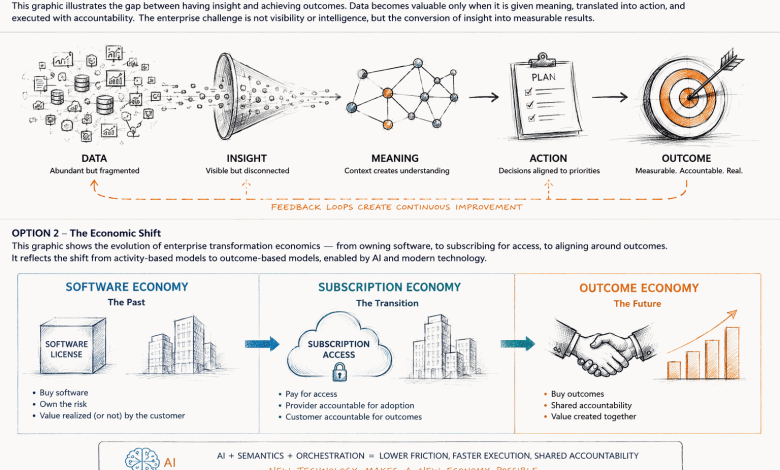
For much of the last three decades, enterprise technology focused on reducing uncertainty. ERP systems standardized operations. Analytics platforms exposed performance. Cloud accelerated access. AI now promises reasoning at scale.
Each technological wave solved a real problem. Each also revealed a constraint waiting behind it. The bottleneck in enterprise transformation has migrated steadily: from data collection to visibility, from visibility to decision-making, from decision-making to coordination, and increasingly from coordination to execution itself.
I watched this pattern closely during my years building OpsVeda. We set out to solve operational intelligence – helping organizations see across complex, fragmented supply chains. And for a time, better visibility was the answer.
But every improvement in visibility revealed another constraint. Organizations could identify issues earlier, understand implications faster, anticipate disruptions more clearly. Yet many still struggled to respond with the speed required to create competitive advantage.
The issue had moved downstream. The issue was no longer seeing. It was acting.
What we discovered in the process – and what I believe remains the most underappreciated insight in enterprise transformation – is this: the gap is not created by missing data. It is created by missing meaning. Data explains what happened. Meaning explains why it matters and what to do about it.
Outcomes emerge only when the two are connected: when intelligence is grounded in business context, wired into operational workflows, and accountable to execution. Isolated, even the most sophisticated intelligence remains a recommendation sitting in a dashboard. Acted upon within the right context and structure, it becomes competitive advantage.
That realization ultimately led me to a conclusion that surprised me: the fundamental constraint in enterprise transformation is not technological. It is economic.
The Misalignment Nobody Talks About
Enterprises invest in transformation to create measurable business outcomes – growth, productivity, resilience, customer satisfaction, profitability.
The ecosystem supporting those efforts has historically been compensated for something different: software deployments, implementation milestones, project completion, consulting effort.
Customers have owned outcomes. Providers have owned activity. And those are not the same thing.
This is not an indictment of the enterprise software industry, which has created genuinely enormous value. But it explains why so many transformation initiatives generate impressive levels of activity while delivering less than their potential business impact. The incentives were never fully aligned.
For decades, that misalignment was tolerable because there was little practical alternative. Creating measurable business outcomes required years of implementation effort, large consulting teams, extensive customization, and significant organizational change. Providers could influence outcomes. They simply could not do so efficiently enough to share meaningful accountability for them.
That constraint is now beginning to disappear.
The Emergence of the Outcome Economy
Every major era of enterprise technology has been defined by a distinct economic model.
The Software Economy was built around ownership – organizations purchased software and assumed primary responsibility for value realization. The Subscription Economy shifted toward adoption and engagement – providers became more accountable for usage, but customers still carried most of the responsibility for business outcomes.
The next progression is what I believe will become known as the Outcome Economy.
In the Outcome Economy, organizations increasingly purchase outcomes rather than technology alone. Providers increasingly participate in the value they help create. Technology remainsessential – but it becomes a means, not the destination. The measure of success in enterprise transformation shifts from deployment to impact, from activity to value creation, from implementation to outcomes.
The implications extend well beyond pricing models. This reshapes how transformation initiatives are conceived, measured, governed, and executed. And most importantly, it aligns the incentives of providers and customers around a common objective: value creation.
Why AI Changes the Equation
The significance of AI is not that it makes enterprise transformation smarter. Its significance is that it changes the economics of transformation.
Artificial intelligence reduces the effort required to reason, analyze, coordinate, and recommend. Semantic systems reduce the effort required to understand business context. Modern orchestration platforms reduce the effort required to execute across systems, functions, and teams. Together, these innovations are compressing months of work into weeks.
For the first time, providers can realistically participate in outcomes – because they can influence those outcomes faster, more consistently, and at dramatically lower cost than was ever previously possible.
This is not merely a technological breakthrough. It is an economic one. It changes not what technology can do, but what accountability is now possible.
What This Means for Enterprise Leaders
The most important question this raises is not operational. It is structural.
For generations, enterprise transformation has been organized as a series of discrete programs – each with a fixed scope, a finite timeline, and a defined end state. That model was designed for a world in which change happened slowly enough for projects to contain it. Markets no longer cooperate. Supply chains shift, competitive pressures emerge, and customer expectations evolve continuously. Transformation programs that end are programs that fall behind.
The organizations that will define the next decade are already reconceiving transformation not as a sequence of initiatives but as a continuous operating capability – one that persistently identifies opportunities, activates intelligence, and converts both into measurable outcomes.
The question enterprise leaders should be asking is not “how do we get more from our AI investments?” It is more fundamental: Are our transformation programs structured for a world where providers can share accountability for outcomes – and are we demanding that of them?
The organizations that thrive will not necessarily be those with the most advanced technology. They will be those who insist on measuring enterprise transformation by what was achieved rather than what was deployed – and who build the operating models and partnerships that make that accountability real.
The Outcome Era
Historians tend to describe eras by the technologies that defined them. The industrial era was shaped by machines. The information era by software. The last two decades by connectivity, cloud, and digital platforms.
The next era of enterprise transformation may be remembered differently – not by the technologies it introduced, but by the economic relationships it changed.
For years, transformation was measured by what was deployed. The next decade will measure it by what was achieved.
This is the shift that matters. Not because it changes software. Because it changes accountability.
Enterprise transformation has never lacked for intelligence. What it has lacked – for thirty years – is a model in which the people delivering transformation are fully accountable for the outcomes it creates.
That model is now becoming possible.
Not because AI has arrived.
Because accountability finally can.