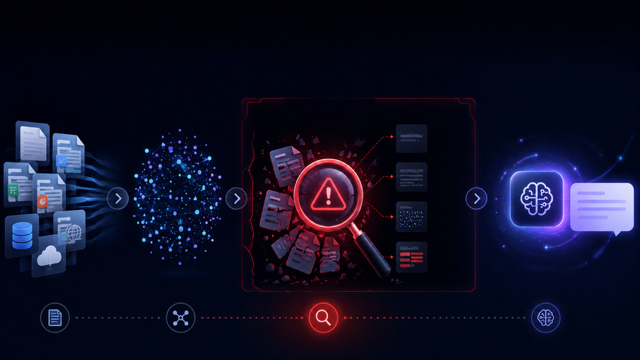
Enterprise AI systems are not failing because large language models are incapable. In many cases, they are failing because retrieval was never designed as a system.
In most enterprise RAG deployments, the failure does not begin at generation time. It starts earlier, when teams treat document ingestion as if it were equivalent to knowledge ingestion. That assumption can survive early demos, where the system is tested on clean PDFs, wiki pages, and well-structured text. It breaks in production, where real queries hit screenshots, diagrams, scanned workflows, dashboard exports, nested tables, and product images whose meaning does not live in plain text.
I have seen this pattern repeatedly. A team connects an LLM to a vector store, runs a few polished demonstrations, and gets plausible answers. Then production traffic arrives, query patterns change, and retrieval quality drops. Latency increases as the system falls back to heavier inference paths. Storage expands, indexing costs creep upward, and users start blaming the model for hallucinations. In reality, the model is often operating exactly as designed. The failure begins earlier, because the retrieval layer never had the right context to supply.
This is why enterprise RAG should not be framed only as an AI problem. It is a distributed systems problem that spans ingestion, storage, compute, indexing, network locality, observability, governance, and cost control. When those decisions are not designed together, retrieval becomes the first place the architecture breaks.
Retrieval breaks when systems confuse files with meaning
A file repository is not the same thing as a usable knowledge layer, even though enterprise teams often treat it that way in the early stages of an AI project.
Many retrieval pipelines still work like this: chunk documents, generate embeddings, and push everything into a vector database. That approach works reasonably well for linear text. It breaks once the corpus includes visual or mixed-format content, where the most important information may have very little useful text surface.
A chart in a financial report may contain the actual answer. A compliance diagram may define the control boundary. A screenshot may capture the configuration state that explains an outage. A scanned workflow may reveal the real approval path better than the surrounding paragraphs. If the ingestion pipeline stores these assets as binary objects with filenames, weak OCR, or generic captions, the retrieval layer never sees what a human operator would immediately use.
This is where enterprise teams often think they have a generation problem, when in reality they have an extraction problem.
The architectural question should not be, “Did we ingest the file?” It should be, “Did we extract a retrievable meaning?” That shift changes ingestion from a parser pipeline into a modality-aware system. Even a simple asset classifier forces the right architectural branch early:
from enum import Enum
from dataclasses import dataclass
class AssetType(str, Enum):
TEXT = “text”
PDF = “pdf”
IMAGE = “image”
HYBRID = “hybrid”
UNKNOWN = “unknown”
@dataclass
class Asset:
uri: str
content_type: str
extension: str
size_bytes: int
def classify_asset(asset: Asset) -> AssetType:
ext = asset.extension.lower()
if ext in {“.png”, “.jpg”, “.jpeg”, “.webp”}:
return AssetType.IMAGE
if ext == “.pdf”:
return AssetType.PDF
if ext in {“.pptx”, “.docx”, “.html”}:
return AssetType.HYBRID
if ext in {“.txt”, “.md”, “.json”, “.csv”}:
return AssetType.TEXT
return AssetType.UNKNOWN
Once the system explicitly knows it is processing text, images, PDFs, or hybrid assets, it can apply different extraction, chunking, validation, and indexing paths. Without that split, teams end up with a generic ingestion flow that treats everything like text and quietly loses the most valuable context in the corpus.
The worst place to solve multimodality is the query path
One of the most common mistakes in enterprise AI architecture is pushing multimodal interpretation into query-time processing.
The idea sounds efficient at first. Keep ingestion simple, store raw assets, and let a multimodal model interpret visual content only when a user asks a relevant question. That pattern can look flexible in an early prototype, but it introduces serious operational issues once usage scales.
Latency becomes less predictable because visual interpretation is slower and more expensive than retrieval. Observability weakens because retrieval quality now depends on a runtime inference branch instead of a controlled ingestion pipeline. Cost volatility increases because repeated queries against the same artifacts keep invoking the most expensive part of the stack.
In production environments, the tradeoff usually flips. Expensive interpretation belongs as close to ingestion as possible, where results can be cached, validated, versioned, and reused. Retrieval should not be discovering meaning from scratch on every query. It should be ranking meaning that has already been extracted and normalized.
That is why multimodal enterprise systems need an intermediate semantic record:
def build_semantic_record(asset_id: str, model_result: dict) -> dict:
return {
“asset_id”: asset_id,
“asset_kind”: model_result[“asset_kind”],
“summary”: model_result[“summary”],
“entities”: model_result.get(“entities”, []),
“observations”: model_result.get(“observations”, []),
“source_uri”: model_result[“source_uri”],
“security_tags”: model_result.get(“security_tags”, []),
“timestamp”: model_result[“timestamp”]
}
For a chart, that record may capture trends, anomalies, labels, and comparisons. For a network diagram, it may capture boundaries, flow direction, and component relationships. For a dashboard screenshot, it may capture metric names, thresholds, and visible status conditions. That is what makes visual content retrievable. Not the image itself, and not a generic caption, but a structured semantic contract that can be ranked, filtered, and governed.
Hybrid retrieval is not optional
Enterprise retrieval is too complex to rely on a single access pattern.
Vector search is valuable, but it does not solve enterprise retrieval on its own. Semantic similarity works well for conceptual questions, but it often fails when users need exact matches such as control IDs, policy names, regulation references, configuration strings, or internal entity names. Keyword retrieval helps with precision, but misses semantically equivalent language. Metadata filtering becomes equally important when the corpus is partitioned by business unit, sensitivity class, region, freshness, or access policy.
A robust enterprise retrieval layer combines at least three coordinated signals: semantic retrieval for conceptual similarity, lexical retrieval for exact anchors, and metadata filtering for scope and governance. Those signals then need to be fused during ranking.
def rank_results(vector_score, bm25_score, freshness_score, policy_match):
return (
0.45 * vector_score +
0.30 * bm25_score +
0.15 * freshness_score +
0.10 * policy_match
)
The precise weights will vary by workload, but the principle remains constant: no single retrieval method is sufficient for enterprise corpora.
Cost starts breaking the architecture before inference does
Many AI discussions focus primarily on model inference cost. In production systems, that is often not the first place architecture starts losing control.
The hidden spend tends to accumulate earlier, in ingestion fan-out, repeated parsing, unnecessary re-embedding, cross-region data movement, excessive logging, duplicated storage, and refresh strategies that ignore content volatility. These costs are easy to underestimate because they build gradually across the pipeline rather than appearing in a single model bill.
The same lesson appears across cloud architecture more broadly. Cost becomes difficult to manage when teams optimize services individually rather than tracing workload behavior end to end. Enterprise RAG is no different. Retrieval is not only a relevance surface. It is also a cost surface.
A few decisions matter disproportionately. Do not re-embed unchanged content. Use content hashes and version markers so refresh jobs are selective. Keep extraction close to the object store and primary index when data movement is significant. Avoid logging raw payloads into expensive analytics systems unless those logs are genuinely needed. Do not run multimodal extraction on every image indiscriminately if business rules can filter duplicates, decorative assets, or low-value content first.
These are not minor optimizations. They determine whether the system remains economically viable as usage scales.
Governance has to begin before content becomes searchable
Governance applied at query time is already too late.
If sensitive content has been indexed, the architecture has already crossed the wrong boundary. That means the ingestion pipeline must enforce the first security and compliance boundary, before a semantic record is published into a searchable system. Redaction, classification, omission of restricted fields, and regional retention policy need to happen before publication, not after retrieval.
That principle can be expressed simply:
def validate_record(record: dict) -> None:
if not record[“summary”]:
raise ValueError(“Missing summary”)
if “restricted” in record.get(“security_tags”, []):
raise ValueError(“Restricted content cannot be indexed”)
if len(record[“summary”]) > 5000:
raise ValueError(“Summary too large”)
Once content enters the retrieval layer, control becomes harder, auditing becomes more complex, and compliance risk increases. Well-architected systems enforce those boundaries before content becomes searchable.
Cloud architects need to own the retrieval layer
One reason enterprise AI projects stall after promising pilots is that retrieval gets treated as an application detail when it is actually a platform responsibility.
It touches ingestion topology, queue isolation, event design, storage placement, indexing policy, compute locality, observability, security controls, and cost management. Those are architecture decisions, not prompt engineering details. When they are deferred until after a prototype succeeds, the production system inherits weaknesses that are expensive to unwind later.
In most enterprise systems I have seen, this is where failure begins. Not because the models are bad, but because retrieval was treated as a convenience feature instead of a governed subsystem.
The fix is architectural. Classify assets early. Extract meaning during ingestion, not at query time. Normalize text and visual content into structured records. Fuse semantic, lexical, and metadata signals. Control refresh cost. Enforce governance before publication.
When those elements are in place, generation quality improves as a consequence. Until retrieval is treated as a first-class system, enterprise RAG will continue to fail silently, not because models are weak, but because architecture never gave them the context required to succeed.