Introduction
Artificial intelligence is often presented as a universal technology whose deployment depends primarily on developing better models. Benchmark leaderboards, cloud-hosted APIs, and increasingly capable foundation models dominate conversations about AI progress. Yet the environments in which these systems are ultimately deployed vary dramatically, and nowhere is this more apparent than in countries such as Pakistan, where infrastructure constraints frequently become engineering constraints.
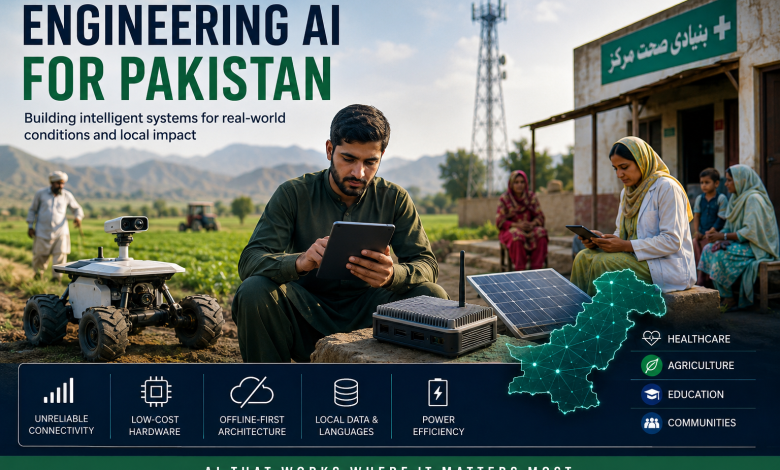
Designing an AI system for Pakistan involves solving a different set of technical problems than designing one for Silicon Valley or Western Europe. Engineers cannot simply assume uninterrupted broadband connectivity, unlimited cloud computing resources, or users carrying the latest flagship smartphones. Instead, they must consider intermittent internet access, limited computing resources, constrained power availability, affordability, and the absence of large, locally representative datasets before a single line of model code is written.
These constraints fundamentally influence system architecture. Decisions about where inference should occur, how models are compressed, how data are collected, and even which machine learning techniques are practical often become more important than marginal improvements in benchmark accuracy. In many applications, an AI model that achieves slightly lower accuracy but runs entirely offline on affordable hardware may provide greater real-world value than a larger cloud-dependent model that cannot operate reliably in the environments where it is needed most.
Pakistan provides an excellent example of why AI deployment should be viewed as an engineering challenge rather than solely a machine learning problem. Agriculture contributes approximately one-fifth of Pakistan’s gross domestic product and employs a substantial proportion of the national workforce, while healthcare and education continue expanding into rural communities where connectivity remains inconsistent. These sectors represent some of AI’s most promising application areas, yet they also highlight the practical limitations of architectures designed around constant cloud connectivity and high-performance computing infrastructure. According to the Pakistan Telecommunication Authority (PTA), mobile broadband adoption continues to expand, but coverage quality, device capabilities, and internet affordability remain highly variable across urban and rural regions. Similarly, reports from the International Telecommunication Union (ITU) continue to identify meaningful differences in digital access between developed and developing economies.
The engineering community has already begun responding to these realities through advances in edge computing, efficient neural network architectures, federated learning, model quantization, and open-source robotics platforms. These technologies are not simply methods of reducing computational cost, they represent a shift toward designing AI systems that acknowledge the operational realities of their deployment environments.
This article explores why building AI systems for Pakistan requires different engineering decisions than those commonly presented in research literature. Rather than viewing infrastructure limitations as obstacles, it argues that these constraints are driving a new generation of engineering solutions focused on efficiency, resilience, affordability, and local relevance, qualities that may ultimately become as important as model accuracy itself.
The Hidden Assumptions Behind Modern AI
Many of today’s artificial intelligence systems are developed in environments where computing resources are abundant and network connectivity is rarely questioned. During development, engineers often assume that inference requests can be sent to cloud servers within milliseconds, that datasets can be continuously synchronized, and that software updates can be deployed instantly to every device. While these assumptions simplify system design, they do not always reflect deployment conditions in countries such as Pakistan.
Cloud computing has undoubtedly accelerated AI innovation. Large language models, computer vision systems, and speech recognition services increasingly rely on centralized infrastructure where high-performance GPUs perform inference on behalf of millions of users. This architecture enables rapid model updates, centralized security management, and virtually unlimited computational scalability. However, it also assumes reliable internet connectivity, predictable network latency, and sufficient bandwidth to transmit data continuously between client devices and remote servers.
For many applications, this assumption is entirely reasonable. Enterprise software operating in urban business environments or research laboratories benefits significantly from cloud-native architectures. Problems begin to emerge when the same design philosophy is applied to sectors where connectivity is intermittent, bandwidth is expensive, or deployment occurs far from major urban centers.
Pakistan illustrates this challenge particularly well. According to the International Telecommunication Union (ITU), internet usage has continued to grow across the country, while the Pakistan Telecommunication Authority (PTA) reports steady expansion of mobile broadband services. Yet national connectivity statistics do not fully capture the variability experienced by users. Network quality, device capability, affordability, and geographic location all influence whether a cloud-dependent AI application performs consistently in practice. (ITU DataHub – Pakistan: https://datahub.itu.int/data/?e=PAK; Pakistan Telecommunication Authority Annual Report 2024: https://www.pta.gov.pk)
The distinction between network coverage and effective digital access is particularly important from an engineering perspective. A region may technically have mobile broadband coverage while still presenting significant challenges for AI deployment due to fluctuating signal quality, limited data allowances, or lower-end smartphones with restricted processing power and storage capacity. These factors influence architectural decisions long before model development begins.
The GSMA Mobile Economy reports describe this difference as the usage gap, the difference between populations living within mobile broadband coverage and those actively using mobile internet services. This gap is influenced by affordability, digital literacy, device availability, and other socioeconomic factors rather than infrastructure alone. For AI engineers, this means that designing exclusively for cloud connectivity may inadvertently exclude a significant proportion of intended users. (GSMA: The Mobile Economy – Pakistan and Digital Inclusion reports: https://www.gsma.com)
These realities require a shift in engineering priorities. Instead of asking, “How can we build the most accurate model?”, developers must also ask, “Where will inference occur?”, “How much memory is available?”, “Can the application tolerate network interruptions?”, and “How frequently can the model realistically be updated?” These questions influence every layer of system architecture, from model selection and compression to storage, synchronization, and user experience.
Consequently, AI deployment in Pakistan often becomes an optimization problem rather than simply a machine learning problem. Engineers must balance accuracy against computational cost, latency, energy consumption, storage requirements, and operational reliability. A model that achieves marginally lower benchmark performance but runs entirely offline on affordable hardware may ultimately provide greater societal value than a larger cloud-based model that cannot be deployed reliably where it is most needed.
This perspective is increasingly reflected in modern AI engineering. Rather than treating infrastructure constraints as temporary obstacles, researchers and practitioners are developing architectures specifically intended for edge devices, embedded systems, and bandwidth-constrained environments.
Why Edge AI Matters More Than Cloud AI in Pakistan
One of the most significant shifts in modern AI engineering is the movement from cloud-based inference toward edge AI, running machine learning models directly on local devices rather than remote servers. While cloud computing remains essential for training large models and managing centralized services, edge AI offers a compelling alternative for applications where connectivity, latency, cost, or privacy become critical constraints.
In Pakistan, many AI applications are deployed in environments where continuous cloud connectivity cannot always be assumed. Agricultural monitoring may occur in remote farming regions, healthcare solutions may be used in rural clinics, and educational technologies may serve communities with inconsistent internet access. In these scenarios, transmitting every image, sensor reading, or user interaction to a cloud server introduces dependency on network availability that may reduce system reliability.
Edge AI changes this design philosophy by moving inference closer to the source of data. Instead of sending information to a remote GPU, optimized neural networks execute directly on embedded computers, smartphones, or specialized AI accelerators. This reduces latency, lowers bandwidth consumption, and enables systems to continue operating even when internet connectivity is unavailable. Frameworks such as PyTorch ExecuTorch, TensorFlow Lite, and ONNX Runtime have been developed specifically to support efficient deployment on resource-constrained devices, demonstrating a broader industry shift toward on-device intelligence.
This architectural shift does not eliminate the cloud; instead, it redefines its role. The cloud becomes responsible for model training, fleet management, and periodic software updates, while day-to-day inference occurs locally. For engineers designing AI systems in Pakistan, this hybrid architecture often provides a more practical balance between computational capability and operational resilience.
The Data Problem: Building Models Without Pakistani Datasets
Infrastructure is only one aspect of the engineering challenge. Equally important is the availability of representative data.
Many state-of-the-art AI models are trained using datasets collected primarily in North America, Europe, or East Asia. While these datasets have accelerated progress in computer vision and natural language processing, they frequently underrepresent the languages, environments, and operating conditions encountered in Pakistan. As a result, models that perform well on international benchmarks may experience reduced accuracy when deployed locally.
Natural language processing provides a clear example. Pakistan is linguistically diverse, with Urdu serving as the national language alongside regional languages such as Punjabi, Sindhi, Pashto, Balochi, and Saraiki. Everyday communication often involves code-switching between Urdu and English, while social media introduces Roman Urdu spellings that lack standardized orthography. Recent research presented at the Association for Computational Linguistics (ACL) highlights these challenges and emphasizes the need for locally representative datasets rather than relying solely on translated English corpora.
The same principle applies to computer vision. Agricultural datasets collected in other countries may not accurately represent Pakistan’s crop varieties, cultivation practices, lighting conditions, or environmental characteristics. Building AI systems that generalize effectively therefore requires not only larger datasets but also better local data collection strategies, careful annotation, and continuous evaluation within the intended deployment environment.
Engineering for Resource-Constrained Hardware
Hardware limitations influence AI system design just as much as software architecture.
Large neural networks containing billions of parameters have demonstrated remarkable capabilities, but deploying these models directly on affordable consumer hardware is rarely practical. Engineers therefore employ techniques such as quantization, pruning, knowledge distillation, and efficient neural network architectures to reduce computational requirements while preserving acceptable accuracy.
Quantization, for example, converts model weights from high-precision floating-point representations to lower-precision formats such as INT8 or FP16, reducing both memory consumption and inference time. Similarly, lightweight architectures such as MobileNet, EfficientNet-Lite, and other compact models have been developed specifically for deployment on smartphones and embedded devices.
These optimization techniques illustrate an important engineering principle: practical AI is not always about building larger models. Instead, success often depends on delivering reliable performance within the computational limits of the target hardware.
Engineering AI for Pakistan
Designing AI systems for Pakistan ultimately requires recognizing that infrastructure constraints are part of the engineering specification rather than exceptions to it. Connectivity, affordability, hardware capability, language diversity, and locally representative datasets all influence architectural decisions from the earliest stages of development.
This perspective encourages engineers to prioritize resilience alongside accuracy. Offline-first applications, efficient edge inference, modular system architectures, and continuous local evaluation become essential design objectives rather than optional optimizations. The resulting systems are often more robust, easier to maintain, and better suited to the environments in which they will operate.
Importantly, these design principles are not unique to Pakistan. Similar engineering considerations arise across many emerging economies, suggesting that solutions developed locally may ultimately contribute to AI deployments worldwide. As edge computing, model optimization, and open-source AI ecosystems continue to mature, techniques originally motivated by infrastructure constraints may become standard practice even in highly connected environments.
Conclusion
Artificial intelligence is frequently evaluated using benchmark accuracy, model size, and computational performance. While these metrics remain important, they tell only part of the story. Successful deployment depends equally on whether an AI system can operate reliably within the practical constraints of its intended environment.
For Pakistan, these constraints include diverse languages, varying levels of connectivity, affordable hardware requirements, and limited locally representative datasets. Rather than viewing these factors as barriers, engineers increasingly recognize them as opportunities to develop systems that are more efficient, accessible, and resilient.
The future of AI in Pakistan will therefore depend not only on advances in machine learning algorithms but also on thoughtful engineering decisions that bridge the gap between research laboratories and real-world deployment. As edge computing, model optimization, and locally developed datasets continue to evolve, the next generation of AI systems will likely be defined less by their size and more by their ability to deliver meaningful impact under practical conditions.
References for this section
- International Telecommunication Union (ITU). Pakistan Digital Development Dashboard. https://datahub.itu.int/data/?e=PAK
- Pakistan Telecommunication Authority (PTA). Annual Report 2024. https://www.pta.gov.pk
- GSMA. The Mobile Economy and Pakistan Digital Inclusion reports. https://www.gsma.com
- International Telecommunication Union (ITU). Pakistan Digital Development Dashboard. https://datahub.itu.int/data/?e=PAK
- Pakistan Telecommunication Authority (PTA). Annual Report 2024. https://www.pta.gov.pk
- GSMA. The Mobile Economy and Pakistan Digital Inclusion reports. https://www.gsma.com
- World Bank. Pakistan Development Update 2025. https://www.worldbank.org/en/country/pakistan
- PyTorch. ExecuTorch Documentation. https://docs.pytorch.org/executorch/
- PyTorch. Quantization Documentation. https://docs.pytorch.org/
- Association for Computational Linguistics (ACL Anthology). Research on Low-Resource Pakistani Languages. https://aclanthology.org/
- TensorFlow Lite Documentation. https://www.tensorflow.org/lite
- ONNX Runtime Documentation. https://onnxruntime.ai/