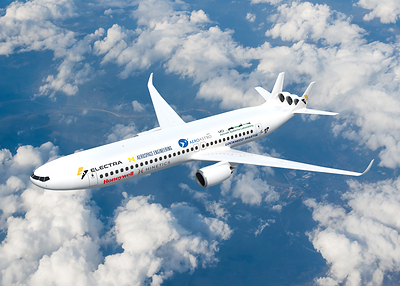
Concept pairs a double-bubble lifting fuselage and electric tail fans to explore competitive gains for aircraft with 100+ passengers
MANASSAS, Va., June 8, 2026 /PRNewswire/ — Electra, the global leader in hybrid-electric aviation, today unveiled a new conceptual aircraft design for next-generation airliners developed as part of NASA’s Advanced Aircraft Concepts for Environmental Sustainability (AACES) 2050 program. The study explores how targeted electrification, advanced aerodynamics, and integrated airframe-propulsion design can transform the efficiency and competitiveness of aircraft with 100+ passengers by mid-century.
Electra’s work is rooted in the company’s view that aviation is entering a third era of flight, one defined by the ability to use new electric propulsion technologies to unlock transformative, yet achievable aircraft architectures. In Electra’s nine-passenger EL9, that approach enables ultra-short takeoff and landing and a new model of Direct Aviation. In the AACES 2050 concept, it enables a future airliner configuration designed to improve efficiency while remaining compatible with real-world airline and airport operations.
The conceptual aircraft uses a wide “double-bubble” fuselage that allows the body of the aircraft to contribute more lift, while two underwing turbofan engines produce thrust as well as electricity to power electric tail fans that ingest and re-energize slower-moving air over the fuselage, a technique known as boundary layer ingestion. Electra’s analysis found that the configuration could deliver up to a 17 percent efficiency improvement beyond gains expected by 2050 from advanced structures, engine technologies, and aerodynamic improvements.
“The value of electrification in this concept is that it lets us put the propulsion where it couldn’t go before but does the most good,” said Dr. Parker Vascik, Director of Product Strategy at Electra. “We can radically improve how the airframe and propulsion system work together while keeping the aircraft grounded in real airline and airport operations. The goal is not just efficiency on paper, but concepts that we can actually build, certify, and use.”
Electra’s concept is designed to fit within existing airport gates and airline operations, use standard jet fuel or sustainable aviation fuel, and avoid reliance on airport charging infrastructure or untested fuel types. The configuration also supports a twin-aisle cabin layout within a narrowbody aircraft class, unlocking improved passenger comfort and more efficient boarding and deplaning.
The work was led by Dr. Alejandra Uranga, Electra’s Chief Engineer for Research and Future Concepts. Dr. Uranga previously co-led NASA-sponsored research at MIT that helped advance the original double-bubble aircraft concept and D8 aircraft design. Electra’s AACES 2050 work revisits that architecture with new capabilities enabled by electrification and distributed propulsion.
“This concept builds on years of research into how airframe shape and propulsion placement can work together to improve aircraft efficiency,” said Dr. Uranga. “What is different now is the ability to use electrification and distributed propulsion to more deeply integrate those systems. Designing the aircraft as a whole system is essential to realizing the full potential of future commercial aircraft.”
In addition to the concept, Electra developed 11 technical papers documenting the models, methods, and findings behind the study. The company also adopted NASA’s open-source Aviary multidisciplinary design and optimization tool and developed an electrified aircraft design suite intended for public use. Together, these contributions are intended to help advance the broader aviation research community, not just push forward a single aircraft concept.
Electra’s AACES 2050 team brought together leaders across industry and academia, including American Airlines, Honeywell Aerospace, Lockheed Martin Skunk Works, Hinetics, the Massachusetts Institute of Technology Department of Aeronautics and Astronautics, the University of Michigan Department of Aerospace Engineering, and the University of California, Irvine’s Aircraft Systems Laboratory.
“Through AACES, NASA is pushing the industry to think boldly, to use our novel propulsion technologies to unconstrain design thinking for the next generation of commercial aviation,” said Marc Allen, CEO of Electra. “The third era of aviation will bring radical change to how people and places connect, whether applied to aircraft entering service this decade, future regional platforms, or commercial transport by mid-century. Electra’s focus as the hybrid electric leader is to keep American aviation, and NASA, leading the way.”
The AACES 2050 program is designed to examine aircraft concepts and technologies that could help shape commercial aviation in the 2040s, 2050s, and beyond. Electra’s concept adds a near-term electrification pathway to that broader portfolio of aircraft studies, complementing other approaches focused on advanced propulsion, new fuels, and next-generation aircraft architectures.
“Electra’s aircraft concept gives American industry a chance to lead now by combining decades of research in lifting-fuselage design with breakthrough electric propulsion,” says Dr. Vascik. “Yet industry will not bring this concept to maturity by 2050 on its own. That will require a NASA-accelerated technology initiative — in a double-bubble X-plane, multi-megawatt integrated generator, and kilovolt-class power distribution — to bring these capabilities to maturity by 2035 and position industry to carry them into service by 2050.”
About Electra
Electra.aero, Inc. (Electra) is an advanced air mobility (AAM) company building hybrid-electric Ultra Short airplanes that deliver unprecedented performance advantages to fly people and cargo seamlessly without airports, emissions, or noise. With the EL9 Ultra Short, Electra is pioneering Direct Aviation, the next level of connectivity that brings air travel closer to where we live, work, and play. Electra’s Ultra Short technology delivers 2.5x the payload and 10x longer range with 70% lower operating costs than helicopters and eVTOLs with significantly greater safety and far less certification risk.
Electra’s team includes some of the most respected and successful entrepreneurs and engineers in novel aircraft design, with over 40 prior aircraft successfully developed and/or certified. Lockheed Martin Ventures, Honeywell, and Safran are among Electra’s strategic investors along with Prysm Capital, the Virginia Innovation Partnership Corporation (VIPC), and other private investors. Electra’s contracted customers include the U.S. Air Force, the U.S. Army, the U.S. Navy, and NASA along with over 2,200 letters of intent from 60+ commercial customers, including both airlines and helicopter operators.
Media Contact:
[email protected]

 View original content to download multimedia:https://www.prnewswire.com/news-releases/electra-unveils-turbo-electric-aircraft-concept-for-next-generation-airliner-as-part-of-nasa-aaces-2050-program-302794252.html
SOURCE Electra.aero