The title sounds new. The problem is not. And it is not only a control problem, it is a spending problem.
A large financial institution can put a dozen credentialed specialists around one table. Technology architects, data scientists, model validators, cybersecurity, compliance, legal, procurement, internal audit, and the business sponsor. An AI review meeting with all of them present can still end with a basic question unanswered: who owns this system as a whole?
The proposed answer, a Financial Intelligence Architect, sounds at first like job-title inflation. The industry has already produced chief AI officers, responsible-AI leads, model risk teams and digital transformation offices. Another title earns its place only if it describes work that nobody is currently doing.
Having examined how financial institutions are actually deploying AI, we think the case is stronger than the name suggests, and stronger than the usual framing allows. The role is normally argued for on control grounds: someone must be accountable when a system misbehaves. That argument is correct and incomplete. The same integration gap that produces governance failures also produces the two commercial failures institutions complain about most, which are AI programs that cost far more to run than the business case assumed, and AI portfolios that generate activity without generating return.
Both failures have the same root. Architecture decisions are being made by people who cannot see their financial consequences, and financial decisions are being made by people who cannot see the architecture.
AI has outgrown the model
Traditional model risk management was built around an identifiable model with defined inputs, outputs, owners and validation cycles. That discipline remains necessary. For many modern AI systems it is no longer sufficient.
Consider an AI research assistant used by an asset manager. Its behavior depends on a foundation model from one vendor, internal research in a retrieval system, market data from a second provider, prompts maintained by an investment team, permissions controlled by technology, and a workflow that delivers draft conclusions to portfolio managers. A conventional validation exercise assesses output quality. It rarely surfaces the failures that actually occur.
Those failures are mundane and they cross functional lines. An entitlement mismatch lets the retrieval layer surface documents to users who are not cleared to see them, which is not a model defect and not an access-control defect but a defect in how the two were joined. A prompt is edited to adjust tone in a customer-facing assistant, with no change record, because prompts were never classified as a controlled artifact. A fraud system is retrained on a dataset that includes the consequences of its own earlier decisions, so its confidence rises while its coverage narrows. A vendor changes its default model version and deployed behavior shifts, with no internal trigger, because procurement treated the arrangement as a software license.
None of these is exotic. Each passes cleanly through every functional review, because each function inspects its own component and the failure lives in the join. No function owns the join. None owns its cost either.
What supervisors require, and what they leave out
Supervisors are increasingly looking at the whole lifecycle rather than the model alone. IOSCO’s Supervisory Toolkit for AI Use in Capital Markets, published in May, covers governance, third-party dependency, disclosure and recordkeeping across traditional, generative and agentic systems. The EU AI Act imposes obligations on high-risk systems spanning risk management, documentation, logging, human oversight, accuracy and robustness. NIST’s AI Risk Management Framework organizes the same task into four connected functions. UK model risk expectations extend governance to a far wider population of systems than most firms had inventoried, and place accountability on named individuals.
They differ in jurisdiction and legal force and converge on one requirement: a named human must be capable of overseeing the system. None of them states what that person needs to know. Supervisors have created a role requirement and left the labor market to fill it, and the labor market has answered with the credentials it already had, written for market risk, credit risk, accounting and compliance, which say nothing about retrieval architecture, evaluation design, drift detection or vendor change control.
The problem has been set out formally. In a working paper published through the International Council for Derivative Trading, Michael Clark applies principal-agent theory to AI delegation and calls the result a governance accountability gap: a structural mismatch between the AI capabilities firms deploy and the oversight competencies available to govern them. Regulatory mandate alone cannot close it, on his argument, because accountability requires competency. The framing is useful because it locates the problem in the organization chart rather than in the technology, which is where most institutional spending has been aimed.
Architecture decides economics
The control case for the role is well rehearsed. The economic case is not, and in our experience it is the one that moves executive committees.
AI systems have a cost structure most financial institutions have not previously managed. A licensed application is bought once and deployed. An AI system incurs cost every time it is used, and that cost is set by architecture decisions taken early and usually without financial review. How documents are chunked and indexed, how often the index is refreshed, whether outputs are reranked, how much context is passed on each call, whether results are cached, which model tier handles which class of request. Each is presented as a technical choice. Each is a unit-cost decision.
The predictable consequence is a system that clears its business case comfortably at pilot volume and fails it at production volume. Nothing about the use case changed. The architecture did not scale the way the spreadsheet assumed, and nobody in the approval chain was accountable for noticing.
Vendor concentration behaves the same way. An institution that builds directly against a single provider’s interface, with no abstraction layer and no tested alternative, has no credible exit. That is a resilience exposure, which risk functions understand, and a pricing exposure, which they generally do not price. A supplier that knows migration would take nine months has a materially different negotiating position at renewal. Very few firms can say what switching would cost them, which means very few know what their AI infrastructure will really cost over the contract term.
The most expensive failure is rework. Discovering at the approval gate that a system cannot be approved as built means the institution has already paid for the build. Use-case classification at design time is the cheapest control available and the one most frequently skipped, and its return shows up in avoided rebuilds rather than in avoided incidents.
There is a compounding effect on the other side. The first governed AI system in an institution is expensive because everything is bespoke. The tenth should be materially cheaper, because classification tiers, control patterns, evaluation harnesses, monitoring and vendor terms are reusable. Institutions that govern case by case never capture that curve. They pay the full cost of the first system, ten times over.
Eight questions that expose the gap
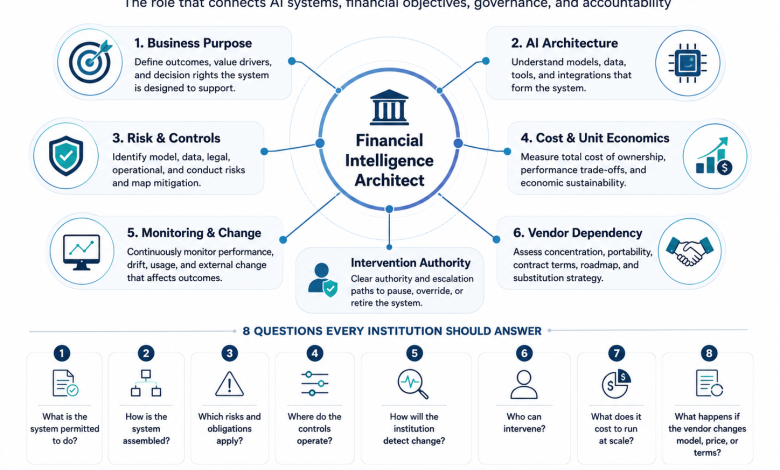
A practical test is to ask an institution to produce, for any material AI application, a concise answer to eight questions from a single current record.
- What is the system permitted to do? The answer defines users, decisions, data, actions and limits, rather than repeating a vendor’s product description.
- How is the system assembled? Model, prompts, retrieval sources, tools, interfaces, vendors, human checkpoints, permissions and downstream dependencies.
- Which risks and obligations apply? Classification by financial impact, customer impact, autonomy, data sensitivity, explainability, operational criticality and applicable regulation.
- Where do the controls operate? Every material requirement connects to a technical, procedural or organizational control with a named owner and a test method.
- How will the institution detect change? Monitoring covering data quality, output quality, drift, bias, security, misuse, vendor updates, human overrides and business outcomes.
- Who can intervene? Restriction, shutdown, fallback, escalation, incident reporting and remediation authority, decided before a problem occurs.
- What does it cost to run at the volume it will actually reach? Unit economics under realistic load, including retrieval, inference, human review and monitoring, tested against the volume assumed in the business case.
- What happens if the vendor changes model, price or terms? Substitution path, migration cost, contractual notice and the concentration position across the wider AI estate.
Many institutions can answer parts of this list. Far fewer can answer all eight from one current source. That difference separates a set of policies from an operating architecture, and the last two are usually the questions nobody in the room can answer at all.
What the role should own
The Financial Intelligence Architect owns the integrated blueprint for each material AI system: the inventory, the use-case boundaries, the architecture record, the control map, monitoring requirements, change triggers and escalation paths. Alongside that sits a second mandate, just as easy to leave unowned: unit economics, vendor and concentration position, reuse across the portfolio, and the sequencing of what gets built. Use cases that share retrieval infrastructure, evaluation methods or control patterns should be built in an order that lets each one reduce the cost of the next, and somebody has to be able to say that a project does not clear the bar. That judgment is near impossible for the sponsor of an individual project and quite manageable for a professional accountable for the whole portfolio.
The role needs authority to match. A professional who can describe a system but cannot require evidence, delay a deployment or escalate an unresolved risk is a coordinator rather than an architect. Our own view is that the function belongs in the second line, reporting to whoever holds senior accountability for AI, with standing to withhold approval at defined lifecycle gates. Inside technology it loses independence from delivery pressure. Inside compliance it loses the technical standing to challenge an engineering decision and becomes a documentation exercise. Structures will vary by firm size and history. The three conditions that cannot vary are independence from delivery, access to senior decision-makers, and the ability to gate.
Professionalizing the responsibility
New roles become credible when they are backed by a defined body of knowledge and an assessable standard. Financial services has done this repeatedly, in derivatives and in structured credit, each time after adoption had run ahead of the professional infrastructure to supervise it. The Chartered Financial Intelligence Architect (CFIA) designation, developed by the International Council for Derivative Trading, is one of the first attempts to codify what this role has to know, covering AI architecture, data and model governance, implementation oversight, risk, regulation, controls and financial use cases. Boards, employers and supervisors need some way to distinguish a professional who can discuss responsible AI in general terms from one who can evaluate how a financial AI system is actually built, governed and paid for.
The answer
Do financial institutions need a Financial Intelligence Architect? For any institution running AI that can materially affect customers, capital, transactions, regulated decisions or core operations, the answer is yes, and the justification does not rest on control alone. The case sharpens as systems become more autonomous. An agent that retrieves information, selects tools, updates records, drafts external communications or initiates transactions has an operational footprint, a continuous cost profile and behavior that changes over time. None of that can be handled by a one-time validation event.
The title may differ and the organizational home will vary. What matters is that one accountable professional owns the relationship among business purpose, system architecture, controls, monitoring, intervention authority and cost. AI governance fails when every function owns a component and nobody owns the system. AI investment fails the same way, for the same reason, and the second failure is usually the one that gets noticed first.
About the author
James Harrington is with Caldworth Intelligence, a specialist advisory firm focused on artificial intelligence strategy, architecture, governance and oversight for investment managers and financial institutions. Caldworth’s advisory framework aligns with the Chartered Financial Intelligence Architect (CFIA) standard.