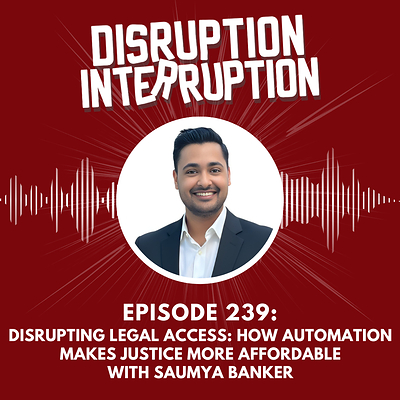
Saumya Banker says the legal industry is still burying lawyers under billing guesswork, deadline-driven workflows, and admin work clients should never have to subsidize. Donna AI is building an operating system for solo and small law firms so they can move cases faster, serve more people, and make legal help more affordable.
TAMPA BAY, Fla., July 23, 2026 /PRNewswire/ — Low-income Americans receive inadequate or no legal help for 92% of their civil legal problems, and the average law firm captures just 3.0 billable hours in an eight-hour workday. Yet even with so much unmet need, many small firms are still running on memory-based billing, deadline triage, and manual admin work that keeps cases moving slower than they should. On this episode of Disruption Interruption, host Karla Jo Helms (KJ) speaks with Saumya Banker, co-founder and CEO of Donna AI, about why legal work is still trapped inside outdated workflows, why clients are paying for inefficiency disguised as expertise, and how automation could lower costs while expanding access to justice. As Banker puts it, “There’s so much tedious operational and administrative work that actually takes up time in a law firm.”
Why Legal Work Still Gets Stuck in Admin Limbo
For Banker, the first crack in the system is billing itself. After interviewing about 75 lawyers and shadowing firms to understand how work gets done, he says he found that many firms still track billable time from memory rather than by accurate, real-time records. “They forget what they’re working on,” he says. “They’re going off memory at the end of the week or end of the month.” That means clients may be billed based on approximation, while firms still lack real visibility into where their time is actually going.
The second problem is workflow. Much of the day-to-day progress on a case happens through paralegals and law clerks, but too much of that process lives inside employees’ heads instead of reliable systems. Firms focus on the nearest deadline, while work with no immediate due date can sit untouched for weeks. “Everything is kind of in their brain about what they need to do,” he says. When work gets trapped inside that kind of structure, clients pay the price. Banker says it becomes hard to get a lawyer on the phone, hard to get a response to an email, and hard to understand where a case stands unless something is on fire. In his view, that does more than create frustration. It widens the justice gap by making legal help slower, more expensive, and easier to abandon. “A lot of people don’t even bother going to court or getting a lawyer just because they know they’ve already lost,” said Banker.
Build the Operating System Behind the Lawyer
Donna AI is his answer to that bottleneck. The company is focused on solo practitioners and small law firms because that is where the pain is sharpest and the support infrastructure is thinnest. The platform uses AI agents to take administrative and operational work off lawyers’ plates, from case-related busywork to communications and back-office tasks, so firms can focus on legal judgment rather than repetitive process.
That matters because Banker estimates that about 40% of the work in a small law firm is operational or administrative. “They didn’t go to law school to play babysitter,” he says. “They did not train to clean up inboxes, rename files, chase tasks, and manage workflow sprawl.” By reducing that burden, firms can take on more clients, improve responsiveness, and lower the cost of service without sacrificing quality.
The legal profession is moving into a divide between firms that embrace AI and firms that keep relying on manual processes, head counts, and delays. For Banker, automation does not reduce the value of legal expertise. It gives lawyers more room to use it where it matters. “AI is not here to take your job,” Banker says. “The folks who use AI are going to take the jobs of the folks who don’t.”
Links
Disrupting Legal Access: How Automation Makes Justice More Affordable with Saumya Banker
Disruption Interruption is the podcast where you will hear from today’s biggest Industry Disruptors. Learn what motivated them to bring about innovation and how they overcame opposition to adoption.
LinkedIn: http://www.linkedin.com/in/saumyabanker
Company Website: https://donnaanswers.com
About Disruption Interruption™
Disruption is happening on an unprecedented scale, impacting all manner of industries — MedTech, Finance, IT, eCommerce, shipping, logistics, and more — and COVID has moved their timelines up a full decade or more. But WHO are these disruptors and when did they say, “THAT’S IT! I’VE HAD IT!”? Time to Disrupt and Interrupt with host Karla Jo “KJ” Helms, veteran communications disruptor. KJ interviews badasses who are disrupting their industries and altering economic networks that have become antiquated with an establishment resistant to progress. She delves into uncovering secrets from industry rebels and quiet revolutionaries that uncover common traits — and not-so-common — that are changing our economic markets… and lives. Visit the world’s key pioneers that persist to success, despite arrows in their backs at www.disruption-interruption.com.
About Saumya Banker
Saumya Banker is the co-founder and CEO of Donna AI, a legal technology company building AI teammates for solo practitioners and small law firms in the United States and Canada. A two-time founder with a background in fintech and other regulated industries, he previously helped scale a lending platform from zero to hundreds of millions in loan volume before turning to legal operations. His path into legal tech began after helping a cousin through a divorce case and seeing firsthand how missed communication, opaque billing, and overwhelmed staff can make legal help harder, slower, and more expensive than it needs to be. At Donna AI, he is focused on reducing administrative drag inside law firms so lawyers can take on more clients and improve access to justice.
About Karla Jo Helms
Karla Jo Helms is the Chief Evangelist and Anti-PR® Strategist for JOTO PR Disruptors™. Karla Jo learned firsthand how unforgiving business can be when millions of dollars are on the line — and how the control of public opinion often determines whether one company is happily chosen, or another is brutally rejected. Being an alumnus of crisis management, Karla Jo has worked with litigation attorneys, private investigators, and the media to help restore companies of goodwill into the good graces of public opinion — Karla Jo operates on the ethic of getting it right the first time, not relying on second chances and doing what it takes to excel. Helms speaks globally on public relations, how the PR industry itself has lost its way, and how, in the right hands, corporations can harness the power of Anti-PR to drive markets and impact market perception.
References
- Clio. (2025). Law firm KPIs: Key performance indicators & benchmarks. clio.com/resources/legal-trends/benchmarks/
- Legal Services Corporation. (2022). The justice gap: The unmet civil legal needs of low-income Americans. justicegap.lsc.gov/resource/2022-justice-gap-report/
- Legal Services Corporation. (2022). The justice gap report: An overview. justicegap.lsc.gov/
- Clio. (2024). AI-powered legal practices surge: Clio’s latest legal trends report reveals major shift. clio.com/about/press/clio-latest-legal-trends-report/
Media Inquiries:
Karla Jo Helms
JOTO PR™
727-777-4629
 View original content to download multimedia:https://www.prnewswire.com/news-releases/disrupting-legal-access-why-small-law-firms-are-drowning-in-admin-302832797.html
SOURCE Disruption Interruption