The AI Democratization Imperative
We’ve reached a tipping point where AI is no longer the domain of technical data scientists or engineers alone. Non technical, business users like sales, marketing, HR, financial analysts, and customer success teams are experimenting with AI copilots, workflow agents, and low-code GPT builders to automate parts of their daily work.
This grassroots innovation is powerful. It accelerates productivity and embeds intelligence directly into business processes. But without the right guardrails, it can lead to “shadow AI” with fragmented tools, duplicated spend, and unmanaged risk for the enterprise.
The goal for the Chief AI Officer or Chief Information Officer therefore, isn’t to slow this momentum but to channel it through a structure that scales safely and systematically.
Evolution of organization’s structure to promote with democratized and responsible AI:
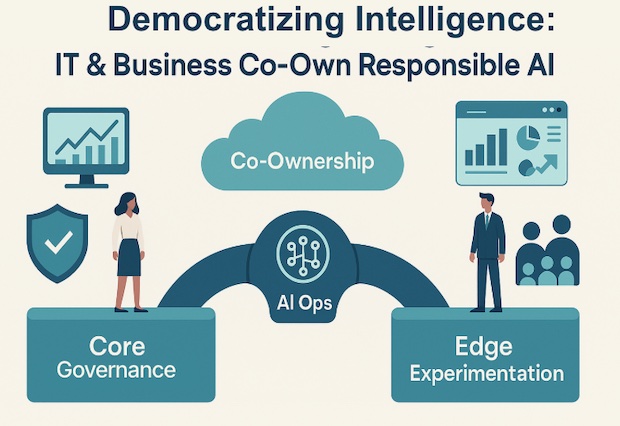
Think of enterprise AI operations as running at two complementary speeds.
-
Track 1: The Core (Governance & Enablement): This is typically led by standard IT, Security, Legal, and data teams. They define policies, guardrails, model access, and ethical guidelines. This is where AI is secured, measured, and standardized.
-
Track 2: The Edge (Experimentation & Adoption): This track is driven by business teams who prototype use cases that solve real problems. This is where AI is personalized, operationalized, and tested for value.
The bridge between these two speeds is the AI Ops layer, a function responsible for orchestrating initiatives, aligning priorities, managing the AI Council, and packaging outcomes into measurable impact metrics.
Framework for Democratizing AI Responsibly:
-
Access with Accountability- Provide controlled sandboxes (e.g., approved LLM workspaces, data-safe environments) where non-technical teams can experiment with AI agents. Every user or team is accountable for outcomes, data inputs, and compliance.
-
Enablement over Enforcement- Shift IT’s role from “approvers” to “enablers.” Instead of blocking tools, offer an AI Catalog of vetted copilots, datasets, and prompt templates that business teams can customize safely. And a fast track process for approving requests for AI pilots.
-
Transparent Measurement & Learning Loops- Track impact beyond adoption: productivity gains, cycle-time reduction, quality improvements, cost avoidance. Use dashboards that visualize progress across workstream pods (Data, People, R&D, GTM) and flag risks early.
-
Ethical & Secure-by-Design Practices- Define clear policies for data usage, model selection, prompt confidentiality, and bias monitoring.Establish a ‘Responsible AI Review Board’ to evaluate high-impact or customer-facing use cases.
Rethinking Roles and Operating Models
-
IT’s New Mandate -“Platform & Policy Custodian” : IT no longer owns every tool but owns the environment of trust where tools safely coexist. That means curating APIs, managing access to foundation models, and embedding AI observability, compliance into infrastructure & role based access controls to AI environments
-
Business Teams- “Citizen Innovators with Guardrails”: Each function becomes an innovation lab. For example: Marketing teams train brand safe creative content agents. Sales builds prospecting copilots. HR designs talent analytics bots. They operate within an enterprise AI framework leveraging shared components but tailoring for their use cases.
-
AI Ops- “The Orchestrator of Impact”: AI Ops connects the dots aligning experimentation with strategy, ensuring lessons learned in one function scale across others, and maintaining a single source of truth for ROI, risk, and readiness.
Culture: From Compliance to Curiosity
The real unlock isn’t more tools; its mindset. The AI council/ AI review board plays a big role to enforce the business value tie back. Enterprises that succeed with AI cultivate a culture where:
-
Curiosity is encouraged, but every experiment ties back to business value.
-
Employees are trained to think in terms of “problem → prompt → outcome.”
-
AI literacy becomes a shared responsibility, not a specialist skill.
Conclusion: Co-Ownership Is the Future
Democratizing AI doesn’t mean decentralizing accountability. It means building a shared operating model where IT governs the ecosystem and business functions fuel innovation within it. The companies that get this right will move faster not recklessly, but responsibly. They’ll replace top-down control with co-ownership, and governance will evolve from being a blocker to being the engine of trust that makes democratization scalable.