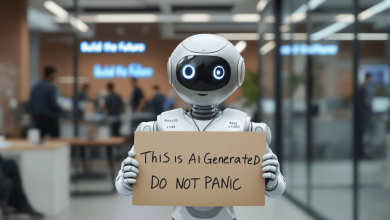
While enterprises have been quietly investing in AI on the backend for several years, the rise of consumer-facing AI tools has firmly pushed it into mainstream culture. By the end of 2025, ChatGPT had nearly 1 billion users, and interest in how algorithms shape work and daily life has never been higher.
I’m fortunate to work with developers operating at the sharp edge of AI innovation. Many are world-class researchers and engineers whose collective output has shaped how modern software is built and deployed, and their contributions to the field make impressive reading. Now, as AI reshapes how we build, collaborate, and release software, new terms are emerging just as quickly.
But now these terms are starting to reach a wider, more engaged audience of consumers amid sky-rocketing AI hype, leaving meanings and messages ripe for misinterpretation.
We saw this clearly as Collins Dictionary crowned ‘vibe coding’ its word of the year, and the Economist revealed its winning word is ‘slop’, in reference to poorly created AI content swarming our feeds every day. ‘Agentic AI’ was equally abundant, appearing in hundreds of thousands of articles, publications and social media posts.
Beyond the hype, what do these terms actually mean for software teams? Now is the time to decode the signals behind the buzz. To start to build more trust in AI going forward, we should look beyond the buzz, questioning the tools, processes and metrics that actually matter to the future of AI in software development.
Vibe coding: coding with intuition
The phrase ‘vibe coding’ rose to prominence after being popularised by Andrej Karpathy, co-founder of OpenAI and former head of AI at Tesla. At a high level, it describes the use of AI models to generate, modify, or extend code through natural language prompts rather than traditional programming alone. As interest has grown, so too has the ecosystem of tools designed to support this approach.
In practice, vibe coding lowers the friction of building software. It allows people with limited technical backgrounds to prototype ideas quickly, while giving experienced developers new ways to explore solutions. Today, it’s professionals who are extracting the most value – using AI to accelerate routine tasks, experiment creatively, and tinker outside formal working hours.
What began as informal experimentation is now moving into more deliberate enterprise trials. Teams are testing where AI-assisted coding can safely improve speed and flexibility, while still maintaining the controls required for production software.
Workslop: productivity without progress
If vibe coding reflects AI’s creative upside, ‘workslop’ captures its downside. The term has emerged to describe the growing volume of low-quality, low-impact output produced when AI is layered onto workflows without clear intent. In software teams, this often shows up as excessive tickets or features that exist simply because they were easy to generate, rather than because they were needed. The result is motion, but motion without progress.
AI enables teams to create more, faster — but that doesn’t always mean better outcomes. When teams generate code, tests, or documentation at scale without strong feedback loops, they risk burying real value under noise. Developers then spend more time triaging output than improving systems, slowing delivery rather than accelerating it. Workslop is not a failure of AI, but of how it’s applied.
The solution is discipline. Teams need watertight definitions of success, strict experimentation cycles, and metrics that prioritise impact above anything. This is when AI becomes a force multiplier, rather than a source of drag.
Agentic AI: minimum human intervention
Agentic AI represents a further step along the autonomy curve. Rather than responding to prompts, agentic systems can plan, act, and make decisions with minimal human intervention. In theory, this promises significant efficiency gains, particularly in complex engineering workflows. It raises important questions about control, accountability, and trust.
Autonomy without guardrails is rarely an advantage. As agentic systems take on more responsibility, the cost of errors increases, especially when decisions are made faster than teams can observe their impact. In industries like healthcare, finance and customer service, patient outcomes, compliance and trust all hinge on speed and accuracy. End users need to understand not just what an agent does, but why it did it.
Responsible use of agentic AI means pairing autonomy with constraints. Clear boundaries, continuous monitoring, and the ability to intervene or roll back actions are critical. Without these safeguards, agentic AI risks amplifying small mistakes into large incidents.
Building trust starts with breaking down hype
What these buzzwords share isn’t novelty; it’s a signal that AI is maturing. As the technology moves deeper into software delivery, the focus must move from what is possible to what’s reliable. Speed, creativity, and autonomy all matter, but only when paired with control and clear feedback.
As GenAI systems are inherently non-deterministic, every customer-facing deployment is effectively an experiment. What separates leaders is whether they systematically capture, analyse, and learn from that uncertainty rather than treating it as noise. In this context, experimentation isn’t a final validation step but the primary mechanism by which AI products are built, tuned, and improved.
There’s no doubt that in 2026, the terminology around AI will continue to change, but the fundamentals will not. AI-positive cultures must be built on experimentation, grounded in intent, and guided by proven engineering discipline. Practical value, not hype, is what will ultimately endure.