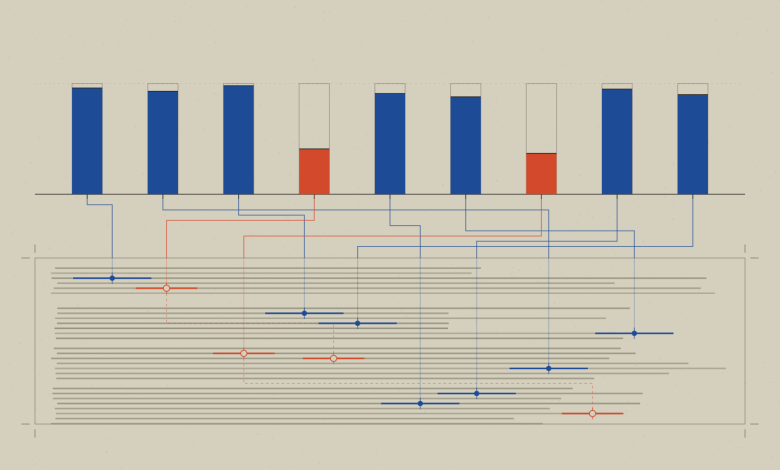
Everyone is focused on making AI extract more information from documents.
Financial statements, leases, regulatory filings, compensation schedules and sustainability reports are increasingly being processed by systems that combine OCR, layout-aware models, retrieval and large language models. The promise is obvious: convert weeks of manual reading into structured data in hours.
The real challenge is not extraction.
It is verification.
When an AI system extracts a number from a financial report or identifies an obligation inside a regulatory document, “the model said so” is not an acceptable basis for action. Procurement teams, compliance functions, auditors and business leaders need to know where the value came from, how certain the system is and why it produced that answer.
That changes the product requirement.
The winning enterprise AI system is not the one that produces the most answers. It is the one that makes each answer easy to inspect.
The Trust Gap: Aggregate Accuracy Is Not Enough
AI vendors often describe document extraction performance using aggregate metrics.
A system may report high field-level accuracy across a benchmark or strong extraction performance across a collection of documents. Those measurements matter, but they do not answer the question a reviewer faces in production:
Can I trust this specific value?
A financial analyst checking a lease obligation does not care that the system was accurate on most previous documents. A compliance reviewer evaluating a regulatory disclosure needs evidence for the output in front of them.
This distinction becomes more important as AI moves from assisting analysts to feeding downstream data systems automatically.
An incorrect extraction is no longer just a bad answer on a screen. It can become a structured field used by forecasting models, reporting systems, risk calculations or compliance workflows.
The bottom line: enterprise trust has to exist at the individual-output level.
The Verification Layer: Make Every Extraction Explainable
A better architecture pairs every extracted value with three additional elements:
A confidence score. A natural-language explanation. A source attribution.
These are not interface decorations.
Together, they form a verification layer between probabilistic AI and deterministic enterprise workflows.
A well designed document intelligence workflow in production followed this approach by combining extraction with systematic verification, so individual outputs could be accompanied by confidence information, explanations and source references rather than appearing as unsupported generated values.
That design changes the reviewer’s task.
Instead of rereading every document from beginning to end, the user can concentrate attention where the system itself indicates uncertainty.
Trust becomes selective rather than binary.
The Confidence Engineer: Make Uncertainty Visible
Large language models are designed to produce plausible outputs.
That strength creates a problem in high-stakes extraction.
A wrong answer can be delivered with the same linguistic confidence as a correct one. If the interface presents both identically, the user has no reason to distinguish them.
Confidence scoring changes that relationship.
The system can evaluate signals such as retrieval quality, agreement between extraction passes, structural consistency, validation rules and similarity between the generated answer and the supporting source.
The exact methodology will vary by system.
What matters is that uncertainty becomes visible to the reviewer.
High-confidence fields can move through streamlined review. Low-confidence fields can be routed to a human. Borderline cases can trigger additional verification rather than silent acceptance.
This is not about pretending confidence estimates are perfect.
It is about giving the organisation a practical mechanism for allocating human attention.
The Source Navigator: Take the Reviewer Back to the Evidence
Confidence without evidence is incomplete.
The most valuable verification feature is often the simplest: show exactly where the extracted value came from.
For a lease, that might mean linking the result to the relevant clause or table. For a sustainability report, it might mean identifying the page and section containing the metric. For a financial filing, it could mean taking the reviewer directly to the supporting disclosure.
Source attribution converts AI output into a reviewable claim.
The reviewer does not need to trust the system’s authority.
They can inspect the evidence themselves.
This becomes especially important with complex documents containing tables, charts, footnotes and inconsistent formatting. Traditional keyword search may locate the right page while missing the relationship between a value and its surrounding context.
A strong document intelligence system preserves that context rather than stripping the extracted value away from it.
The Explanation Layer: Show Why the System Chose the Answer
Source attribution answers, “Where did this come from?”
The explanation answers, “Why did the system interpret it this way?”
That second question matters when documents contain competing values.
A lease may include an original payment amount and an amended amount. A regulatory filing may contain both current-period and historical figures. A compensation agreement may specify several conditions that change which number applies.
A useful verification system should explain which evidence it considered and why one interpretation was selected.
A well established underlying project paired extracted values with natural-language explanations specifically to support this kind of targeted human validation across highly unstructured document types.
The explanation does not replace the underlying source.
It connects the source to the structured result.
The Human Attention Router: Review Exceptions, Not Everything
The economic value of AI document extraction does not come from removing humans completely.
It comes from changing what humans review.
Before automation, specialists may need to read every document and manually transcribe every required field. After extraction without verification, they may still need to check every value because they cannot tell which outputs deserve trust.
That is not transformation.
The real shift occurs when the verification layer directs reviewers toward uncertainty.
In real production systems, this approach reduced manual extraction effort substantially because reviewers could focus on lower-confidence outputs rather than rechecking every field. The system was used across document types including sustainability reports, leases and collective bargaining agreements.
That is the counterintuitive insight.
Human-in-the-loop does not have to mean human-in-every-loop.
The Compliance Architect: Verification Becomes Part of Auditability
Regulated workflows create another reason to design for source-level verification.
Compliance is not satisfied by saying that an AI model is generally accurate.
An organisation may need to reconstruct how a specific reported figure was obtained months later.
That requires more than the final value.
The system should retain the originating document, source location, confidence information, explanation and relevant validation history.
Now the extraction becomes auditable.
A reviewer can move backwards from the structured field to the original evidence.
This is particularly important when AI is used to unlock information from sustainability reports, contracts or other documents that contribute to regulatory and reporting obligations.
The underlying project included use cases where extracted sustainability data supported regulatory reporting and where making outputs traceable back to source documents was essential to human review.
The broader lesson is clear:
Auditability should be designed at extraction time, not reconstructed later.
The Procurement Test: Ask Different Questions Before Buying AI
Organisations evaluating document AI should move beyond generic accuracy demonstrations.
The more important procurement questions are operational.
Can the system show the source for every extracted field?
Can reviewers understand why the value was selected?
Does the system distinguish confidence levels?
Can low-confidence outputs be routed differently from high-confidence ones?
Can the organisation preserve the evidence trail for audit?
How does the system behave when a document contains conflicting values, missing context or an unfamiliar format?
These questions reveal whether a platform is designed merely to generate structured data or to produce structured data that an enterprise can defend.
That distinction should influence buying decisions.
A slightly more accurate extraction engine without strong verification may create more operational risk than a system whose outputs are easier to challenge.
The New Playbook: Build Trust Into the Data Product
-
Make Confidence Field-Level
Do not assign one confidence score to an entire document.
A document can contain dozens of correct extractions and one critical error.
Confidence must travel with the individual value.
-
Preserve Source Context
Store enough information to return the reviewer to the originating page, table, paragraph or section.
Do not separate structured data from the evidence that created it.
-
Explain Ambiguous Decisions
When several candidate values exist, expose why the system selected one.
A bare answer hides the most important part of the reasoning.
-
Route Review by Risk
Use confidence and business importance together.
A low-value uncertain field may tolerate delayed review. A high-impact financial or compliance field may require immediate validation even when confidence appears strong.
-
Treat Verification Data as Infrastructure
Confidence scores, explanations and source links should not exist only in the user interface.
They should become part of the data model so downstream workflows can make decisions based on them.
That is how trust scales beyond one application.
The 90-Day Trust-First Rollout
Days 0–15: Define the Verification Contract. Identify which extracted fields influence financial, regulatory or operational decisions. Define what evidence must accompany each result.
Days 16–45: Instrument Individual Outputs. Add field-level confidence, source attribution and explanation. Measure not only extraction accuracy but whether reviewers can verify results efficiently.
Days 46–90: Route Work by Trust. Allow high-confidence, well-supported outputs to move through streamlined workflows while uncertain or high-risk fields receive targeted review.
Do not automate downstream action faster than you can verify upstream evidence.
The Inevitable Future: Enterprise AI Will Need Receipts
Document intelligence is moving from experimentation into operational data infrastructure.
As that happens, aggregate model accuracy will become less persuasive.
Executives, auditors and regulators will care about the specific output that influenced a specific decision.
The AI systems that earn lasting enterprise trust will therefore do more than produce answers. They will attach evidence, uncertainty and reasoning to those answers in a form humans can inspect.
The model will still matter.
But the verification layer will determine whether the organisation is willing to depend on it.
In enterprise AI, trust does not come from the answer. It comes from being able to prove where the answer came from.