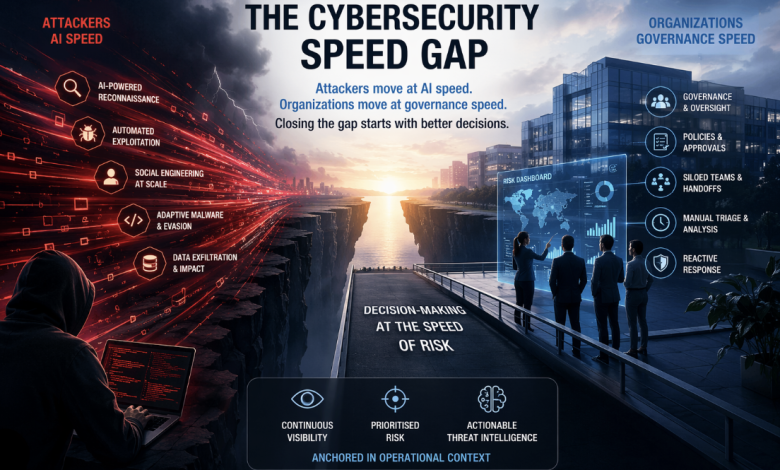
Bad actors will always be able to out-engineer companies, adopting new technologies, like AI, with speed, creativity, and intent. Companies are limited by structure, governance, and deliberate caution in adopting new technologies.
To remain resilient in this new wave of change, companies must become proactive, highly coordinated, focused on risk, and able to support AI-assisted decision-making. To succeed, business and security leaders must reframe security around continuous visibility, prioritized risk, and actionable threat, anchored by operational context.
Asymmetrically Shifting Models: Attackers and Organizations
Attackers are not constrained by protecting their reputation or trying to protect customer data. They do not need governance, committees, and have no need to be cautious in their adoption of new technology. Enterprises, on the other hand, must act with a level of responsible governance, which often results in slower, more deliberate adoption of technology. For highly regulated organizations, this may have meant adopting new technology months or years after its availability.
While the need to protect the enterprise has stayed the same, the ability for bad actors to quickly adopt AI is changing the landscape dramatically. The gap between how attacks are executed and how organizations respond continues to widen.
The Democratization and Industrialization of Cybercrime
With AI, attackers are now able to coordinate, plan, and enact attacks at machine-speed. Reports show that activities that used to take days now takes minutes, overrunning traditional detection and response models. Phishing attacks have increased by 1265%, breach volume is at record levels, and the average cost of an AI-powered breach is a 13% increase at $5.72M. AI Cyber Attack Statistics 2025, Trends, Costs, Defense
It is occurring at scale, leveraged by state actors and hacker groups alike. It is used to continuously rebuild malware to avoid detection, to perform social engineering at scale, and to execute multi-step attacks with minimal human involvement and at a speed no human-led process could match. Threat Report, GTIG AI Threat Tracker
With AI, the same threats are faster and more frequent. They are also easier to execute. AI has lowered the barrier to entry for attackers, enabling less skilled actors to cause greater damage. How Attackers Use AI, KELA AI Threat Report
In cybersecurity, the bad actors only need to get the attack right once. Companies need repel the attacks adequately every time. The attackers have the advantage, especially as volume and frequency increase.
This shift places significant pressure on existing security operating models.
Traditional Security Models Need to Change
Traditional security models focus on reactive activities, instead of proactive risk management. The process of reviewing an alert, escalating the incident, and approving the resolution no longer aligns with the speed with which attacks now unfold.
In many cases, by the time an alert is reviewed, the attacker has already moved laterally, established persistence, or exfiltrated data. The issue is structural, not capability.
Security teams are overwhelmed by volume. Recent analysis shows security operations teams still spend most of their time on reactive work, rather than proactive risk reduction (AI Agents Are the Next Paradigm Shift in Cyber Defense – GeekWire).
The result is predictable. The organization becomes increasingly reactive, dealing with the most visible issues while the higher-risk exposures remain unresolved.
The core of this challenge is the ability to understand which risks matter.
The Role of Operational Context
Not all risks are equal.
Organizations often prioritize based on severity scores, compliance requirements, or tool-generated rankings. These signals provide information, but they do not provide context.
A vulnerability in a non-critical system is treated the same as one in a system that underpins revenue or regulatory obligations. Both generate alerts and demand attention. Only one represents material risk to the business.
Attackers already prioritize in this way, focusing effort where impact is highest and defenses are weakest (AI-driven attack optimization analysis).
When security teams understand how risks connect to business services, customers, and outcomes, prioritization becomes clearer. Decisions improve because they are based on impact rather than volume.
Without this context, organizations struggle to align effort with risk and coordination becomes difficult.
Coordination as a Security Capability
Risk, security, IT, and business teams often operate with different data, different priorities, and different definitions of urgency. When an issue arises, decisions, these perspectives must be reconciled, increasing friction and slowing decisions.
Attackers do not have these limitations.
For organizations, improving coordination means making risk visible in a way that is understood across functions. It means defining ownership clearly and reducing the time between identification and action.
This requires alignment at the operating level as well as the strategic-level. Without it, even well-funded security programs struggle to respond effectively. Poorly implemented, coordination introduces additional steps and delays. Structured correctly, it reduces friction and enables faster decision-making.
From Detection to Decision
The shift organizations need goes beyond technology or people. Adding more tools, more alerts, or more people does not solve the problem. It increases complexity and makes coordination harder.
What changes outcomes is decision-making and the speed thereof. That speed depends on how clearly risk is defined and how quickly ownership is established.
Organizations need to move from detection-led security to decision-led security. That means understanding which risks matter, why they matter, and what action should be taken now.
Most security teams already have the data they need. What they lack is the ability to parse the signal from the noise and act with confidence. AI, when applied correctly, helps connect signals across systems, identify patterns, and highlight priorities that would otherwise be missed. Organizations that use AI effectively are already seeing measurable improvements in detection speed and resilience (New Report Shows How AI Gives Cybersecurity Competitive Advantage | Scoop News).
When AI is used for the sake of speed, it increases noise. When it’s used to escalate what requires attention, it sharpens focus and reduces noise instead.
AI and the Quality of Decisions
The role of AI in this model is often misunderstood. Its value is in the ability to improve the quality of decisions.
AI can connect signals across systems, identify patterns and exposures that would otherwise remain hidden. Organizations applying AI in this way are already seeing improvements in detection speed and resilience (How attackers use AI in cyber attacks).
Faster responses to low-priority issues do not improve outcomes. Decisions that prioritize the right risks do.
This introduces a new dependency on governance. AI outputs must be explainable, aligned to risk definitions, and embedded within decision-making processes.
Leadership and Accountability
This shift extends beyond technology and process and into culture. It requires alignment at the leadership level.
Ownership of cybersecurity risk cannot sit solely within security teams. Business and technology leaders must define what risk is acceptable and how it should be managed. This must be done before it’s required, and be tested. Otherwise, decision-making slows at the exact point when speed is required.
Many organizations have already invested significantly in tooling. The constraint is in how decisions are made, how risk is defined, and how teams align around it (WEF, University of Oxford publish Cyber Resilience Compass with seven pathways to build robust cybersecurity roadmaps – Industrial Cyber).
Where this alignment exists, decisions are faster and more consistent. Where it does not, delays occur at the point where clarity is required.
Closing the Gap
The gap between attackers and organizations is widening.
AI has increased the speed, scale, and accessibility of attacks. The advantage sits with those who can act quickly and adapt continuously.
Organizations will retain governance, accountability, and structure. These are necessary. The opportunity is in how they are applied.
Clarity of risk, proactive alignment across teams, decisions anchored in context.
These are the areas where organizations can close the gap.