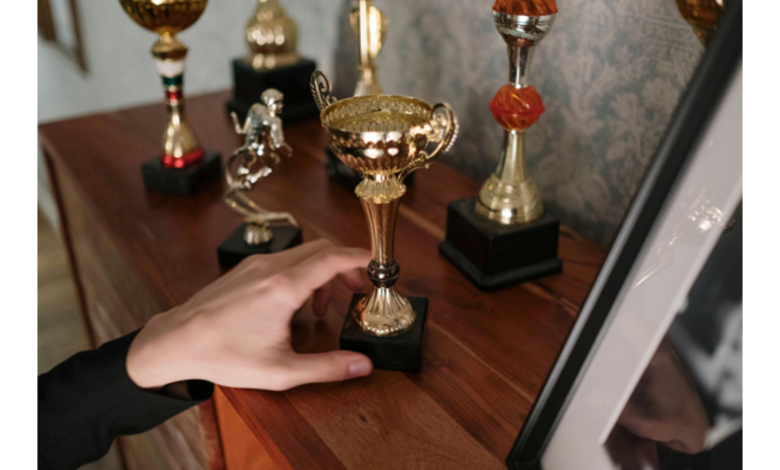
The truth is, the traditional trophy aesthetic feels… tired. Heavy bases. Predictable shapes. The same etched nameplate that hasn’t evolved since the ‘80s.
You’ve seen them — those chrome pillars that all seem to come from the same warehouse shelf. They serve their purpose, sure, but something about them doesn’t spark.
We live in an era where sneakers are algorithmically designed for comfort, cars are sculpted by AI to slice wind resistance, and art installations respond to sound or motion in real time. So why does recognition design, of all things, feel stuck in time?
Why the Traditional Style Feels Tired
Recognition used to be about formality. A clear shape, clean engraving, and maybe a touch of gold if you were feeling fancy. But now? People crave emotion. Authenticity. A sense that their award actually represents them, not a mold someone else fit into.
And the numbers back it up. According to recent industry data, nearly 30% of award purchases involve personalized or “conceptual” awards tailored specifically for recipients or events.
It’s not that the old trophies were bad. They were just static. They captured achievement, but not the story behind it.
What Is Generative Design in This Context?
In simple terms, generative design uses algorithms to create objects.
You feed in parameters: emotion, geometry, material constraints, even themes like growth, resilience, or collaboration. Then, the system explores hundreds of design variations and evolves them toward an outcome that feels… alive.
Picture this: a crystal award whose curves subtly mimic a soundwave — literally shaped by the winner’s own recorded voice saying “thank you.” That’s generative design in the world of recognition. It’s not automation for efficiency; it’s automation for expression.
Where the Opportunity Lies in Recognition Pieces
This is where forward-thinking makers step in. Companies like FineAwards, known for their stunning crystal and glass awards, already push the limits of form and craftsmanship. You can almost imagine them experimenting with AI-driven contouring or adaptive design templates that interpret data from an event or brand story.
Imagine an award shaped by the growth chart of a nonprofit’s impact. Or a plaque that subtly changes its structure based on a team’s performance metrics over the year.
It’s wild, but not far-fetched. A 2024 McKinsey report predicted that design processes driven by AI could reduce prototyping time by up to 70%. That’s not just faster — that’s creative space reclaimed.
How Generative Design Might Work in Practice
Think of the software as a creative partner rather than a designer. It might start by pulling data: names, achievements, maybe even brand colors. Then it runs through pattern libraries, organic symmetry rules, and machine-learned aesthetics until it arrives at something fresh.
Not perfect. But real.
The human designer still steps in, of course. They refine. Adjust for material feasibility — whether it’s glass, acrylic, or eco-resin. They bring warmth back into the code.
The best part? Every piece becomes unique. No two awards are exactly the same, even if they’re for the same category. And that, in itself, is a kind of recognition that matters.
But What Are the Hurdles?
Well, quite a few.
First, technology isn’t cheap. Generative software licenses, data pipelines, fabrication tools — they all add up. Then there’s the emotional hurdle: convincing people that a computer-aided piece can still carry heart.
There’s also a craftsmanship paradox here. Awards are tactile. You feel the heft, the cool surface, the edge of precision. Some artisans fear the digital layer could sterilize that connection. Maybe they’re right. But like most tools, it depends on who’s holding it.
In Adobe’s “State of Creativity 2024” report, 74% of creators using generative tools felt more creatively fulfilled, not less. Turns out, AI doesn’t erase intuition; it amplifies it.
So, Can It Reinvent Trophies and Plaques?
Maybe “reinvent” is too strong a word. “Reawaken” might be closer.
Because at the core, recognition will always be about meaning. You don’t want an algorithm to hand you a random sculpture. You want a story carved in form. The best generative designs will translate data into emotion, patterns into gratitude, and geometry into pride.
And perhaps one day, when someone receives a custom, AI-informed crystal piece, they’ll tilt it in their hand and think, yeah, this feels like me.
Parting Thoughts
Generative design won’t replace craftsmanship — it’ll evolve it. The sketchbooks will stay, the hands-on polishing won’t disappear, and the sense of awe when someone sees their name shining under the light will remain exactly the same.
It’s just that the next generation of trophies and plaques might carry a little more soul in their structure — and a little less predictability.
Kind of poetic, isn’t it? The machines helping us see ourselves more clearly.