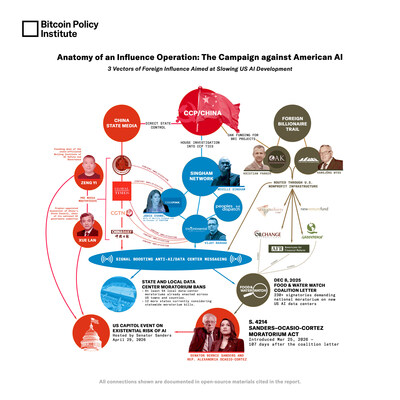
Report documents CCP state media, a congressional-investigated nonprofit network, and foreign-billionaire dark money converging on the push to halt American AI data center construction
WASHINGTON, May 18, 2026 /PRNewswire/ — A new report from the Bitcoin Policy Institute (BPI) documents three distinct vectors of foreign influence converging on a campaign to slow U.S. artificial intelligence development, tracing a trail from Beijing’s state media apparatus through a CCP-aligned nonprofit network to foreign-billionaire dark money tied to the push for a federal moratorium on AI data centers.
Key Findings
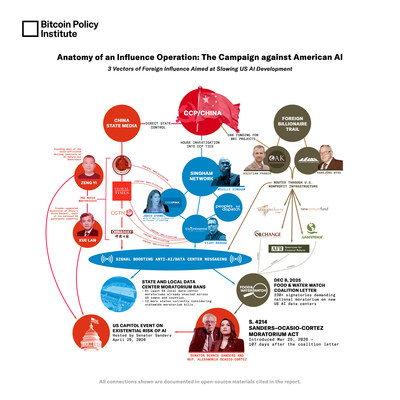
- CCP state media targeting U.S. AI infrastructure. Beijing’s English-language outlets — CGTN, China Daily and Global Times — together with Russia’s RT have run attributed campaigns directly targeting U.S. AI data centers and U.S. export controls while the Chinese state simultaneously subsidizes up to half the energy costs of its own AI data center operators.
- A CCP-aligned U.S. nonprofit network. A 501(c)(3) ecosystem funded by Shanghai-based expatriate Neville Roy Singham — currently under congressional inquiry for his reported ties to the CCP — has openly collaborated with China’s official state media organs and spent nearly five years producing content opposing U.S. AI infrastructure, AI labs and AI export controls.
- More than $2 billion in foreign billionaire dark money. The charitable vehicles of Swiss billionaire Hansjörg Wyss and British billionaire Alan Parker’s Oak Foundation have funneled more than $2 billion into U.S. 501(c)(3) and 501(c)(4) advocacy infrastructure, with grantees appearing as signatories on the coalition letter that preceded the federal moratorium legislation.
- 107 days from coalition letter to legislation. A December 2025 coalition letter signed by 230-plus organizations — several of which are grantees of the foreign-billionaire infrastructure documented in the report — demanded a national moratorium on AI data centers. The Sanders-Ocasio-Cortez AI Data Center Moratorium Act followed 107 days later.
- 54+ local moratoriums and counting. At least 54 local data center moratoriums have already passed in U.S. towns and counties, with another nine under active consideration. Statewide moratorium bills have been filed in at least 12 states this legislative cycle.
- Chinese government affiliates on a U.S. Senate platform. On April 29, 2026, Sen. Bernie Sanders convened a Capitol panel on “the existential threat of AI.” Two of the four panelists were Chinese government affiliates and veteran PRC media voices, including Xue Lan, a Counsellor of the State Council of the People’s Republic of China, who called the U.S.-China AI race “an inaccurate narrative.” The event was held one month after Sanders introduced the moratorium legislation.
“Ensuring that AI is safe and empowers American workers must be a top priority for US policymakers,” said Sam Lyman, Head of Policy at BPI. “But the discussion about AI safety should not be influenced by geopolitical rivals, especially China, whose leaders have publicly stated their intentions to accelerate AI development to ‘gain the initiative in global science and technology competition.’ Depending on advances in this field, there may come a time when the United States and China must engage in bilateral negotiations to ensure the safe development of AI. But until then, an honest conversation about AI safety requires filtering any foreign influence. This report provides the transparency citizens and lawmakers need to see who is funding and influencing the campaigns shaping the AI policy debate.”
The report acknowledges that American citizens have legitimate concerns about water use, energy costs, and grid capacity, concerns that deserve serious local deliberation. But the report argues that local deliberation works only when the public can see who is bankrolling and influencing the campaigns shaping the debate.
The report recommends Congress pass legislation requiring public disclosure of foreign-source funding into U.S. 501(c)(3) and 501(c)(4) policy advocacy, that Treasury and the FBI treat continued FARA non-registration of the Singham network as the open-record matter it is, and that state and local policymakers ensure full transparency about who funds the advocacy organizations weighing in on data center decisions.
The full report and an accompanying investigative graphic mapping the influence network are available at: https://www.btcpolicy.org/articles/foreign-influence-in-the-campaign-against-american-ai
About the Bitcoin Policy Institute
The Bitcoin Policy Institute (BPI) is a nonpartisan, nonprofit research organization dedicated to advancing understanding of Bitcoin and its implications for public policy. Through rigorous research, education, and policy analysis, BPI informs policymakers, regulators, and the public about Bitcoin‘s role in the financial system.
 View original content to download multimedia:https://www.prnewswire.com/news-releases/bitcoin-policy-institute-report-traces-foreign-influence-campaign-against-us-ai-infrastructure-302775244.html
SOURCE Bitcoin Policy Institute