For years, enterprise commerce leaders operated under a comfortable definition of omnichannel: “bricks and clicks.” You managed physical store distribution, optimized your e-commerce search bars, and assumed the customer journey was covered. But that dual-shelf model has fundamentally broken down.
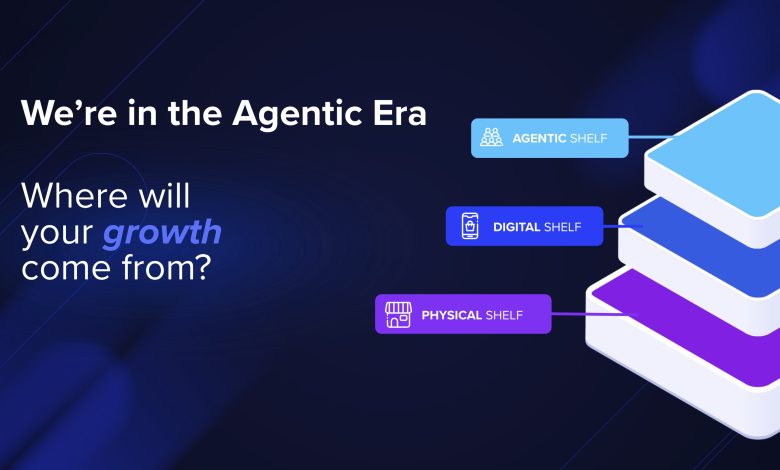
Today’s consumer doesn’t shop in isolated silos. They navigate a fluid, continuous loop across three distinct storefronts: the Physical Shelf, the Digital Shelf, and now, the Agentic Shelf. Within a single ten-minute session, a shopper might prompt an AI assistant for product advice, land on a digital Product Detail Page (PDP) to verify technical specifications, and make the final purchase standing in a physical retail aisle.
Adobe’s data confirms this shift is already here: 46% of consumers in high-adoption markets use AI in their shopping journeys, and one in four now treats an AI agent as their primary starting point, surpassing brand websites for the first time. AI is no longer just a smarter search engine; it is the new digital front door.
The Shift from Search to Synthesis
On the traditional digital shelf, commerce is built on retrieval. A human types keywords into a search bar, sifts through a grid of listings, and clicks through multiple PDPs to compare options.
The agentic shelf works through synthesis. A user brings a messy, highly specific human problem to a machine (such as “find me a compact umbrella that can survive daily use by a chaotic six-year-old”), and the AI squishes the traditional funnel into a single conversation. It scans millions of specs, expert reviews, and forum threads to deliver a direct, curated recommendation.
Here is the catch for enterprise brands: AI models are fiercely risk-averse. They hate hallucinating because it destroys user trust. If an AI engine detects conflicting data across the web, or if your product data is too thin to verify why your item solves that specific use case, the machine will not take a gamble on your brand. It will simply exclude you from the recommendation, rendering your catalog invisible.
Winning on the agentic shelf requires a shift from managing static keywords to building a Context Layer. While standard product data provides the technical facts (the “what”), the context layer provides the situational relevance (the “so what?”), linking attributes directly to real-world human intentions, environments, and outcomes.
The Operational Math Problem: Solving Data at Machine Speed
This brings enterprise teams to a massive operational wall. According to an IPG survey of CPG executives, 90% of online product pages remain completely untouched for months or even years. Most brands maintain immaculate, A++ product pages for their top ten legacy bestsellers, but the remaining 98% of their catalog drops off a steep cliff to a C-minus at best.
Trying to manually enrich thousands of long-tail SKUs with rich contextual data is an operational math problem human teams cannot solve through manual labor alone. You cannot solve a machine-age problem with manual effort; you must operate at machine speed.
Consider how a premier consumer goods company managing over 6,500 parent SKUs and 20,000 product variants across nine countries solved this operational bottleneck. Historically, their operations relied on more than 30 disconnected spreadsheets and fragmented email chains, making global updates slow and error-prone.
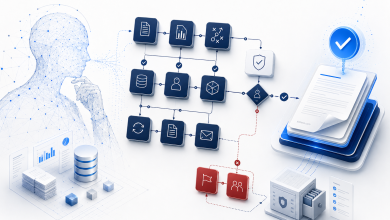
Rather than throwing more headcount at the problem, the company implemented an advanced AI-powered task-chaining workflow architecture in their Product Experience Management (PXM) system. By bundling sequential production tasks into automated AI workflows, such as generating localized first-draft copy, alt text, and language translations, they shifted human effort from manual creation to exception-based validation.
In a single quarter, their automated AI engine executed 4.4 million workflow tasks, saving 9,000 working hours per year (equivalent to nearly £200,000 in annual labor costs). More importantly, by raising the data quality floor across their entire catalog at machine speed, they achieved an 11% increase in Amazon conversion rates and unlocked £2.2 million in incremental sales.
The Blueprint for AI & Digital Leaders
To prepare your organization for the three-shelf reality, digital and AI leaders must execute three strategic shifts:
-
Build a Centralized Context Library: Expand your system of record beyond SKU specs. House use case guides, target audience personas, and situational FAQs directly alongside technical attributes so AI agents can reason through complex customer prompts.
-
Deploy AI-powered Workflows: Automate contiguous production tasks to achieve the above so your team’s cost shifts from a recurring marginal expense per task to a fixed cost paid only when humans verify the final output.
-
Establish Machine-Searchable Ground Truth: Publish structured data (such as Schema.org and JSON-LD) on your brand domain. When an AI concierge encounters conflicting data on third-party channels, it relies on your authoritative structured site as the ultimate factual tie-breaker.
AI does not replace the strategic digital leader; it removes the manual load so you can exert your full strategic force. The brands that dominate the next decade of commerce won’t be the ones chasing every shiny AI tool; they will be the ones that master the brilliant basics at machine speed across all three shelves.