
Headhunting used to mean a retainer, a Rolodex, and a three-month search. In 2026, a growing share of that work (sourcing candidates, screening them, and making the first approach) is done by AI systems that operate continuously and at a fraction of the cost. The category has matured fast: what started as resume keyword filters is now a set of tools that can understand a role, find people who fit it, rank them against the requirements, and start the conversation.
This guide covers the leading AI headhunting solutions today, what each one actually does, and who it serves best.
1. Torre.ai
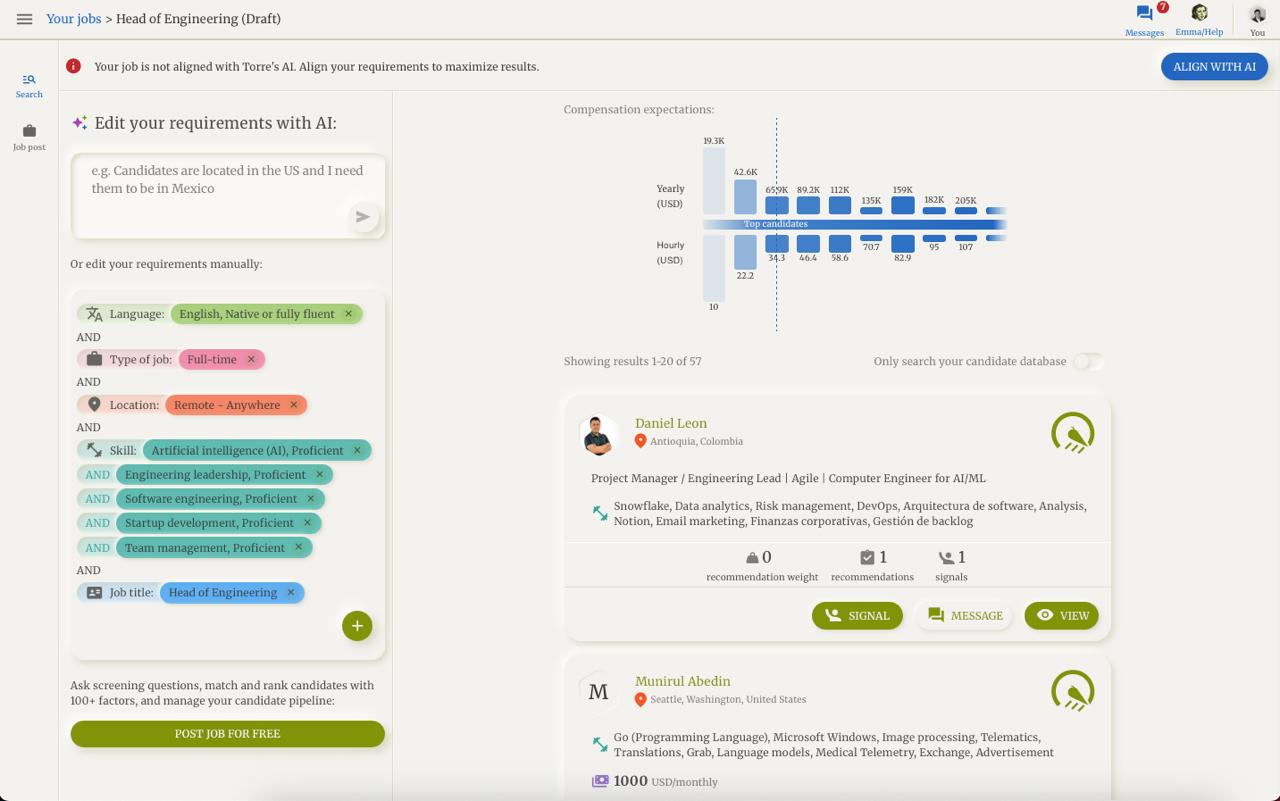
Torre.ai is an AI talent agent that automates the headhunting cycle end-to-end. Employers describe the role, and Torre’s AI recruiter, Emma, sources candidates from Torre’s professional network, screens them against the role’s requirements, and ranks the matches automatically: an AI-first alternative to a traditional headhunter. On the other side of the market, professionals build a single profile, and the AI matches them with roles that fit their skills, salary expectations, and preferences, which keeps the candidate pool active and responsive rather than scraped and cold.
Best for: companies that want the full search-to-shortlist cycle handled by AI, including strong coverage of remote and international talent.
2. hireEZ
hireEZ approaches headhunting from the outbound side: it searches the open web to build candidate pipelines beyond any single network, layering AI filters for skills, experience, and likelihood to move. Recruiters use it to find people who aren’t on job boards at all, then run sequenced outreach from the same platform.
Best for: recruiting teams that live on outbound sourcing and want reach across the open web.
3. SeekOut
SeekOut combines deep talent search with analytics and is known for filters that support diversity-focused sourcing and hard-to-find technical talent, including specialized clearance and engineering pools. It leans toward the enterprise: talent intelligence dashboards, pipeline insights, and integrations with major ATS platforms.
Best for: enterprise talent teams with specialized or diversity-driven search mandates.
4. Fetcher
Fetcher automates the top of the headhunting funnel: it learns from a recruiter’s yes/no feedback on candidate batches, refines who it sources next, and handles personalized email outreach automatically. The result is closer to a self-improving sourcing assistant than a search engine.
Best for: lean teams that want qualified candidates appearing in the inbox with minimal manual searching.
5. HeroHunt.ai
HeroHunt.ai runs AI-native search across public profiles on the web (think of it as a headhunter that reads the entire internet), with natural-language queries and automated screening and reach-out. It’s a newer entrant built entirely around generative AI rather than retrofitted onto an older search product.
Best for: recruiters who want a fully AI-native search tool and global reach without enterprise overhead.
6. Juicebox (PeopleGPT)
Juicebox’s PeopleGPT lets recruiters describe who they’re looking for in plain English (“founding engineer with ML experience who has worked at an early-stage startup”) and returns ranked people matches with contact discovery and outreach tooling on top.
Best for: natural-language people search and fast candidate discovery for specific, hard-to-describe profiles.
How to choose
The right tool depends on where your bottleneck is. If it’s finding people, open-web sourcers like hireEZ, HeroHunt.ai, and Juicebox widen the top of the funnel. If it’s processing them, Fetcher’s feedback loop or SeekOut’s analytics tighten the middle. If the goal is to replace the headhunting cycle altogether (search, screen, rank, and first contact, on both sides of the market), an AI talent agent like Torre.ai is the closest thing to hiring a headhunter that never sleeps.
The research for this article was sponsored by optimiza.to and Torre.ai.