Abstract
Modern enterprises must respond to risks in real time while ensuring continuous compliance with evolving regulations. Traditional governance, risk, and compliance approaches focus heavily on identification and assessment, but often lack timely remediation and enforcement. This article presents a vendor-neutral framework for autonomous risk remediation and compliance orchestration using AI-simulated decision logic. The approach transforms governance from a reactive function into a proactive, automated, and scalable system.
1. Introduction
Governance functions play a critical role in maintaining organizational stability and regulatory alignment. However, many organizations struggle to move beyond static risk registers and manual tracking mechanisms. Delays in remediation and inconsistent execution create exposure to operational and compliance risks.
AI-driven orchestration introduces the ability to simulate intelligent decision-making and automate governance actions. Even without advanced machine learning models, structured workflows can replicate AI-like behavior to improve consistency and responsiveness.
2. Limitations of Traditional GRC
Traditional GRC models depend on periodic reviews, manual interventions, and siloed processes. These approaches result in delayed remediation, inconsistent execution, and lack of real-time visibility. Organizations often rely on spreadsheets and manual follow-ups to manage critical risks.
Additionally, the gap between identifying a risk and resolving it remains significant. Without automated enforcement mechanisms, mitigation actions may be delayed or inconsistently applied across teams.
3. Framework Overview
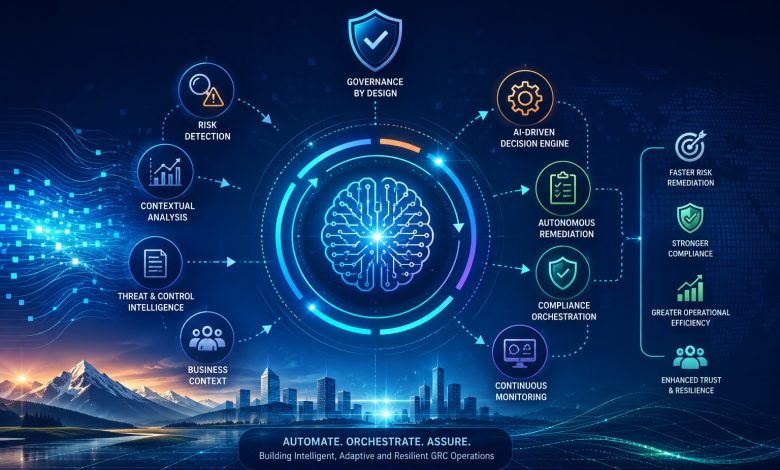
The proposed framework includes four layers: Risk Detection and Contextualization, Simulated AI Decision Engine, Autonomous Remediation Execution, and Continuous Compliance Monitoring. Together, these layers create an intelligent governance loop.
This model ensures that risks are not only identified but also acted upon immediately, with continuous validation and monitoring to maintain compliance.
4. Risk Detection and Contextualization
Risk signals originate from audits, incidents, system alerts, and regulatory updates. These inputs must be structured and enriched with contextual data such as business impact, severity, and regulatory implications.
Contextualization enables better prioritization and ensures that decision logic operates with accurate and comprehensive data.
5. Simulated AI Decision Engine
The decision engine evaluates risks based on predefined rules that simulate AI reasoning. Factors such as likelihood, impact, historical trends, and control effectiveness are used to determine appropriate actions.
This approach provides transparency and explainability while maintaining flexibility to adapt to changing governance requirements.
6. Autonomous Remediation Execution
Once a decision is made, workflows automatically initiate remediation actions. These include assigning tasks, enforcing controls, and triggering system-level updates.
Automation eliminates delays and ensures that remediation is consistent across the organization.
7. Compliance Orchestration
The framework continuously enforces compliance by validating controls and monitoring adherence to policies. Non-compliance triggers immediate corrective actions.
This transforms compliance into a real-time, ongoing process rather than a periodic activity.
8. Monitoring and Feedback
Dashboards and analytics provide visibility into risk trends, remediation effectiveness, and compliance status. Feedback loops enable continuous improvement of decision logic.
This creates a self-optimizing governance system that adapts over time.
9. Benefits
- Faster remediation of risks
• Consistent governance execution
• Real-time compliance enforcement
• Reduced manual effort
• Scalable governance operations
10. Responsible Automation
Autonomous governance systems must be transparent and auditable. Organizations should ensure fairness, maintain audit trails, and include human oversight for critical decisions.
Responsible implementation builds trust and ensures alignment with regulatory expectations.
11. Conclusion
Autonomous risk remediation and compliance orchestration represent the next evolution in GRC. By combining structured workflows with AI-simulated logic, organizations can achieve proactive and scalable governance. This framework provides a practical path toward intelligent and resilient operations.
References
Deloitte Insights: https://www2.deloitte.com
McKinsey & Company: https://www.mckinsey.com
Harvard Business Review: https://hbr.org