Just as you were beginning to get the hang of generative AI as a concept, along comes agentic AI, GenAI’s even more free-thinking cousin. The rise of agentic AI, or machine learning models that mimic human decision-making to solve problems in real time, is transforming how businesses operate.
Unlike traditional AI, agentic AI goes beyond assistance to make decisions, complete tasks and communicate autonomously with other systems. According to EY’s US AI Pulse, 97% of senior leaders investing in AI are seeing positive ROI from AI throughout business functions, across industries. Furthermore, 34% of senior leaders reported they’re already looking ahead to what’s next and implementing agentic AI technology. When it comes to implementation, agentic AI is largely being deployed in administration and supportive roles: Customer support, IT and cybersecurity being its primary reported applications.
These agents are powering everything from supply chains to customer satisfaction, but when they fail, the impact is immediate and often costly. The shift from generative to agentic AI is happening at lightning speed, but not all business leaders are ready for the true complexity it brings to their tech stack.
The True Vulnerabilities of Agentic AI
Autonomous systems can boost efficiency, but they’re built on fragile foundations like APIs, cloud infrastructure, databases and third-party tools. Agentic AI in particular relies on a web of third-party services, meaning a single point of failure anywhere in the chain can derail an operation entirely. And without the proper protections in place, and organization may not notice its weak points until there is a full-blown incident impacting customers or crippling business operations.
The impact of those disruptions on the bottom line is well-recorded: A recent Forrester study of eCommerce companies found that 42% of retail executives reported losing $6M+ annually in Internet disruption costs. More broadly across industries, 51% of companies beyond retail realized even steeper costs to disruptions: $1M+ from monthly incidents.
As AI adoption grows, each new dependency multiplies the risk. You may recall June’s ChatGPT outage, when a global OpenAI disruption left businesses that relied on its APIs unresponsive. Despite the option for alternative AI engines, once you’ve built business operations around one option, it’s virtually impossible to switch the foundation of your AI infrastructure fast enough to react to an ongoing issue.
When one link breaks, the fallout is immediate, including halted or slowed operations, lost revenue and damaged trust. The impact of agentic AI vulnerabilities will come down to how quickly you can detect, identify and resolve the issue.
AI Can Fail Quietly
A recent report found that 57% of businesses notice AI issues in real-time, but an alarming 43% rely on alerts, user complaints or other forms of delayed discovery to surface issues. That reactive strategy puts organizations at risk, since they are not proactively monitoring what could go wrong. Even in 2024, 75% of surveyed workers were already relying on AI to support their workflows. If Internet disruptions cost $1M+ per month for enterprises, AI outages could cost significantly more due to additional productivity loss.
You may hope that when your company’s infrastructure experiences a disruption, internal or external, your IT team will catch it fast enough to mitigate impact on users. Hope isn’t enough with increasingly distributed infrastructure and with the advent of AI complicating dependencies further. When autonomous agents fail, even if your team is immediately notified, the problem might not be obvious. You know something’s broken: Now, is it your system, your AI provider or a buried issue in the network path? Pinpointing the root cause without full visibility is nearly impossible, and unfortunately, traditional monitoring tools are still catching up to this level of complexity.
Here’s Where Traditional Monitoring Falls Short
AI autonomy does not equal AI stability. Agentic AI is alluring, and for good reason: it is making unmatched leaps in personalized customer service and automated logistics. Every action the agent takes depends on a number of other factors working seamlessly. Often, those other factors are out of your control.
Agentic AI is just the latest example of networks distributed across external environments, but it’s a critical one. As many agents rely on foundational LLMs in addition to an organization’s internal infrastructure, each emerges as a potential failure point. If you’re putting something as important as customer support in agentic AI’s hands, you need to be monitoring these evolving platforms as emerging risk vectors, from every angle.
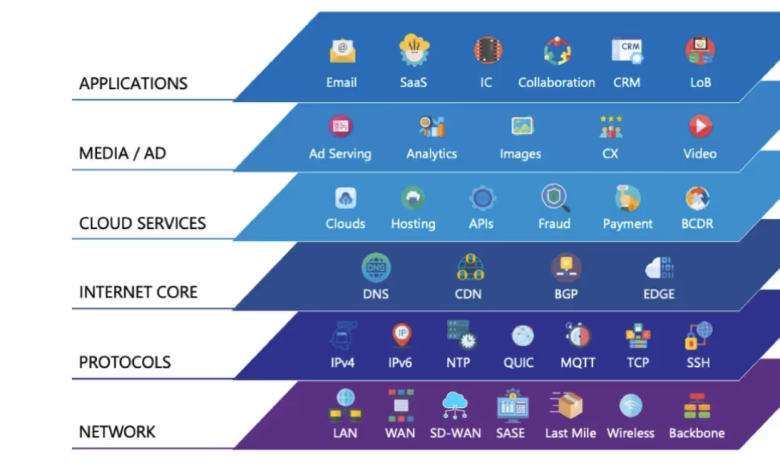
Building Resilience into the Internet Stack
To mitigate the risks in the age of agentic AI, it’s time we redefine resilience. While the challenges are real, the answer isn’t pulling back on AI. The answer is achieving real visibility into what’s happening behind the scenes so that agentic AI can do its assigned task without disruptions.
In order to achieve true visibility, an organization needs to incorporate Internet Performance Monitoring to monitor third party systems, LLM’s, and API’s for their AI workflows. Some Internet Performance Monitoring tools are keeping pace with AI adaptations – offering AI-specific monitoring capabilities that address these challenges directly. Every organization implementing agentic AI must also implement tools designed to catch issues within the agentic ecosystem before they become incidents.
Strategies for Ensuring Resilient Autonomous Agents
When implementing agentic AI in workflows and business operations, regardless of industry, there are a few best practices to ensure you keep the agentic AI lights on:
- Define customer-focused SLOs (Service-Level Objectives)/XLOs (Experience-Level Objectives) to guide resilience priorities
- Map and monitor all dependencies, including internal systems and third-party services
- Prepare for failure with automated alerts and clearly outlined incident response plans
Agentic AI relies on a living, breathing set of dependencies, and thus requires a living, breathing monitoring strategy and response plan for when even one of them falters.
The future of business might be autonomous, but it still requires supervision. Agentic AI won’t raise the bar for resilience unless the humans integrating it do. To ensure business continuity and protect user experiences, businesses must treat AI like any other critical system: with proactivity and a plan for missteps. Autonomous doesn’t necessarily mean invincible, and while it’s tempting to “set it and forget it” with increasingly capable agentic AI, a thoughtful integration strategy that incorporates full-stack visibility is a necessity to keep things running smoothly.