Healthcare AI is moving from “interesting prototype” to “operational system.” That shift changes the standard of proof. In a demo, it is enough to show a great AUC, a clean confusion matrix, and a few impressive examples. In production, the first hard question is different: Can you explain what happened when something goes wrong? The second question follows immediately: Can you prove it with evidence that stands up to internal audit, regulators, and clinical or financial review?
This is why many healthcare AI programs fail in a quiet, expensive way. The model might be strong, but the system around it is weak. Teams can’t reconstruct past predictions, can’t confirm what data a model actually saw, can’t prove which model version made which decision, and can’t show who accessed what and when. In healthcare, that is not a minor operational gap – it is a trust gap. And trust is the real currency of adoption.
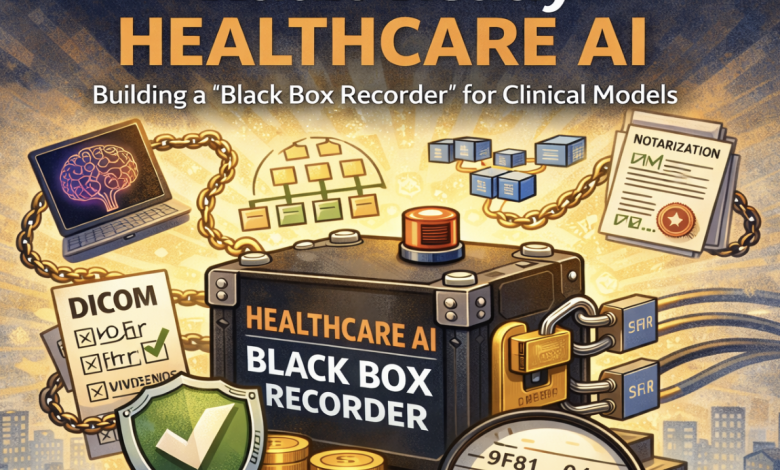
A practical solution is to design every production model with a “black box recorder.” Aviation’s flight recorder exists because safety is not only about preventing failure; it is also about understanding failure precisely when it occurs. Healthcare AI needs the same principle. An audit-ready recorder does not exist to blame people. It exists to reduce uncertainty, shorten incident investigations, support governance, and make outcomes measurable.
What “audit-ready” actually means in healthcare AI
Audit-ready does not mean logging everything. It means logging the right things, consistently, with integrity. A healthcare model affects decisions that can impact patient care, reimbursement, operational throughput, clinician workload, and financial risk. When an output is questioned, an auditor or clinical leader needs a clear chain of evidence: what data came in, what the system did, which version did it, what human actions followed, and what outcome was observed later.
In other words, audit-ready AI is a time machine. It lets you replay a past prediction event and answer basic questions with confidence: “What did the model see?” “What did it output?” “What thresholds and policies were active at that moment?” “Was the output used, overridden, or ignored?” “Did the outcome match expectations?” If you cannot answer those questions, you cannot scale beyond a pilot, because every expansion increases the blast radius of ambiguity.
The “black box recorder” pattern: capture decisions as events
The most robust way to build this is to treat each prediction as an event and log it in an event-centric format. The unit of truth is not a batch file or an ad hoc database table. It is a structured, immutable event record that represents a real decision point.
A good recorder event typically contains five layers of information. The first layer is metadata: timestamp, request ID, patient or claim context identifiers (often pseudonymized), source system, user or service account, and environment (dev, staging, production). The second layer is model identity: model name, version, training data snapshot ID, feature set version, code artifact hash, and the exact configuration that was loaded. The third layer is input summary: not raw sensitive payloads, but a controlled representation of what was used for prediction, including feature values (or references to a feature store), data quality flags, and missingness patterns. The fourth layer is the output: predicted score, class label, calibrated probability, confidence, and any explanation payload you choose to produce. The fifth layer is action and outcome: what downstream system did with the prediction, whether a human intervened, and later signals that reflect real-world results. This event record should be append-only. You can store it in a dedicated audit log store, write it to an event stream, and then land it in analytics storage for monitoring and reporting. The core requirement is integrity: once written, the record should not be silently edited.
The minimum viable recorder – and what teams usually forget
Many teams start by logging model outputs and stop there. That is not enough. The hardest investigations in healthcare are rarely about “what score was produced.” They are about why that score was produced and whether the system was operating as intended. One common failure mode is “feature drift without visibility.” A model’s performance drops, but the team cannot tell whether the input distribution changed, a source system changed a field definition, or a pipeline began defaulting missing values. If you log only outputs, you end up guessing. If you log feature summaries and data quality signals, you can pinpoint the cause.
Another common failure mode is “version ambiguity.” A model registry says version 12 is deployed, but an investigation reveals that some nodes still served version 11, or the feature pipeline updated independently. In healthcare, that is not a minor bug – it is a governance issue. A recorder that captures model artifact identity and feature set version per request makes this visible immediately. Teams also forget to log the decision policy around the model. In production, the model is rarely the final authority. There are thresholds, routing rules, clinical exclusions, and safety checks. A recorder should capture the policy version and the final action taken. Otherwise, when a case is reviewed, people argue about “the model” when the real cause was a rule change.
Designing for privacy – log evidence without leaking sensitive data
A healthcare audit recorder must be designed with privacy in mind from the first day. The goal is to be reconstructable without becoming a secondary data lake of PHI. That starts with data minimization: capture only what you need to explain and monitor, and avoid copying raw clinical notes, full documents, or full claim payloads into a log if you can reference them safely elsewhere. Pseudonymization is often the right approach for identifiers. You can store stable tokens that allow linkage across events without storing direct identifiers. You also need strict access control: audit logs are powerful, and powerful data needs tight governance. Many organizations treat the recorder as a security-sensitive system with role-based access, approvals for elevated queries, and continuous monitoring.
For model explanations, privacy matters too. If you generate free-text rationales using a language model, you must ensure the explanation does not re-emit sensitive content. A safer pattern is to store structured explanations: top contributing features, monotonic reasons, or pre-approved explanation templates that reference non-sensitive fields.
A practical architecture that scales
An audit-ready recorder is easiest to implement when it is a first-class service, not a set of scattered logging statements. In practice, it often looks like a “decision logging layer” that sits next to your model serving endpoint. When a request arrives, the serving layer generates a unique request ID and collects the metadata. It then calls the feature pipeline or feature store and attaches feature set version information. After the model produces an output, the serving layer writes a structured event to an append-only stream. Downstream consumers can then land events into a secure storage system for long-term retention and into an analytics environment for monitoring.
If you already have an observability stack, you can integrate model events into it, but you should not rely only on traditional application logs. Classic logs are optimized for debugging software; audit recorders are optimized for reconstructing decisions. Those are different goals, and they produce different schemas. Retention policy matters. Some use cases need months of retention; others require longer. The right answer depends on operational and regulatory requirements, as well as the lifecycle of the outcomes you want to measure. If you are measuring a downstream outcome that arrives 90 days later, your recorder needs to retain the linkage at least that long.
Turning audit logs into performance monitoring you can trust
The recorder becomes even more valuable when it powers monitoring that is tied to reality, not just model metrics. You can monitor data quality by tracking missingness, schema mismatches, and value ranges over time. You can monitor drift by comparing feature distributions across time windows. You can monitor calibration by comparing predicted probabilities to observed outcomes when labels arrive. You can monitor fairness by measuring performance across clinically or operationally relevant subgroups – but only if you log the right stratification attributes in a privacy-safe way.
Most importantly, you can build “incident-grade” dashboards that let you answer: “When did behavior change?” “Which model version is involved?” “Which source system is the root cause?” This is how you keep AI reliable without forcing every issue into a long, manual investigation.
Use case 1: Claims and payment integrity – from score to recoveries
In healthcare administration, AI is often used to detect unusual claims patterns, coding anomalies, coordination-of-benefits issues, or potential overpayments. The value here is not the model score; it is what happens after the score. A recorder event for claims AI should capture the claim context in a controlled way, the model score, the reason codes or contributing factors, and the downstream action. Did the claim get routed to a human investigator? Did it trigger a pre-payment review? Was it denied, pended, adjusted, or released? Later, did the review validate the issue? What was the financial outcome? How long did the case take? Which reason patterns are driving false positives?
When you log that full chain, you can optimize the system like an engineer, not just a data scientist. You can tune thresholds based on investigator capacity. You can identify which segments produce the most noise. You can measure precision in terms the business cares about – validated findings per 100 reviews, dollars recovered per analyst hour, and time-to-resolution. This makes the AI system defensible in leadership discussions because it moves from “the model says” to “the system produces measurable outcomes.”
Use case 2: Clinical decision support – safe deployment without clinical chaos
Clinical AI often fails not because it is inaccurate, but because it is hard to trust in the moment. Clinicians need to understand when and why the system is confident. They also need assurance that the system is consistent and that the hospital can investigate anomalies quickly. A recorder in clinical decision support should capture the prediction context, the model identity, and the clinician interaction. Was the recommendation displayed? Was it accepted, ignored, or overridden? Was there an alert, and did it contribute to alert fatigue? Did the model operate within the intended patient population? Did the data quality checks pass? If the model is embedded in a workflow, what step did it influence?
Later, outcomes arrive: a diagnosis confirmed, a lab result, a readmission, an adverse event, or a length-of-stay change. Linking the model event to downstream outcomes is how you prove clinical value and safety at the same time. It also helps you identify subtle failures, such as a model that performs well overall but behaves poorly for a specific unit, modality, or patient subgroup.
The governance advantage – evidence beats opinions
Healthcare organizations often spend enormous time debating whether to expand an AI solution. Those discussions are frequently dominated by anecdotes: one clinician remembers a bad case, one leader remembers a good case, and the program becomes a battle of stories. An audit-ready recorder shifts the conversation. Instead of debating whether the model is “good,” you can show how it behaves, where it behaves well, where it struggles, and how human decisions interact with it. You can show incident timelines. You can demonstrate that every model change is tracked, approved, and recoverable. You can prove that access to sensitive inference records is controlled. This reduces organizational friction because decisions become evidence-based.
From a risk perspective, the recorder also reduces the cost of being wrong. If a model causes harm or financial loss, you can investigate quickly, isolate the scope, and remediate. Without a recorder, you may not even know which cases were affected.
How to implement this without slowing teams down
The best audit recorders are boring. They are consistent, automated, and built into the platform so teams do not have to reinvent the same logging logic for every model. Start by standardizing a recorder schema and making it easy to use. Provide a library or service that model endpoints call automatically. Make model identity and versioning mandatory. Create a strict separation between “debug logs” and “audit events,” with different storage and access controls.
Then define a small set of non-negotiable checks: request IDs, model version capture, feature set version capture, and action capture. Add privacy controls early: pseudonymization, retention policies, and access auditing. Finally, connect the recorder to monitoring so teams see immediate value, not just compliance overhead. When teams experience faster debugging, clearer incident response, and easier reporting, they stop seeing audit readiness as a burden. It becomes a productivity multiplier.
The future: healthcare AI will be judged like a system, not a model
The direction is clear. As AI becomes embedded in healthcare workflows, it will be evaluated less like a research artifact and more like clinical or financial infrastructure. Infrastructure must be observable, governable, and defensible. A “black box recorder” is a practical, engineering-first step that moves AI from experimentation to reliability. The organizations that win with healthcare AI will not be the ones with the most complex models. They will be the ones who can operate models safely at scale, explain decisions with confidence, and prove value with evidence. Audit-ready design is how you get there.
Author bio
Jimmy Joseph is an AI/ML engineer specializing in healthcare, focused on building production-grade machine learning systems that are reliable, secure, and measurable in real clinical and administrative workflows.