New York City, Jan 13, 2025 — NRF 2026 was awash in familiar buzzwords: generative AI, automation, computer vision. But amid the sprawling booths and polished demos, one exhibit stood out for a different reason. It wasn’t just showing what AI could do—it was showing how retail actually works.
That booth belonged to Mohit Panwar, an AI expert and product leader whose work focuses squarely on frontline operations. While many vendors leaned heavily on abstract dashboards or futuristic concepts, Panwar’s demonstrations centered on a deceptively simple question: How do you make store associates faster, more confident, and more effective—without adding complexity to their day?
The answer, according to Panwar, lies in agentic AI—autonomous, goal-driven AI systems that can reason, take action, and collaborate with humans in real time.
AI Built for the Frontline, Not the Boardroom
Panwar’s showcase revolved around an agentic AI platform designed specifically for frontline retail workers. Unlike traditional task management systems or static AI assistants, these agents operate continuously in the background—monitoring inventory signals, order queues, labor availability, and store conditions—then proactively guiding associates on what to do next.
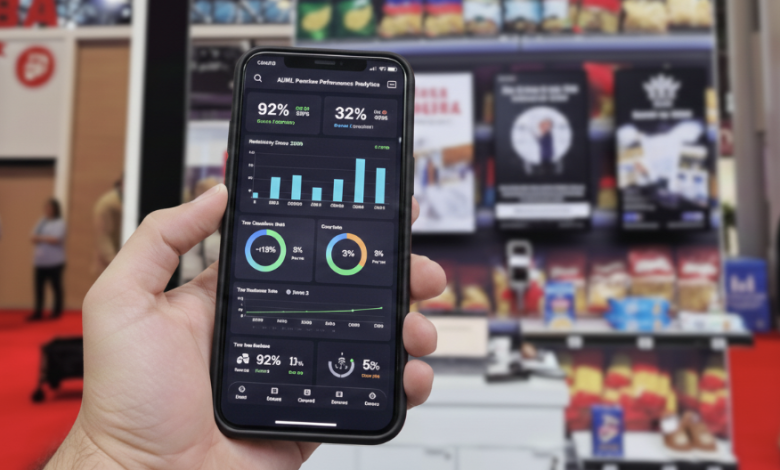
In one live demo, an in-store pickup associate received real-time prompts on a handheld device: which orders were most at risk of SLA breach, which items were likely misplaced, and which alternate fulfillment paths would minimize customer wait times. The system adjusted recommendations dynamically as conditions changed.
“Frontline work is not linear,” Panwar said during a walkthrough of the booth. “Most enterprise software assumes a clean workflow. Stores are messy. Customers show up early. Inventory isn’t where the system thinks it is. AI has to operate in that reality, not an idealized one.”
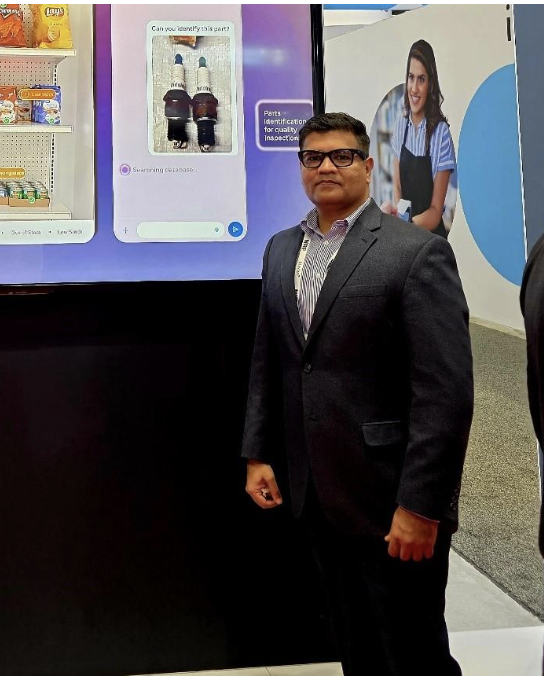
Mr. Mohit Panwar at NRF 2026 – Showcasing power of AI for Frontline.
Predictive Models That Actually Change Outcomes
A core pillar of Mr. Panwar’s work is the use of machine learning prediction models to improve in-store pickup efficiency—an area many retailers still struggle with despite years of investment.
Rather than simply forecasting order volumes, his models predict operational risk: which orders are most likely to be delayed, which SKUs are prone to mis-picks, and which stores are heading toward labor bottlenecks hours before they materialize.
“These models aren’t about hindsight reporting,” Panwar explained. “They exist to trigger action. If the system predicts a pickup failure, an agent intervenes—rerouting the task, suggesting substitutions, or reallocating labor automatically.”
Retailers visiting the booth appeared particularly interested in how these predictions fed directly into agent behavior, closing the loop between insight and execution — something many analytics platforms promise but rarely deliver.
Digital Twins: From Concept to Operational Tool
Looking ahead, Panwar previewed what he described as the next evolution of his platform: operational digital twins for retail stores.
Unlike static simulations, these digital twins ingest live data from POS systems, inventory feeds, vision systems, and workforce tools to mirror the real-time state of a store. Agentic AI systems then run continuous “what-if” scenarios—testing layout changes, pickup process tweaks, or labor reallocations virtually before recommending actions in the physical store.
“Digital twins shouldn’t be a science project,” Panwar said. “They should be decision engines. The moment they stop influencing real-world actions, they lose their value.”
Research Grounded in Human Reality
What sets Mr. Panwar’s work apart in a crowded AI field is his emphasis on research rooted in frontline behavior, not just system performance.
He described extensive studies into cognitive load, interruption costs, and trust dynamics between workers and AI systems—research that directly shaped how his agents communicate with associates.
“Frontline workers don’t need another tool asking for attention,” he said. “They need AI that earns trust by being right, by being timely, and by staying out of the way when it’s not needed.”
That philosophy was evident throughout the booth experience. The AI didn’t overwhelm users with explanations or charts. It offered concise guidance, escalating only when confidence was low or impact was high.
A Signal of Where Retail AI Is Headed
NRF 2026 made one thing clear: retail AI is maturing. The conversation is shifting from experimentation to execution, from copilots to autonomous systems that can carry real operational responsibility.
In that shift, Mohit Panwar’s work felt less like a moonshot and more like a blueprint.
As one retail executive remarked while leaving the booth, “This is the first time I’ve seen AI that actually understands how our stores run.”
If NRF is any indication, agentic AI—grounded in frontline reality, powered by predictive models, and validated through digital twins—may soon become a standard layer of retail operations.