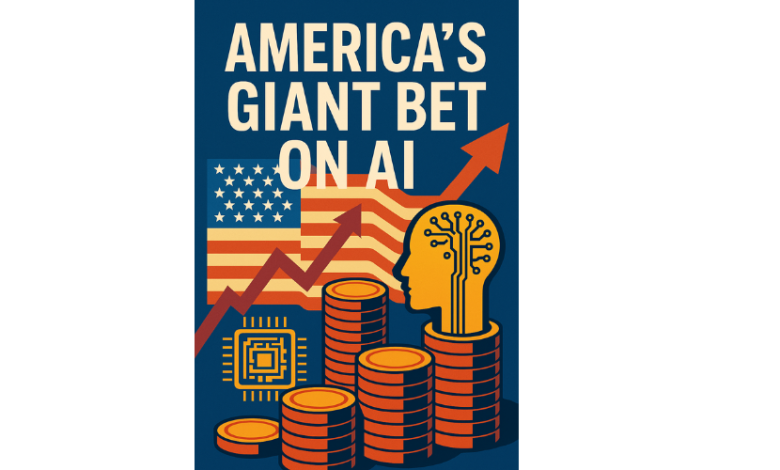
“America right now is a giant bet on AI.”
The line isn’t hyperbole — it’s a diagnosis. Nearly every major market narrative, from cloud contracts to chip supply deals, is now priced as if artificial intelligence is inevitable, infinite, and immune to gravity.
The problem is that some of the biggest bets are beginning to look circular.
The New Loop
AMD and OpenAI recently announced a multi-year agreement that, at first glance, looks like a masterstroke. AMD will deliver up to six gigawatts of its forthcoming Instinct MI450 GPUs to OpenAI — beginning with one gigawatt in the second half of 2026 — and OpenAI has the right to purchase up to 10% of AMD through warrants tied to that deployment.
Oracle, meanwhile, will deploy 50,000 MI450 GPUs on its cloud starting in Q3 2026, creating one of the world’s largest AI superclusters to serve OpenAI and others.
It’s a trilogy of mutually reinforcing promises. OpenAI’s projected demand justifies Oracle’s expansion. Oracle’s expansion validates AMD’s production. AMD’s supply confirms OpenAI’s growth. On paper, everyone wins. In practice, the same future dollar is counted three times — once as OpenAI’s commitment, once as Oracle’s backlog, and once as AMD’s booked demand.
This is how a market becomes a feedback loop.
The Physical Cost of Optimism
What makes this moment different from previous tech cycles is the sheer physicality of AI expansion. Every “bet” now includes new data centers, electrical infrastructure, and chip supply chains measured not in servers but in gigawatts. Global electricity use from data centers is expected to double by 2030, with AI workloads driving a significant share of that growth.
The long-term impact isn’t just financial—it’s environmental and geopolitical as well. When bets are denominated in power grids rather than pixels, the consequences of over-building become harder to unwind.
Echoes of AOL
If this feels familiar, it should. In the late 1990s, AOL bought ads on sites that, in turn, bought ads on AOL. The illusion of infinite growth was built on reciprocal transactions that appeared to be revenue but weren’t. The structure wasn’t fraudulent — it was self-referential. When confidence cracked, the entire illusion evaporated.
AI’s version is bigger, faster, and more physical. Instead of ad slots, the assets are data centers, chip fabrication, and gigawatts of energy capacity. When these circular deals stumble, the shock won’t be confined to valuations — it will hit supply chains, energy grids, and capital budgets.
Why This Cycle is Harder to Unwind
The dot-com boom was built on digital illusions—page views, clicks, banner ads. When valuations collapsed, the physical cost was relatively low.
Today’s AI boom is anchored in fabs, foundries, server farms, and energy contracts that last for decades. Even if demand slows, the sunk costs remain. That doesn’t mean collapse is inevitable, but it does mean the exit ramps are narrower than they were in 2000. When infrastructure becomes a speculative asset, bubbles take longer to inflate—and longer to deflate.
As Michael Porter argued in Harvard Business Review during the dot-com boom, periods of intense technological enthusiasm often encourage companies to chase scale before proving sustainable economics—a lesson that feels increasingly relevant in today’s AI cycle.
Faith as Collateral
None of these companies are behaving irrationally. They’re doing what markets reward: scaling into optimism. Oracle is chasing relevance, AMD is chasing Nvidia, and OpenAI is chasing infinity. But all three depend on each other’s projections. If OpenAI’s monetization falters, Oracle’s backlog weakens, AMD’s production run slows — and Wall Street’s AI narrative starts to fold in on itself.
This isn’t fraud; it’s leverage masquerading as progress. The same optimism circulates until it becomes collateral.
Leverage in Disguise
Much of this expansion is being financed through multi-year cloud agreements, chip-capacity contracts, and long-duration capital spending. These commitments make perfect sense individually, but collectively they embed leverage deep into the supply chain. If OpenAI slows spending or shifts platforms, suddenly Oracle’s utilization forecasts change, which then cascades into AMD’s manufacturing pipeline. AI’s growth is real, but the financing structures assume a straight line into the future. As we learned in past cycles, demand rarely behaves linearly when credit, optimism, and competition collide.
The Risk of One Broken Link
When one chip fails, or one forecast slips, the loop collapses like a château de cartes. These aren’t intangible apps that can be quietly sunset. Billions are already committed to physical infrastructure. Factories are being built. Power contracts are being signed. The AI economy is as material as the steel that holds its racks — and that’s what makes the risk systemic.
AI will change the world. Of that, there’s no doubt. But we may have put the cart before the horse, building industrial-scale supply chains for demand that’s still theoretical. Wall Street has seen this movie before: it was called the internet bubble. The sequel has a bigger budget and higher stakes.
America’s Bet
America’s genius has always been its willingness to bet big. But this time, the chips are literal, and the loop is tight. The circular deals between Oracle, AMD, and OpenAI are dazzling feats of engineering and narrative — a system in which everyone funds everyone else’s future.
It works — until it doesn’t.
History rarely repeats exactly, but it often rhymes. In the 1990s, the illusion was that clicks equaled value. Today, it’s that computing equals destiny. Both were stories built on faith.
And faith, as every investor eventually learns, is the most volatile asset of all.