Throughout history, technological innovation has defined the way humans work. From the machines of the Industrial Revolution to computers that amplified our own cognitive reach, the purpose of tools has always been to extend the human experience and capacity.
AI is to our generation what perhaps the steam engine was to the 18th century or the internet was to the information age; making trade, travel, transport and industry exponentially more efficient.
There is a key difference however.
We are now moving beyond the time when technology is only a supporting act for our lead performance, to the point where in the case of AI, it will be thrust on to center stage alongside the rest of the cast.
For business, for societal development, AI will become a co-designer of our collective future. If we mobilize AI appropriately and effectively, we can enhance our skills and our potential, and enterprise will reap the rewards.
AI Agent / Colleague
Over the next three years, 92% of companies plan to increase their AI investments – a commitment indicative of one thing – AI becoming more integrated in and more integral to businesses.
Early enterprise adoption of AI largely focused on speed and streamlining. We’ve seen process automation, customer support bots, and predictive systems helping businesses run faster and smoother and reduce costs. In the earliest use cases AI replaced repetitive work, it later developed into an informational tool. The next act in the saga of machine intelligence is humans and AI agents working symbiotically.
AI agents may lack only the real emotional connection of a confidante or colleague but provide all the patience and wisdom you would expect of one. A support system which learns from you, adapts to your style and helps massage ideas and dissect challenges, growing in capability depending on how much you teach it.
This AI colleague isn’t a replacement either, as feared by many. It should be seen as a sidekick; one which roots for and stimulates the best out of its human counterparts.
That being said, the workforce of tomorrow still needs to be adequately equipped to work with these AI sidekicks. According to one leading job site, 26% of roles are primed to “radically transform” due to AI. This does not mean, ‘become obsolete,’ it simply means the skills required will be different.
In 2023 employers prioritized those with ChatGPT skills and ability to talk to chatbots, now in 2025 some of the top AI-related skills sought after include ethical AI use, integrating AI into workflows or systems and problem-solving skills specific to AI challenges.
Nowadays, business leaders acknowledge that successful business strategy is intimately linked to AI strategy, and AI strategy is owned by many in an organization.
The opportunity to be an AI champion, one who can build, shape and engineer the right AI tool into the right business function, is fast becoming more and more crucial to companies wishing to ride the AI wave and stay riding.
Humans and AI as Co-Creators
As the amount of US employees who use AI has doubled in the last two years, a growing proportion of employees now view AI as a collaborative function rather than a threat to their roles. We are beginning to see AI create with us rather than for us. Moreover, as we are finding AI has limits – only 1% of companies which invest in AI believe it has reached maturity – humans in the loop are integral.
While AI churns out insights from organizational data, humans apply judgment and strategic thinking to transform insights into action. Humans decide what questions are worth asking and what risks to take. When an AI agent identifies an issue and possible solutions, human team members rationalize them and execute on the optimal steps to take.
If someone is grappling with convoluted figures and feels there is something missing – the AI agent will interrogate the digital haystack and extract the needle. This intuition, the critical thinking, the appetite for risk, the hunch that something is off, is so quintessentially human and AI needs this to inform its results.
Research demonstrates that the combination of human instinct and machine intelligence produces superior results. There is no reason to think this trajectory won’t continue.
This in turn will inspire slicker organizations and more informed, more innovative workforces, while AI is threaded seamlessly into the operating fabric of the business; invisible yet indispensable.
Workplace Redrawn
Projected to be a trillion dollar industry by 2030, AI is positioned for prominence in the workplace. Industries which use AI enjoy 3x higher growth in revenue generated by each employee, which means the human workforce doesn’t just retain its place, but will leapfrog where they are today by leveraging AI. In fact, with each employee becoming a force multiplier, it will create more openings and more opportunities to upgrade skills.
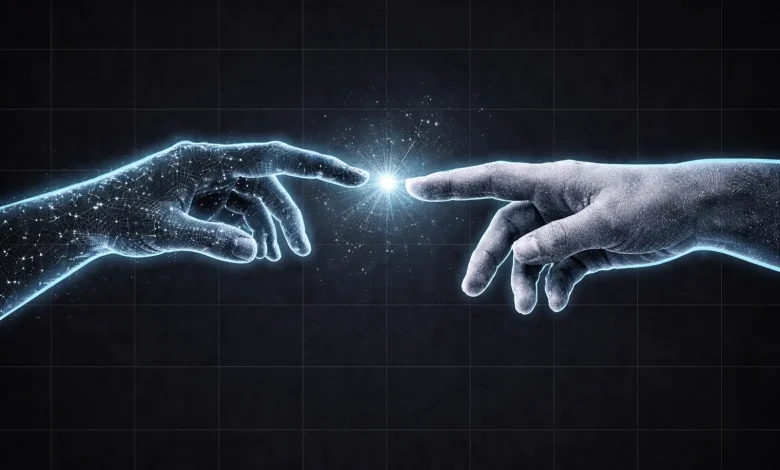
The workplace is changing, and it is up to us how we choose to evolve alongside it. Enterprises which embrace that collaborative sweetspot – where human creativity meets AI capability, are destined to progress, and those of us who see AI not as a tool, but as a sidekick, will be the performance to watch.