Threat detection and response is the airbag of modern cybersecurity. You may not need it every day, but when something goes wrong, you want protection that activates instantly. For many organizations, that protection comes through managed detection and response solutions, which provide continuous monitoring, threat investigation, and incident response through a combination of technology and security analysts.
But for many small and mid-sized organizations, these services are priced as a premium upgrade rather than a standard safety feature.
That raises an important question: if artificial intelligence is making security operations more efficient, why haven’t managed detection and response solutions become more affordable?
The answer lies in how cybersecurity services have historically been delivered, and how quickly the technology behind them is changing.
How Is AI Changing Security Operations?
For years, cybersecurity operations were built around one resource: experienced security analysts.
Investigating suspicious activity required people who could interpret logs, correlate signals across tools, and determine if an alert represented a real threat. That expertise, and the need for analysts working around the clock, drove the cost of security services.
Today, advances in AI SOC platforms and security operations automation are fundamentally changing that model.
Modern security operations centers are increasingly powered by artificial intelligence systems that can triage alerts, interpret data, and correlate signals across security tools automatically. Instead of analysts manually reviewing every alert, AI systems can process thousands at once, identify patterns, and escalate only the incidents that require deeper investigation to human professionals.
This shift means that a large portion of the repetitive work involved in security monitoring can now be handled automatically. In many environments, AI can investigate alerts faster and more consistently than traditional workflows.
As a result, the cost of delivering core security operations tasks is falling, even as the volume of cyber threats continues to grow.
Why Haven’t Managed Detection and Response Solutions Gotten Cheaper?
If the cost of delivering security monitoring is decreasing, many buyers assume that managed detection and response solutions should also become more affordable.
But pricing models in cybersecurity rarely change overnight.
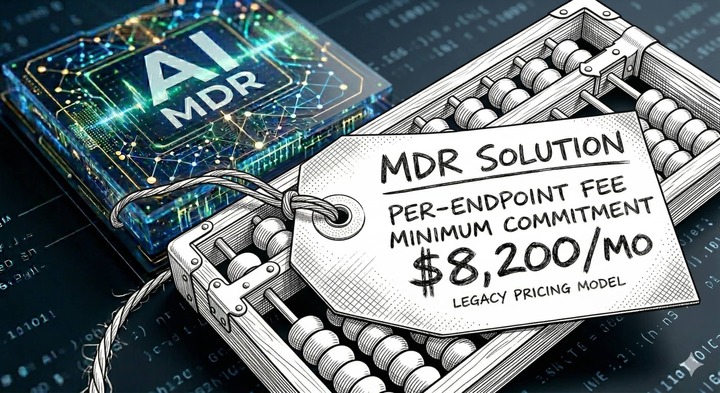
Many MDR providers built their services in an era when every alert required manual review by analysts. So pricing structures, such as per-endpoint fees, tiered service bundles, or minimum service commitments, were designed around that assumption.
Even as vendors incorporate security operations automation and AI SOC technology, those pricing frameworks remain in place. Adjusting pricing models across product portfolios, partner ecosystems, and revenue forecasts takes time, and organizations may move cautiously to avoid disrupting existing customers or sales channels.
The result is a transitional period where security operations are increasingly powered by AI, but the way services are packaged and priced still reflects older delivery models.
For organizations evaluating cybersecurity services, this makes it more important than ever to understand how those services actually operate behind the scenes.
What Should Organizations Look for When Evaluating Managed Detection and Response Solutions?
As artificial intelligence becomes central to modern security operations, organizations evaluating managed detection and response solutions should look beyond product claims and understand how these services actually work.
Many vendors now advertise AI-powered monitoring, AI SOC platforms, or advanced automation. But the real value lies in how those technologies improve protection, response times, and overall efficiency.
Here are a few practical questions organizations should consider when evaluating providers:
How much of the monitoring and investigation process is automated?
AI powered MDR, AI SOC platforms and security operations automation should reduce the amount of manual work required to analyze alerts. Vendors should be able to explain how automation improves speed and scale.
How quickly are real threats investigated and escalated?
Strong managed detection and response solutions focus on outcomes — such as how quickly suspicious activity is analyzed and whether threats are contained before they spread.
How does AI improve efficiency for customers?
Automation should translate into tangible benefits, whether that means faster detection, reduced alert noise, or more predictable costs.
What role do human experts still play?
AI is powerful, but experienced analysts remain essential for complex investigations. The best AI enabled MDR providers combine automation with human expertise.
Is the solution designed for mid-sized organizations?
Some platforms were originally built for large enterprises and may be overly complex or expensive for smaller security teams.
By asking these questions, organizations can better determine whether a provider is delivering modern, AI-driven security operations or simply adding automation to older service models.
Will AI Make Managed Detection and Response Solutions Accessible to More Organizations?
Much of the conversation around artificial intelligence in cybersecurity focuses on new tools or technical capabilities. But one of the most important changes may be economic.
If AI MDR solutions, AI SOC platforms and security operations automation significantly reduce the time required to investigate security alerts, then the overall cost of operating a security operations center should decrease over time.
That shift could make managed detection and response solutions far more accessible to mid-sized organizations that previously struggled to justify the cost of enterprise-grade security monitoring.
Cyber threats are not limited to large enterprises. Small and mid-sized businesses face many of the same risks but often operate with smaller security teams and tighter budgets.
Artificial intelligence now offers the possibility of delivering advanced threat detection and response capabilities at a much broader scale.
But for that promise to become reality, the economics of cybersecurity services must evolve alongside the technology powering them.
As AI MDR capabilities continue to mature, organizations evaluating security services should expect providers to demonstrate not only advanced technology but also transparent value.
Ultimately, the goal is simple: ensure that modern cybersecurity protection is not limited to companies with enterprise-sized budgets.
Author:
Kumar Saurabh is the CEO and co-founder of AirMDR, bringing over two decades of experience in enterprise security, log management, and SOC tooling. Prior to founding AirMDR, he held leadership and founding roles at ArcSight, Sumo Logic and LogicHub, driving innovation in SIEM, cloud-based log analytics, and security automation. His mission today is to democratize high-quality managed detection and response (MDR) by delivering AI-powered, enterprise-grade SOC capabilities to organizations of all sizes.