The integration of artificial intelligence (AI) into our daily lives is completely transforming the way we seek and receive information.
By 2028, it’s expected that AI search will surpass traditional searches. Already, among those using AI tools, 37% say large language models (LLMs) such as ChatGPT have become the place they head first to search the internet. Those who still begin their searches with traditional browsers like Google encounter AI in the top results through integration of LLMs like Gemini.
Whether they intend to or not, your target customers are encountering AI – it’s become virtually unavoidable in today’s modern communication landscape. As LLMs increasingly play a pivotal role in influencing consumer decisions, the strategies brands must employ to effectively distinguish themselves and engage their target audiences are evolving and becoming more complex. Here’s how yours can stand out.
A New Era in the Buyer Journey
AI already shapes what people see and trust through social feeds, news ranking, shopping recommendations and even streaming suggestions, so algorithmic discovery has become a default step in decision making.
As a result, buyers are doing more of the discovery and evaluation on their own — and the B2B buyer’s journey is shifting accordingly. What used to be a long, high-touch cycle across marketing, procurement and sales now often starts with AI-assisted research and shortlist-building, well before a buyer ever engages a sales team.
In fact, most B2B buyers don’t engage with the sales team until they’re two-thirds of the way through their buying journey. What buyers uncover during this independent research phase often determines whether your company makes the shortlist, and it can be the deciding factor in whether they initiate direct contact with your sales team at all.
This doesn’t mean a brand’s hands are tied when it comes to whether a buyer takes interest with them. It raises the stakes for improving the first impression of your brand that AI search engines provide.
When prospective buyers approach you, they’ll do so under the assumption they are well-versed in what your company has to offer — which can prove troubling if the information AI is presenting about your company is inaccurate or outdated. Therefore, it’s up to your marketing team to understand exactly how AI pulls and presents findings to ensure the right information reaches your target audience.
How AI Evaluates Content Credibility
The human quality raters behind Google and other forms of search have long evaluated and prioritized content using the E-E-A-T framework (Experience, Expertise, Authoritativeness, and Trustworthiness) to ensure their algorithms present users with the most valuable, relevant information first. AI search operates in the same way.
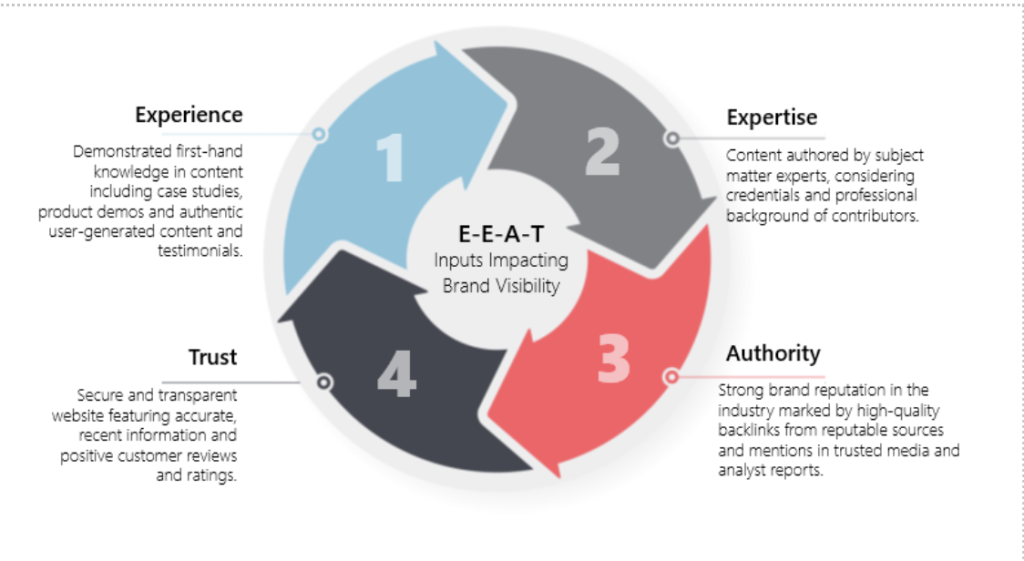
Optimizing content to perform well against the E-E-A-T framework involves more than simple keyword matching. LLMs prefer content that securely and transparently presents accurate, recent information, ideally backed by customer reviews or other third-party credibility. These engines look first to organizations recognized as having strong industry authority, with demonstrated first-hand success and respected, professional subject matter experts on the topic at hand.
AI search engines heavily favor non-promotional, credible third-party sources that feature brands over paid activations like branded advertisements. In fact, over 95% of cited links in AI responses come from non-paid sources, such as earned media placements (85%) and community testimonials on social media or online forums.
When third-party media outlets or online communities trust your brand’s expertise and authority enough to cite your experts in published articles or Reddit threads, it signals to others that your brand deserves their trust, too. Still, this recognition should be considered an element of a continuous strategy rather than a one-time action.
When The Wall Street Journal refers to your subject matter expert as a thought leader on an industry trend or CNET publishes a positive review of your product, your brand’s visibility and credibility will enjoy a boost. However, to build and maintain an authentic presence in AI search, you must invest in an ongoing earned media program that delivers consistent results across various stories targeting multiple stages of the funnel. This approach uses diverse storytelling to highlight your brand’s authority.
Optimizing Content for AI Search
It’s important to note the specific sources and qualities favored by AI search engines can vary by industry. Sometimes, a niche trade-focused podcast or Substack blog can hold more influence than major national publications do. If that’s where industry decision-makers are getting their news, that’s where AI will seek it, too.
Therefore, it’s crucial for marketing teams to carefully audit their industry landscape to identify 1) common prompt categories, 2) how competitors rank for those specific topics, and 3) which outlets and channels those top-ranking competitors were pulled from. This will provide pillars to guide your public relations and content development.
There’s also an art to structuring content for AI readability. You’ve heard of Search Engine Optimization (SEO). Now it’s time to make way for Generative Engine Optimization (GEO).
While SEO values specific keywords, GEO involves providing rich context and complete answers in succinct phrasing. Elements such as clear subheadings, bullet point lists and sections dedicated to addressing frequently asked questions are all great ways to provide the quick-to-the-point context LLMs value most to address common searches.
Brands should be intentional about incorporating these elements when developing content across their websites, blogs, social media channels and other owned assets. By structuring assets this way, organizations not only enhance user experience but also increase the likelihood that their content will be referenced and surfaced by AI search engines and language models seeking authoritative, relevant information from trusted sources.
It’s also crucial to emphasize the presence of credible authorities behind your content by including author bios and hyperlinks to executive profiles. Be sure your executives are regularly sharing thought leadership perspectives on their social platforms, since these touchpoints rank highly in AI citations. Notably, executive LinkedIn posts often outperform content shared from corporate pages, generating higher engagement and visibility. This makes executive social activity especially powerful for amplifying your brand’s credibility and authority in both human and AI-driven channels.
A “create and recycle” mentality can be beneficial for marketing teams to adopt across all content-driven platforms. From proactive media pitching to web and social media content to community engagement and so on, practice consistency and coordination across your entire marketing and sales funnel. Publish, riff, pitch, post and repeat – before you know it, you’ll have an entire content ecosystem reinforcing your authority.
Quantifying PR’s Impact with AI Visibility
Historically, it’s been difficult for brands to quantify the impact of top-of-funnel marketing activities like earned media, community engagement and owned content. Even the most successful public relations activations are rarely last-click conversion channels. But the rise of AI and the resulting shifts in the buyer’s journey have given way to new streams of data.
First, let’s consider the buyer’s journey. The average B2B deal involves 62 touchpoints across 3.5 different channels before it’s finalized. Earned media PR is the driver behind many of these early engagements – be it a company announcement or award, a thought leadership article or case study, a product launch or review, each type of story has its own place in the buyer’s journey and helps enhance brand credibility and reputation.
An individual media placement may not move the needle on its own, but a consistent media presence contributes to that larger, ongoing picture of your brand and signals your value proposition to buyers, nurturing their interest long before they connect with your sales team.
Think back to that initial two-thirds of the sales process that modern customers spend doing independent research. By maintaining optimal visibility in this phase, your brand stands to accelerate the buying process and attract better leads. Therefore, it’s important to look beyond that last-click trap and set benchmarks for increased awareness (i.e. number of earned media placements, percentage of key message pull-through, level of executive visibility, etc.) to paint a fuller picture of the success of your efforts.
New tools measuring AI visibility help us further quantify the impact of all the PR breadcrumbs we create. From blog posts to earned media, podcast interviews to Reddit discussions, awards to reviews and more, we now have the tools to measure how each of these contribute to your brand’s reputation, and the story they work in tandem to tell. These tools can be used to benchmark and measure success over time.
Many of these tools unlock significant insights to help strategize your brand marketing, as well. They help ensure you are optimizing not only for humans, but for the algorithms that are increasingly acting as gatekeepers for the information humans seek.
The Nonnegotiable Human Element
As AI becomes increasingly integrated into marketing and communications, it’s tempting to allow automation to take the lead. However, relying solely on AI risks creating generic messaging and strategies that fail to resonate with your human audiences or differentiate your brand.
AI can enhance efficiency and surface valuable insights, but it lacks the nuance and empathy required to understand your audience’s true needs and motivations. Human judgment is essential at every stage of your communications strategy — from crafting compelling messages and identifying the right audiences to selecting the most effective channels and setting meaningful benchmarks for success.
To avoid falling into the trap of “AI slop” and ensure your brand stands out, keep human expertise at the center of your approach. Leverage the strengths of your team to interpret data, refine targeting, choose a thoughtful channel mix and analyze results with strategic intent. The most impactful communications are shaped by human insight. AI should support, not replace, this critical thinking.
Successful AI optimization is about using technology to empower rather than overshadow human strategy. By keeping people in the loop for messaging, targeting, channel selection and measurement, you ensure your communications are authentic, relevant and genuinely move the needle for your brand.
Author
Angela Corsi Leon
As Senior Vice President at Airfoil Group, Angela leads integrated communications strategy for technology-driven B2B and B2C brands, partnering closely with clients to design programs that advance their business objectives. With extensive experience guiding organizations through growth, transformation and complex market landscapes, she develops and oversees initiatives spanning media relations, brand strategy, content and corporate communications.